Most brands don’t have a strategy problem. They have a coherence problem. The content exists. The social accounts are active. Ads are running. And yet the whole thing doesn’t add up to anything. Audiences leave without understanding what the brand stands for, because every element is pulling in a slightly different direction.
The Brand Ecosystem is how Subverse solves that. It’s a systems model that connects six interconnected spheres of brand work into a single, reinforcing structure. When it functions properly, every part of the brand strengthens every other part. When one sphere is missing or misaligned, the gaps show.
This article explains what the Brand Ecosystem is, how each sphere works, where brands most often break down, and how to build a version of it that holds together under pressure.
What You’ll Learn
- What a Brand Ecosystem is and why it matters for small and mid-size businesses
- How the six spheres of the ecosystem function and relate to each other
- Where most brand strategies fragment and why
- How to diagnose weak points in your current brand system
- What coherence looks like in practice
What Is a Brand Ecosystem?
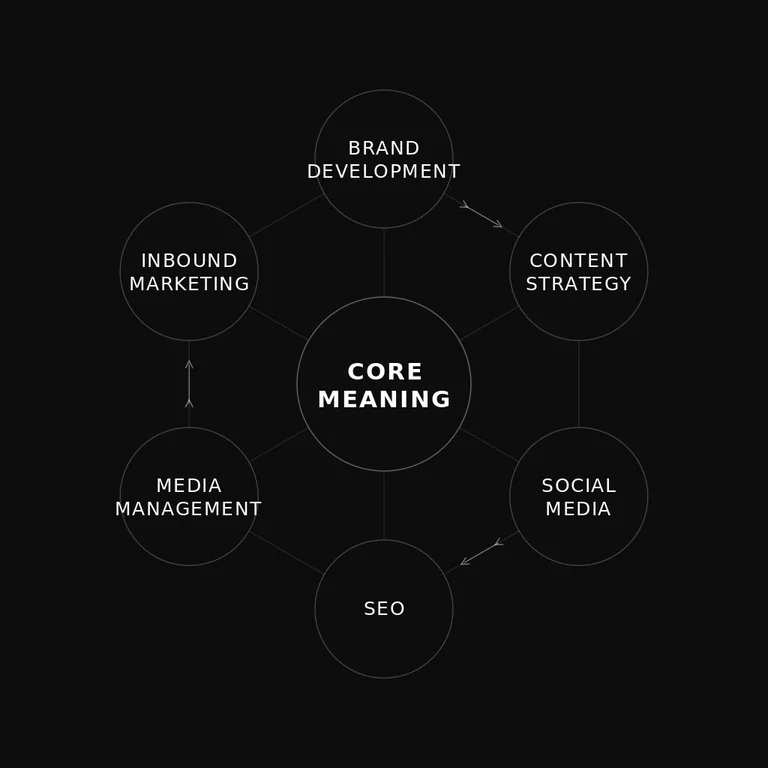
A Brand Ecosystem is a systems model that connects brand development, content strategy, social media, SEO, media management, and inbound marketing into one reinforcing structure. Each sphere has a distinct role. None operate independently. The ecosystem’s strength comes from how the spheres reinforce each other, not from the individual performance of any single one.
The term “ecosystem” is not metaphor for its own sake. It reflects a real structural truth: brand meaning is not produced by any single channel or tactic. It accumulates through repetition, coherence, and the consistent reinforcement of the same signals across every interaction an audience has with the brand.
A functioning Brand Ecosystem allows organizations to grow without losing clarity. Decisions become easier because there is a shared understanding of what the brand means. Execution becomes more consistent because every output is measured against the same standard.
Key takeaway: A Brand Ecosystem is not a marketing plan. It is a design for how meaning is built and maintained across every sphere of brand activity.
Why Do Most Brand Strategies Fragment?
Most brand strategies fragment because they are built as collections of independent tactics rather than as interconnected systems. Each channel is managed separately, optimized for its own metrics, and disconnected from a shared understanding of what the brand is trying to communicate.
The result is mixed signals — visible, measurable ones. When JCPenney launched its “Fair and Square” rebrand in February 2012, advertising positioned the chain as a curated boutique experience with everyday low pricing. But the stores still served a coupon-dependent audience that had learned to shop during clearance events. The campaign said one thing; the floor experience said another. Same-store sales dropped 32% in a single quarter, and the company lost $4.3 billion in annual revenue over the course of 2012. None of the individual pieces were incompetent. The signals contradicted each other, and audiences responded by leaving.
Fragmentation is most common in organizations that grew their marketing capabilities reactively — adding channels as platforms emerged rather than building from a clear foundation. By the time the problem is visible, there are years of disconnected content to contend with.
Common failure mode: Brands treat each channel as its own problem to solve, rather than as one expression of a single underlying meaning. Optimization at the channel level does not produce coherence at the brand level.
Key takeaway: Fragmentation is not a content quality problem. It is a structural problem. The fix is not better content in each channel — it is a shared system of meaning that all channels express.
What Are the Six Spheres of the Brand Ecosystem?
The Brand Ecosystem is composed of six spheres: Brand Development, Content Strategy, Social Media, SEO, Media Management, and Inbound Marketing. Each sphere serves a distinct function. Together, they form a complete system for building brand meaning and converting it into sustainable growth.
Brand Development
Brand Development defines what the brand stands for and how it should be understood. It covers purpose, positioning, values, visual identity, verbal identity, and narrative structure. This is the sphere that everything else must express. Sorting out how brand strategy differs from brand design early keeps visual identity expressing a defined meaning rather than standing in for one.
Without a clear brand foundation, execution across every other sphere becomes guesswork. Content teams make arbitrary decisions about tone. Social media posts follow platform trends rather than brand priorities. Paid media targets audiences without a clear picture of who the brand is for or what it is offering.
Brand Development is not a one-time exercise. It requires revisiting as organizations evolve. But it must exist before strategy in other spheres can be coherent.
Content Strategy
Content Strategy translates brand meaning into deliberate, repeatable signals across channels. It determines what the brand communicates, how it communicates it, and through what formats and cadences.
The most common failure in content strategy is production without architecture. Brands publish consistently but without a clear framework for what the content is supposed to do or what meaning it is supposed to reinforce. Volume without coherence does not build understanding. It produces noise.
An effective content strategy is structured around the brand’s core narratives and the specific questions its audience is trying to answer. It determines not just what to publish, but what sequence of ideas builds the understanding the brand needs its audience to develop.
Social Media
Social Media is the most visible, real-time expression of the Brand Ecosystem. It surfaces how the brand behaves in the present tense — how it responds, what it chooses to amplify, which conversations it joins and which it ignores.
Social media also functions as a feedback mechanism. The signals that resonate and the ones that don’t reveal what the audience actually cares about, which shapes content strategy and informs brand development over time.
Treated as an isolated channel, social media optimizes for engagement metrics that may have little to do with brand meaning. Treated as part of the ecosystem, it becomes a site where meaning is tested and refined in real time.
Search Engine Optimization
SEO connects the brand to the specific questions audiences are already asking. It is the gateway into the ecosystem — the mechanism by which people who have never encountered the brand find it at moments of genuine interest and intent.
Most brands treat SEO as a technical discipline separate from brand strategy. This produces content that ranks but doesn’t build the brand, or brand content that expresses meaning clearly but cannot be found. SEO that functions within the ecosystem is built around the questions the brand’s audience is asking and the answers only the brand can give credibly.
Search visibility is not just about traffic. It is about showing up with clarity at the moments when audiences are actively trying to understand something your brand understands well.
Media Management
Media Management governs how the brand extends its reach through paid channels — advertising, sponsorships, partnerships, and distribution. When the ecosystem is coherent, paid media accelerates signal delivery. When the ecosystem is fragmented, paid media amplifies confusion at scale.
The most costly media management mistake is investment before foundation. In October 2010, Gap reportedly spent around $100 million on a complete visual identity overhaul — new logo, new design language — launched without consumer testing, without a strategic rollout, and without any accompanying shift in what the brand actually offered. Within 24 hours the backlash produced over 2,000 negative comments, a protest Twitter account with 5,000 followers, and 14,000 parody redesigns. Gap reversed the decision in six days. The spend was not inherently excessive. It landed before the brand had built the clarity to support it, and the audience rejected it at a speed that made the gap between investment and foundation impossible to ignore.
Effective media management is informed by the full ecosystem. It knows what the brand stands for, what content is performing organically, what the audience responds to, and what the brand is trying to accomplish at each stage of the relationship.
Inbound Marketing
Inbound Marketing is where the ecosystem proves its value. It converts the coherence built across all other spheres into action — guiding audiences from first contact through to commitment.
Inbound works when the rest of the ecosystem has done its job. Audiences who understand what the brand stands for, who trust its signals, and who have been guided toward a clear sense of what the brand offers are far more likely to act. When the ecosystem is fragmented, inbound marketing has to compensate for missing clarity, which means more friction, more objections, and lower conversion.
The channels — lead magnets, email nurture sequences, conversion pathways — are less important than the foundation they rest on. Inbound marketing performs best when it is the final expression of a system that has already built understanding and trust.
Key takeaway: The six spheres are not a menu of options. They are interdependent components of a single system. Strength in all six creates momentum. Weakness in one creates friction that the others cannot fully absorb.
How Do the Six Spheres Work Together?
The spheres work together through reinforcement — each sphere expresses the same underlying brand meaning in a different context, and each sphere feeds information back into the others.
Brand Development establishes the meaning. Content Strategy expresses that meaning through deliberate, repeatable narratives. Social Media tests and amplifies those narratives in real time. SEO makes them discoverable at moments of intent. Media Management extends their reach. Inbound Marketing converts the accumulated understanding into action.
The reinforcing dynamic works in both directions. Social media insights refine content strategy. SEO data reveals what questions audiences are actually asking. Inbound conversion data shows where the brand’s narrative is creating genuine trust and where it is falling short. The ecosystem learns and adjusts.
This is why isolated optimization fails. A brand can have excellent content and poor SEO, excellent SEO and a fractured social presence, excellent paid media and an inbound experience that fails to convert. Each sphere can perform well on its own metrics while the system as a whole produces confusion.
Key takeaway: The ecosystem works through reinforcement, not addition. Adding more channels without aligning them to a shared meaning makes the problem worse, not better.
How Do You Diagnose and Strengthen Your Brand Ecosystem?
Diagnosing a Brand Ecosystem starts with a coherence audit: an examination of whether each sphere is expressing the same underlying meaning, or whether the spheres have drifted into separate, contradictory directions.
Here is a practical starting framework:
- Define the core meaning. In one or two sentences, state what your brand stands for and what it offers that others do not. If this is difficult to articulate clearly, Brand Development is the starting point.
- Audit for consistency. Read your website, your most recent social posts, your paid ads, and your most recent email campaigns in sequence. Do they feel like they come from the same brand? Do they reinforce the same meaning, or do they feel like outputs from different teams with different assumptions?
- Identify the weakest sphere. The ecosystem is only as strong as its weakest component. Where is friction accumulating? Where are audiences dropping off, losing clarity, or failing to convert? That is typically where the gap exists.
- Reconnect to foundation. Most ecosystem problems trace back to an unclear or unstated brand foundation. Before optimizing execution in any individual sphere, ensure Brand Development has established a foundation that the other spheres can actually express.
- Rebuild from the center outward. Strengthen Brand Development first, then Content Strategy, then evaluate each remaining sphere against the clearer foundation.
Best practice: Don’t try to fix all six spheres simultaneously. Identify the sphere where misalignment is most damaging and fix the foundation it rests on. Coherence compounds — clarity in one sphere makes clarity in adjacent spheres easier to achieve.
Key takeaway: Building a coherent Brand Ecosystem is not a one-time project. It is an ongoing discipline of ensuring that every sphere continues to express the same underlying meaning as the brand, the market, and the audience evolve.
A Coherence Audit in Practice
A services firm we worked with had the opposite of a content problem. They published constantly — a steady blog, an active social presence, paid campaigns running alongside both. The coherence audit found the break in a single sphere: social media had drifted away from everything else. The feed chased platform formats and trending hooks while the website and the blog argued a specific, considered point of view. Two competent channels, two different brands.
The signal showed up in what happened after someone followed them. People who arrived from social rarely moved toward anything — they liked a post and went quiet. The channel was performing on its own metrics and contributing nothing to understanding. We didn’t add a sphere or raise the spend. We rebuilt social as an expression of the meaning Brand Development had already defined, so the feed reinforced the same point of view the rest of the ecosystem was making. Within a couple of cycles the pattern changed: attention coming from social began carrying into the site and into the inbound path, because the brand people met on the feed matched the one they found everywhere else.
Conclusion
A brand built on disconnected tactics does not accumulate meaning over time. Each effort resets the conversation instead of building on it. Audiences learn to expect inconsistency, which makes trust expensive to build and easy to lose.
The Brand Ecosystem exists to solve this. When Brand Development defines clear meaning, and every other sphere expresses that meaning coherently, brands become easier to understand, easier to trust, and easier to choose.
The question worth asking is not whether each part of your brand is working. It is whether all the parts are working together. That gap — between individual effort and systemic coherence — is where most brand-building potential goes unrealized.
Start there.