

Most brands enter influencer marketing with the wrong question. They ask how to get more reach. The better question—the one that actually drives results—is how to get taken seriously.
Silent influencer marketing is built around that second question. It’s a strategy of restraint, where brand presence emerges naturally within a creator’s content rather than being performed for the audience. No hard sells. No discount codes. Just a product that exists, visibly, in a context that makes the audience want to exist there too.
This article explains what silent influencer marketing is, why audiences respond to it when they’ve learned to ignore everything else, and how brands can build campaigns around it without falling into the traps that undermine the approach.
What You’ll Learn
- The precise definition of silent influencer marketing and how it differs from standard paid campaigns
- Why restraint outperforms volume in influencer strategy
- How to identify influencers and structure collaborations that feel genuinely organic
- What metrics actually capture the value of this approach
- The failure modes that turn “silent” into “invisible”
What Is Silent Influencer Marketing?
Silent influencer marketing is a brand strategy in which products or services appear within a creator’s content organically, without explicit promotion or direct calls to action. The brand is present but not performing. Audiences encounter the product as part of the influencer’s life—not as the point of the video or post.
The term distinguishes this approach from standard paid influencer campaigns, which typically include disclosure language, scripted endorsements, and some form of conversion mechanic (a promo code, a link, a swipe-up). Silent marketing removes the sales apparatus and substitutes association for persuasion.
One clarification that matters: silent influencer marketing is not undisclosed advertising. Where commercial relationships exist, disclosure requirements apply. The “silence” refers to sales mechanics—not to transparency with the audience.
In practice: a fitness creator wearing a brand’s apparel in every training video without mentioning it. A chef filming recipe content on a specific brand of cookware without naming the manufacturer. A travel writer photographing a property they’ve chosen to stay in, without framing the post as a sponsored stay. The brand earns presence by being part of a world the audience wants access to.
Key takeaway: Silent influencer marketing bets on association over announcement. The brand doesn’t ask to be noticed. It earns notice by being where the audience is already paying attention.
Why Does Silent Influencer Marketing Work?
Silent influencer marketing works because audiences have developed accurate pattern recognition for promotional content—and strong aversion to it. The same reflex drives the de-influencing backlash, where audiences reward the creators who tell them what not to buy. The moment a creator shifts into sales mode, something changes. Engagement drops. Credibility softens. Audiences don’t consciously object; they disengage.
When a brand appears as part of a creator’s actual life rather than as the point of the content, it bypasses that resistance. The absence of salesmanship reads as sincerity. And sincerity, in a landscape saturated with disclosure-required partnerships and performance-driven endorsements, is genuinely scarce.
There’s also a signal quality argument here. How a message is delivered says something about the message itself. A brand that earns placement in genuinely aspirational content signals that it belongs there. The audience infers value from context. They don’t need to be told the product is worth having if they’ve already decided the person using it is worth watching.
Patagonia has built one of the strongest brand identities in outdoor retail without aggressive promotional campaigns. On Black Friday 2011 it ran a full-page ad in The New York Times headlined “Don’t Buy This Jacket.” Bloomberg Businessweek reported in August 2013 that in the two years after it ran, Patagonia’s sales rose almost a third, to $543 million—though the company opened 14 stores over the same stretch, so the ad is not carrying that figure by itself. Their influencer relationships work the same way: creators who use the products appear in them, in the field, doing the thing. The brand doesn’t need to be announced. Context carries it.
Glossier scaled with almost no paid apparatus. The company launched in October 2014 out of Emily Weiss’s beauty blog Into The Gloss, and Weiss told Entrepreneur in 2017 that around 70 percent of online sales and traffic came through peer-to-peer referrals, a share she said had held steady as the business grew. Products appeared in natural routines, not in scripted tutorials engineered to drive clicks.
Key takeaway: Trust is the medium. Audiences don’t convert because they were told to. They convert because they concluded, on their own, that the product was worth having.
How Does Silent Influencer Marketing Differ from Traditional Influencer Campaigns?
Traditional influencer campaigns and silent influencer marketing differ in objective, structure, and what they’re actually asking the creator to do.
| Element | Traditional Campaign | Silent Marketing |
|---|---|---|
| Primary objective | Direct conversion, clicks, or sales | Brand association and long-term loyalty |
| Creator’s role | Spokesperson or promoter | Authentic user within their own context |
| Campaign structure | Scripted deliverables, required messaging | Loose guidelines, organic integration |
| Measurement | Conversions, click-through rate, promo redemptions | Brand sentiment, earned media, audience trust signals |
| Time horizon | Short-term, campaign-specific | Long-term, relationship-based |
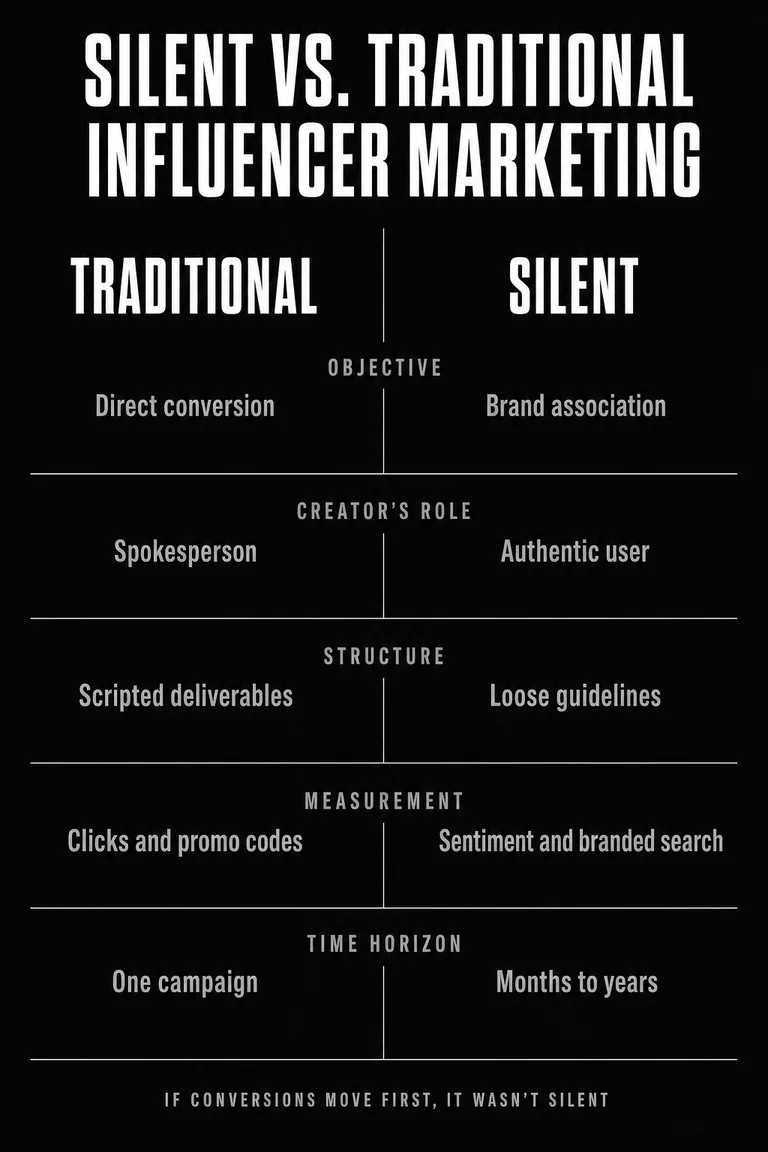
How to choose between them depends on what the brand needs right now. If the objective is immediate conversion and the brand has strong existing trust with the creator’s audience, a traditional campaign can be efficient. If the objective is building brand perception in a new audience—or sustaining it in an existing one—silent marketing typically outperforms. Many brands run both: explicit campaigns alongside ongoing relationships with creators who use their products naturally.
How Do You Implement Silent Influencer Marketing?
Silent influencer marketing requires more relationship investment than standard campaigns, and less creative control. The core disciplines are influencer selection, relationship quality, and restraint from the brand side.
1. Select for alignment, not audience size
The most important variable is whether the creator’s world is one where the product genuinely belongs. Follower count matters less than relevance and credibility. An outdoor brand appearing in the content of a creator who actually climbs has more signal value than appearing in a larger creator’s paid post. The question to ask: does this person actually use this? Would they, unpaid?
A computer-generated persona answers neither question, because there is no unpaid life behind it to check. It has to be judged on other ground: our full guide to virtual influencers in marketing sets out the test a synthetic figure has to pass against the brand’s own signals.
2. Build the relationship before the campaign
Silent marketing works when it’s genuine. That means investing in relationships with creators before structuring campaigns around them. Send products without an ask. Engage with their work. Understand how they tell stories. When collaboration does happen, it should feel like a natural extension of a relationship that already exists—not a transaction with organic packaging.
3. Give creative latitude, not creative direction
The most common mistake brands make in silent marketing is trying to control the output. Specific messaging guidelines, required talking points, and mandated brand moments kill the organic quality that makes the approach work. Provide context on values and audience. Let the creator determine how the product fits their story.
4. Think in months, not campaigns
A single organic-feeling brand appearance has modest impact. The same brand appearing consistently, across many pieces of content, over time—that’s what builds association. Les Binet and Peter Field, working through nearly a thousand campaign case studies in the IPA Databank, put the efficient budget balance at roughly 60 percent brand building to 40 percent sales activation. The activation half spikes and decays; the brand half compounds. Silent marketing sits almost entirely on the 60 side. It gives up the short-term spike deliberately, which means a brand that judges it on the activation timetable will always conclude it failed.
Common failure mode and fix: Brands select influencers based on demographic overlap with their target audience, then wonder why the integration feels forced. The fix is selecting based on lifestyle and value alignment first. Demographic overlap is a secondary filter, not the primary one.
How Do You Measure the Impact of Silent Influencer Marketing?
Silent influencer marketing doesn’t respond to the metrics that traditional campaigns use. There’s no promo code to track, no click-through rate to optimize. Measuring it requires a different framework—and patience with a longer feedback loop.
Useful signals include brand sentiment tracking across social platforms over time, audience growth and follower quality (are new followers engaging, or just adding to a number?), share-of-voice shifts in the creator’s niche, and qualitative audience signals in comments. Social listening tools can surface unprompted brand mentions that emerge in the wake of sustained influencer activity.
The most direct signal, when available, is organic branded search volume. Silent marketing that’s working tends to show up as increased searches for the brand by name—people who encountered it somewhere and wanted to know more. That’s not coincidence. That’s the approach working.
Our own publishing runs on those terms. The articles carry no conversion mechanic—no offer, no gate, no code—and for a long stretch the only number that moved was how often we were seen. From a standing start in September 2025, monthly impressions went from 130 to just over 4,000 by May, and average search position climbed out of the mid-thirties into the low teens. Clicks stayed in single digits a month until April.
Around month three that flat click line looks like failure, and the instinct is to put the apparatus back—add the offer, chase the conversion, make something happen. We decided against it, on the grounds that the flat line was the expected shape rather than a warning. Our site is not an influencer campaign, but the measurement problem is the same one: presence registers first, and everything downstream of it registers late enough to look like nothing is working.
If the approach is working: expect to see increases in unprompted brand mentions and branded search before conversion data moves. If conversions are the first thing showing movement, the campaign probably wasn’t as silent as intended.
The Case for Restraint
The instinct in marketing is to increase. More reach, more impressions, more noise. Silent influencer marketing goes the other direction. Be where it matters. Be there authentically. Let the audience do the concluding.
That restraint isn’t passivity. It requires more rigorous influencer selection, more genuine relationship investment, and a willingness to measure results over months rather than days. The payoff is brand association that functions like trust—earned slowly, eroded fast, and worth considerably more than the impressions a louder campaign would buy.
We have a stake in this argument. Subverse is a narrative branding studio, and what we build is a system where every signal carries the same meaning. Restraint is the discipline that keeps that system standing. A brand is understood over time, through signals that agree with each other, and a signal that has to announce itself is one the system could not carry on its own. A promo code dropped into an otherwise organic placement contradicts the claim the placement was making.
That makes silent influencer marketing a narrative problem before it is a media one. It works because the audience arrives at the judgment themselves, and a judgment someone reaches on their own holds without being repeated back to them. The sales mechanic takes that judgment out of their hands. You get the click and lose the thing the click was supposed to indicate. Restraint is what keeps the conclusion theirs.
The brands building durable equity right now are not the ones with the loudest influencer networks. They’re the ones showing up, quietly, in the right places.