

Most brands approach social media the same way: watch what’s trending, then decide whether to join in. That’s a reactive posture, and for most brands, it’s the only posture they ever develop.
The problem is that reactive brands don’t build meaning. They rent attention. Every trend they chase is borrowed equity they’ll have to return when the moment passes. The brands that compound their value over time are the ones that can do two things at once: respond to what’s moving the culture and generate signals that move it themselves.
This article explains how to build a social media strategy that does both.
What You’ll Learn
- Why the trend vs. trendsetting tension is really a coherence problem
- How to evaluate which trends are worth engaging with
- What distinguishes brands that set trends from brands that chase them
- How to structure a content approach that handles both reactive and proactive signals
- Common failure modes and how to avoid them
What Is the Difference Between Following Trends and Setting Them?
Following a trend means adjusting your content to participate in a conversation that already exists. Setting a trend means initiating a conversation that others then join. The strategic difference is significant: one borrows momentum, the other generates it.
Both have legitimate uses in a social media strategy. The error is treating them as interchangeable. Trend-following builds visibility in the short term; it’s a tool for staying in the cultural frame. Trendsetting builds authority over time; it’s a tool for defining what the cultural frame is about. Brands that only follow trends accumulate reach but rarely accumulate meaning. Brands that only set trends risk becoming irrelevant between major moments.
A functional strategy uses both deliberately, with trend-following serving as tactical engagement and trendsetting serving as the long game.
Key takeaway: Trend-following is a visibility tactic. Trendsetting is a brand-building strategy. Neither works well without the other, and conflating them leads to incoherence.
How Do You Evaluate Whether a Trend Is Worth Engaging With?
A social media trend is worth engaging with when it has genuine overlap with a brand’s established meaning and when the brand can contribute something specific—not just presence. Trends without that overlap produce content that feels opportunistic, which audiences notice and discount.
The test is simple: can the brand say something true and relevant about this topic? Not just something adjacent, and not something performative. If the answer is yes, the trend is worth engaging. If the entry point requires the brand to stretch or strain its voice to fit, the trend is better left alone.
Consider brand coherence as the filter. A brand built around craft and precision can authentically engage with conversations about quality, process, or standards—even when those conversations emerge from unexpected places. The same brand trying to participate in a viral entertainment moment will almost always look like what it is: a brand that wants the engagement without having earned the relevance.
Common failure mode: Brands confuse engagement metrics with brand-building metrics. Les Binet and Peter Field drew this line sharply in The Long and the Short of It (IPA, 2013), their study of roughly a thousand campaigns in the IPA Databank: short-term activation and long-term brand building run on different clocks, and the tactics that win the first often starve the second. A trend-chasing post can outperform a genuine brand statement in the short term while gradually eroding the coherence that makes the brand worth following in the first place.
Key takeaway: Use brand coherence as the filter, not engagement potential. If participation requires compromising the signal, pass.
What Makes a Brand a Trendsetter on Social Media?
Trendsetting brands on social media share a consistent pattern: they have something specific to say, and they say it before the broader conversation catches up. The trend-setting moment is rarely planned as such. It’s usually the result of a brand that has been consistent enough in its perspective that when a cultural conversation opens up around that perspective, the brand is already positioned as a reference point.
Apple and Nike are the examples most cited in this context, but the mechanism is clearer in smaller, more observable cases. A brand that has spent two years publishing clear, specific thinking about a particular problem will be cited when that problem becomes a mainstream conversation. The audience didn’t follow the brand because it predicted the trend; they followed it because it had something real to say. The trend found them.
This is the strategic implication: trendsetting is downstream of intellectual honesty and consistency. Brands that develop and publish genuine points of view—positions they’ll hold even when the topic isn’t trending—build the kind of authority that positions them to lead when the conversation arrives.
Key takeaway: Trendsetting is not a campaign tactic. It’s the result of sustained, specific, honest communication over time. Brands that try to manufacture trend-setting moments without that foundation produce content that reads as performance.
How Do You Structure a Social Media Strategy That Handles Both?
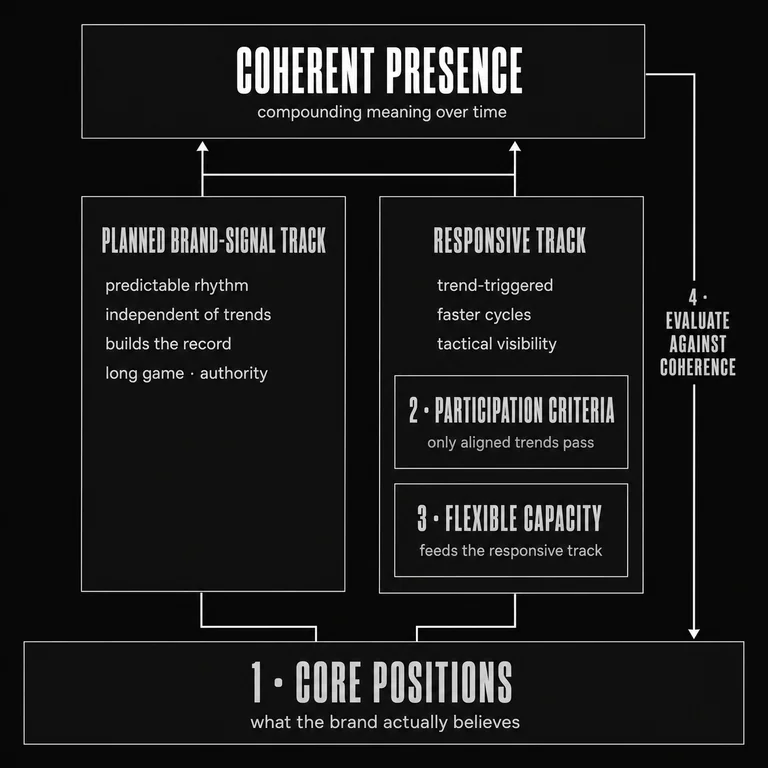
A social media strategy that manages both trend responsiveness and proactive brand-building requires two distinct content tracks operating in parallel.
The first track is the brand’s ongoing signal: content that develops and reinforces the brand’s specific perspective, independent of what’s trending. This content runs on a predictable rhythm and serves the long-term coherence of the brand’s communication. It does not chase the algorithm; it builds the record.
The second track is the responsive layer: content structured to engage with relevant trends when they arise. This track requires monitoring, faster production cycles, and clear criteria for what qualifies as a worthwhile engagement opportunity. The criteria should be written down and agreed upon in advance, not determined case by case under time pressure.
The practical structure looks like this:
- Establish the brand’s core positions. Before engaging with any trend, know what the brand actually believes about its domain. This is the foundation that makes all responsive content coherent rather than arbitrary.
- Set explicit participation criteria. Define in advance what makes a trend worth engaging with: topic alignment, audience overlap, the brand’s ability to contribute something specific. This prevents reactive decision-making under deadline pressure.
- Build flexible production capacity. The calendar holds the brand’s core signal. The slack in that calendar is what enables genuine responsiveness. Brands that overload their calendar with planned content leave no room to respond when something worth responding to appears.
- Evaluate each engagement against coherence, not just metrics. After engaging with a trend, ask whether the content reinforced or diluted the brand’s meaning. This feedback shapes future criteria.
Key takeaway: A dual-track structure—planned brand signal plus responsive engagement—is more effective than trying to treat every piece of content as both. Clarity about what each track is for prevents the confusion that produces incoherent social media presences.
What Are the Risks of Over-Indexing on Trends?
The primary risk of over-indexing on trend responsiveness is coherence erosion. Each trend engagement that doesn’t connect to the brand’s core meaning adds noise to the signal. Over time, audiences learn to discount the brand’s communication because they’ve come to understand it as reactive rather than substantive.
In our work, this failure looks the same almost every time. A brand starts treating each trend as its own opportunity, the calendar fills with reactive posts, and engagement holds steady or even climbs. What erodes underneath doesn’t show on a dashboard: the audience slowly loses the ability to say what the brand is for. We’ve watched months of strong reach leave a brand less understood than it was when it started — the reach went up and the meaning went down. By the time it surfaces in the numbers a business actually cares about, the brand has spent a long stretch teaching its audience not to expect a point of view.
The pattern is consistent enough that we measure it. When we audit a brand’s last quarter of social posts, we sort each one into two piles: posts that carry the brand’s own position, and posts that ran only because something was trending. In feeds that have tipped into reactive posting, the trending pile is roughly three times the size of the other. We treat that three-to-one ratio as an early warning, because it shows up while the engagement chart still looks healthy.
The second risk is voice dilution. Brands that spend significant energy adapting their content to trend formats often lose the distinctiveness that made their communication worth following. The voice becomes a function of whatever the trend requires rather than something that comes from the brand itself.
Pepsi’s 2017 “Live for Now” ad is the clearest case. Released on April 4, 2017, the spot showed Kendall Jenner stepping out of a photoshoot to hand a police officer a can of Pepsi during a protest — an attempt to step into the era’s culturally charged conversations without a coherent, pre-established position on any of them. The backlash was immediate, and Pepsi pulled the ad the following day. The content reads as opportunistic, and the reaction ran proportional to the scale of the moment the brand reached for.
The corrective is not less engagement with trends. The corrective is more clarity about who the brand is before engaging. Brands that have developed a specific, consistent perspective can participate in almost any relevant conversation without risking coherence, because their participation is visibly an extension of something real.
Key takeaway: Trend over-reliance is a symptom of an underdeveloped brand position. The fix is to build the position, not to reduce the engagement.
Conclusion
The tension between trend responsiveness and trendsetting resolves when a brand has a specific enough position that both activities serve the same end. Trend engagement becomes coherent because there’s a clear filter: the brand participates when it has something real to say. Trendsetting becomes possible because the brand has been consistent enough, honest enough, and specific enough that when the culture arrives at the conversation, the brand is already there.
Most social media strategy advice focuses on tactics: what to post, when to post, how to respond. The more useful question is what the brand actually believes, and whether its communication reflects that consistently. The tactics follow from there.
The brands that compound value on social media are not the ones with the best content calendars. They’re the ones with the clearest perspective and the discipline to communicate it consistently, regardless of what’s trending.