
Walk into any clothing store today, and you’ll find slogans that once carried genuine weight. “Revolution.” “Feminist.” “Resist.” They appear not as calls to action but as aesthetic choices, printed on mass-produced cotton and sold at a markup. What began as a challenge to the system has been softened, repackaged, and sold back. This is not coincidence. It’s recuperation—the process by which capitalism absorbs subversive ideas, transforms them into consumable products, and neutralizes any threat they posed to the existing order.
Understanding recuperation matters not just to activists and sociologists, but to anyone trying to build meaning that survives contact with the market.
What you’ll learn:
- What recuperation is and how the process actually works
- Historical examples of radical movements absorbed by commercial culture
- Why recuperation is structurally effective, not just opportunistic
- Whether resistance can survive capitalism’s capacity for absorption
- How to recognize recuperation when it happens—and what can be done about it
What Is Recuperation?
Recuperation is the process by which capitalism identifies subversive or countercultural ideas, strips them of their political content, and reintroduces them as consumer products or lifestyle choices. The concept was developed by the Situationist International in the 1950s and 1960s, most closely associated with Guy Debord and the theoretical framework of the “society of the spectacle.”
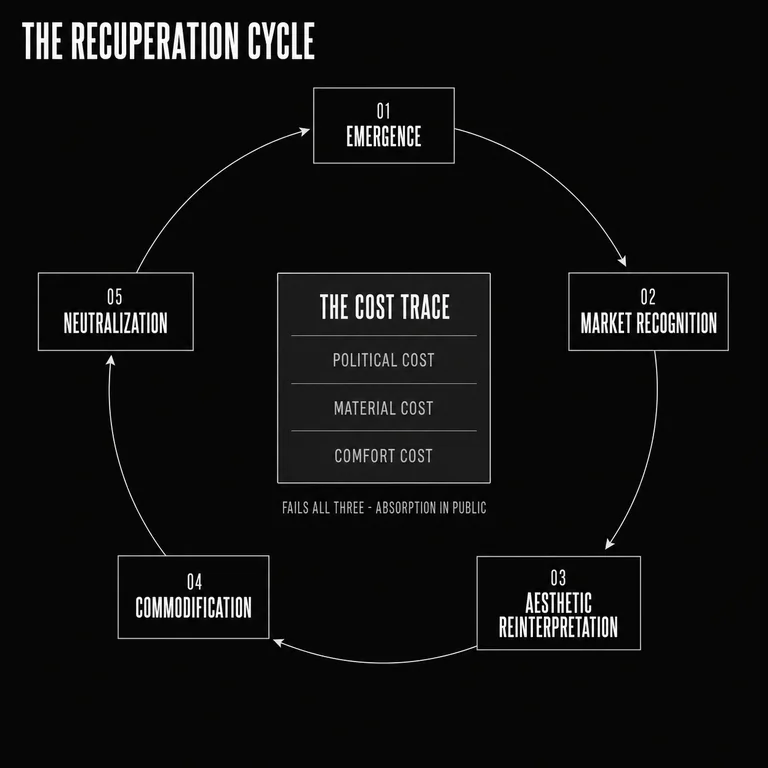
In practical terms, recuperation follows a recognizable pattern: a movement or idea emerges that challenges existing power structures. The market recognizes its cultural traction. The idea is reinterpreted as an aesthetic rather than a politics, divorced from the structural demands that originally animated it, and repackaged as something you can buy rather than something you must do. The movement survives in form while losing its function.
Key takeaways:
- Recuperation converts political meaning into commercial product, preserving the symbol while discarding the substance
- The concept originates with the Situationist International, particularly Guy Debord’s The Society of the Spectacle (1967)
How Does Capitalism Co-opt Resistance Movements?
Capitalism co-opts resistance by recognizing cultural momentum and redirecting it through market mechanisms. The cycle is consistent: a countercultural idea gains traction. The system identifies it as commercially exploitable. The idea gets reinterpreted as a lifestyle choice rather than a political position. Those who adopt the aesthetic can feel aligned with the original movement while making no structural demands on the system.
Punk is the clearest example. Born from frustration with mainstream consumerism and corporate culture, punk was explicitly anti-market. It lived in DIY spaces, small venues, and underground networks that deliberately rejected commercialization. Within a decade, the same spiked jackets and distressed band tees that symbolized that rejection were being manufactured at scale and sold by the companies punk sought to discredit. The movement that stood against commercialization became one of its products.
This pattern doesn’t happen by conspiracy. It happens because the market is structurally attentive to cultural signals, and because radical aesthetics are often visually and emotionally compelling—which makes them commercially useful once the politics can be separated from the style.
Key takeaways:
- Recuperation is a market function, not a deliberate conspiracy—the system rewards cultural attentiveness
- The separation of aesthetic from political content is the mechanism, not a side effect
What Are Historical Examples of Recuperation?
Three historical cases show how recuperation operates across different movements and time periods.
The Counterculture Movement of the 1960s
The counterculture’s initial force came from its rejection of consumerism, the Vietnam War, and corporate conformity. Communal living, anti-materialism, and protest were its substance. By the early 1970s, the same corporations those movements opposed were selling the aesthetic: psychedelic imagery on soda advertisements, peace symbols as jewelry, “free spirit” as a marketing concept. The form survived. The critique did not.
Corporate Feminism
Feminist movements of the 20th century made structural demands: equal pay, reproductive rights, legal protections against workplace discrimination. These were claims on political and economic power. What corporate culture absorbed was the vocabulary of empowerment—diluted into slogans, pinkwashed into product campaigns, and used to sell consumer goods. Brands adopted the language of liberation while many continued practices their customers were organizing against. The market did not neutralize feminism because it opposed it. It neutralized it by making it easier to express as a consumer identity than as a political commitment.
Black Lives Matter and the Corporate Response
After the 2020 uprisings for racial justice, a significant portion of corporate America moved quickly to associate with the movement. Black squares appeared on Instagram. Solidarity statements were issued. Limited-edition merchandise appeared bearing language lifted from grassroots activism. Many of these same companies continued to employ discriminatory practices, fund politicians opposed to racial justice legislation, and enforce supply chains built on exploitative labor. The call for systemic change became a PR opportunity. The speed with which this happened—days, not months—illustrates how efficiently contemporary capitalism can execute recuperation.
The money is where the gap shows. A Washington Post analysis by Tracy Jan, Jena McGregor and Meghan Hoyer, published in August 2021, added up what America’s 50 largest public companies and their foundations had committed since May 2020: $49.5 billion. Of that, $45.2 billion—more than 90 percent—was structured as loans or investments the companies stood to profit from, over half of it mortgages. Outright grants came to $4.2 billion. The portion that reached organizations working on criminal justice reform, which is what the protests were demanding, came to about $70 million—roughly one dollar in every seven hundred pledged.
Key takeaways:
- Recuperation accelerates when a movement’s visual and verbal language becomes culturally dominant
- Corporate adoption of activist language does not require corporate commitment to activist goals
- The 2020 pledges measure the gap: of $49.5 billion committed, more than 90 percent was structured as profitable loans and investments, and about $70 million reached criminal justice reform (Washington Post, August 2021)
Why Is Recuperation So Structurally Effective?
Recuperation works because it exploits the gap between symbolic participation and material action. Buying a t-shirt with a political slogan requires no real commitment. Sharing aestheticized activism on social media produces social belonging without structural risk. The system is not suppressing resistance—it’s offering a substitute for it that satisfies the same psychological needs for identity, belonging, and moral coherence.
This is the mechanism’s real power: it doesn’t destroy the desire for change. It redirects it. Pre-packaged identities simulate resistance without threatening the mechanisms that produce the conditions being resisted. People can feel they are participating in something meaningful while the structures they’re nominally opposing continue operating unchanged.
Recuperation also works by making radical ideas safe and palatable. Ideas that challenge power are threatening precisely because of their edges. When those edges are smoothed into consumer products, the ideas lose what made them disruptive. A slogan on a t-shirt does not organize labor. A solidarity hashtag does not change policy. The more an idea gets commodified, the less it registers as urgent—to the people encountering it, and eventually to the people who originally held it.
Key takeaways:
- Recuperation succeeds by satisfying the desire for meaning without requiring the cost of action
- The mechanism doesn’t destroy radical desire—it redirects it toward consumption
Can Resistance Survive Capitalism’s Capacity for Absorption?
Resistance can survive recuperation, but only when movements remain structurally aware of the mechanism and work deliberately against it. Three approaches have demonstrated staying power.
Continuous adaptation
Movements that remain effective do so by evolving before full absorption occurs. When a tactic, aesthetic, or slogan gets commodified, the movement shifts. This is not retreat—it’s the recognition that the form is not the substance, and that protecting the substance sometimes means abandoning forms that have been colonized. Underground movements and decentralized organizing are harder to recuperate because they have no fixed aesthetic to commodify.
Détournement
The Situationists who named recuperation also developed a counter-strategy: détournement. The practice involves hijacking commercial messages and recontextualizing them to expose or critique the system that produced them. Political street art that alters corporate billboards operates on this principle. So does ironic appropriation that uses a company’s own slogans to critique its practices. Détournement doesn’t prevent recuperation, but it forces the system to contend with its own symbols being turned against it.
Organizing that cannot be aestheticized
The most durable resistance is structural rather than symbolic. Community organizing, mutual aid networks, legal challenges, and direct political action don’t lend themselves to aesthetic commodification because they don’t have a look. They have a practice. The work of building durable institutions—even unglamorous ones—has proven consistently harder for the market to absorb than the language of those institutions.
Key takeaways:
- Movements that conflate their aesthetic with their purpose are more vulnerable to recuperation
- Structural organizing is harder to commodify than symbolic participation
How Has Social Media Changed the Speed of Recuperation?
Social media has compressed the recuperation timeline from years to days. Movements that once took a decade to get absorbed into mainstream culture now face commodification within weeks of gaining visibility. Pew Research Center counted roughly 47.8 million uses of the #BlackLivesMatter hashtag on Twitter between May 26 and June 7, 2020—just under 3.7 million a day, with 8.8 million on May 28 alone. A vocabulary saturating that fast reaches every marketing department in the country long before the demands behind it are answered. This acceleration has created a new challenge: radical movements spread faster than ever before, but they are also absorbed faster than ever before.
Hashtags that begin as calls for justice become marketing strategies before the underlying conditions have been addressed. Influencers monetize activist aesthetics, converting engagement into revenue and, in the process, converting participation into spectatorship. The viral mechanics that make movements visible are the same mechanics that make them exploitable.
Digital platforms are not inherently hostile to resistance—encrypted communication, decentralized organizing, and independent media create spaces that are harder for market forces to penetrate. But the dominant platforms are advertising businesses. Their incentive structures reward content that generates engagement, which means they reward emotional activation over sustained commitment. Movements operating primarily on these platforms are structurally exposed to the recuperation dynamic.
Key takeaways:
- Social media reduces the recuperation timeline from years to days
- Platform incentive structures reward emotional activation over sustained commitment, which accelerates absorption
What Does Recuperation Look Like Inside a Brand?
Recuperation gets described at the scale of movements. It runs at the scale of a single organization too, and that smaller version is where our work happens.
The brief usually arrives already shaped. A company holds a position it can defend, a reason for existing that predates its marketing, a values statement it means. What it asks for is a refresh—a new identity, a campaign, some way to make the position land now that its whole category has started speaking the same way. By then the language has already been absorbed. The vocabulary that once distinguished the company reads as decoration on every competitor’s homepage, and eventually on its own.
That is the same mechanism with the political stakes removed and the structure intact. The form survives; the function dies. A values statement that outruns practice is a slogan on a t-shirt: it costs nothing to display and asks nothing of whoever displays it.
We turn those briefs down as written. A new identity built over an unresolved position reproduces the problem in better taste. Instead we reopen the question the brief assumed was closed—why this brand deserves to exist, and whether anything the company actually does confirms it. Sometimes the finding is that the claim was accurate the day it was written and has not been for a while. The correction there is to change the practice or change the claim, and we say which one we think it is.
The rest is structural: a stated position, language the client can speak from without reaching for it, and every signal the organization sends answerable to the same meaning. The test we apply is whether the client’s team can use it in a room we are not in. If they cannot, the work is unfinished, whatever it looks like.
We hold that standard because the alternative is absorption, one organization at a time. A brand held together by aesthetic coherence is the most absorbable kind—the look travels, the meaning stays behind, and nothing underneath it changes when it gets copied. A claim with a cost attached behaves differently. It can be imitated in appearance and still not be true of the imitator, which is the only durable protection a brand has against its own language being used to sell something else.
Key takeaways:
- Recuperation operates on organizations as well as movements—a brand’s own language gets absorbed by its category and returns as decoration
- A claim that costs the organization nothing to hold is the easiest kind to copy, and the first kind to stop meaning anything
How Can You Recognize and Respond to Recuperation?
Recognizing recuperation requires tracking the distance between a movement’s stated demands and what gets amplified about it. When the aesthetic spreads but the politics don’t, recuperation is happening.
That distance is measurable, and it measures in one currency. Recuperation strips the cost out of a position and leaves the position on display, so the way to catch it in progress is to ask what the adoption cost whoever adopted it. Call it the Cost Trace. Three questions, applied to a specific case, each with a read attached.
1. The political cost — does adoption of the language coincide with support for the movement’s actual demands?
Set what the adopter funds against what it says. Fails when a company that publicly opposes discrimination continues funding the politicians blocking anti-discrimination legislation: the symbol has been decoupled from the substance. Passes when the money and the statement point the same direction, particularly where that direction costs the adopter something with its own shareholders or customers.
2. The material cost — does buying the product redirect resources toward structural change?
Follow the money past the packaging. Fails when the cause appears on the label and nowhere in the accounting, or when the contribution is capped low enough that the campaign announcing it costs more than the contribution. Passes when a traceable share reaches the organizations doing the structural work and the amount is stated rather than implied. Some cause-linked commerce clears this. Most does not.
3. The comfort cost — is the version of the message travelling furthest the most demanding one, or the most comfortable one?
Compare what the movement asked for against the version in circulation. Fails when the demand has been softened into a sentiment anyone can hold, which is why the softened version travels: it asks less. Passes when the demand still costs something to repeat and is being repeated anyway.
A case that fails all three is not a movement being supported. It is a movement being absorbed, with the absorption happening in public.
Running the Cost Trace doesn’t require cynicism about every organization that adopts progressive language. It requires specificity: what is actually being demanded, and is the response meeting that demand or replacing it with something more palatable?
Key takeaways:
- Recuperation is identifiable when aesthetic adoption outpaces substantive alignment
- The Cost Trace tests a case in three places — political, material, and comfort cost — and a case that fails all three is being absorbed in public
Where This Mechanism Shows Up
This piece is the general account: the absorption process described at the level where it applies to anything with a symbol attached. Four companion pieces run the same mechanism through specific domains, where it does things the general version can only point at.
- Media and entertainment — anti-capitalist film and television, where the absorbed critique is itself the product and the corporations being satirized are the ones financing the satire.
- Design and visual language — punk aesthetics in graphic design, which tracks what survived that absorption: the visual grammar outlived the politics, and any brand wanting to look like it means something can now borrow it.
- Community and place — the commodification of third spaces. Here the object being absorbed is belonging itself: the signals of community deployed as a retention tool, without the conditions that would make the community real.
- Symbols and meaning — the power of symbols in consumer behavior, covering the substrate the whole argument rests on: how meaning attaches to a symbol in the first place, which is what recuperation exploits when it keeps the symbol and discards the rest.
Conclusion
Capitalism will continue absorbing radical ideas. That capacity is not incidental—it is structural. An adaptive market identifies cultural traction and monetizes it, and movements that build strong identities make themselves legible to that process.
What this means for movements is not that resistance is futile, but that resistance that depends primarily on aesthetic coherence is the most vulnerable kind. Symbols get absorbed. Slogans get commodified. What endures is the structural work: the organizing, the institutions, the sustained commitment to demands that can’t be satisfied by a product.
The next time you see a political slogan on a t-shirt or a corporation claiming solidarity, the question to ask isn’t whether the sentiment is sincere. Run the Cost Trace on it: what did that position cost whoever is holding it? A sentiment that costs nothing to display is the one recuperation has already finished with. That distinction is where the real work lives.