

Most leads aren’t ready to buy when they first encounter your brand. Lead nurturing is how you build enough meaning and trust that, when they are ready, the decision already feels obvious.
This guide covers what lead nurturing is, why programs stall on coherence rather than cadence, and which parts of the machinery are worth building at all.
What You’ll Learn
- Why lead nurturing fails when it treats prospects as targets rather than audiences
- How to build a multi-channel approach that reinforces rather than repeats
- What lead scoring reveals about engagement—and what it misses
- How to align nurturing content with where a prospect actually is in their decision process
What Is Lead Nurturing?
Lead nurturing is the ongoing process of maintaining meaningful contact with potential customers from initial interest through purchase decision. The goal is not to accelerate a transaction but to build enough trust and relevance that the prospect feels confident choosing you when they are ready to decide.
Nearly every guide on this subject opens with the same figure: 50% more sales-ready leads at a third of the cost. It is credited to Forrester Research, it has circulated in this vertical for more than a decade, and it almost never arrives with a document behind it — HubSpot’s roundup carries it as item 17, attributed to “Forrester Research,” with no report title, no year, and no link. A number repeated that long without anyone reopening it is not evidence. It is a password.
The pattern underneath it survives the loss. Nurturing gets built as a sequence of prompts rather than a system of signals, and audiences register the difference well before any of it reaches a dashboard.
Definition:
| Element | Content |
|---|---|
| Term | Lead nurturing |
| Plain definition | Sustained engagement with potential customers that builds trust and relevance over time |
| Why it matters | Most prospects require multiple meaningful touchpoints before they are ready to buy |
| Common confusion | Often mistaken for automated email sequences, when it describes the entire system of engagement across every channel |
Key takeaway: Lead nurturing is not follow-up. It is a coherent system of signals that builds meaning with an audience over time.
Why Do Most Lead Nurturing Programs Fail?
Most lead nurturing programs fail because they prioritize volume over relevance. They send more messages rather than better ones. They automate the cadence without addressing the content.
The result is predictable: open rates fall, unsubscribes rise, and the brand becomes noise in someone’s inbox rather than signal worth paying attention to.
Three failure modes appear most often:
- Treating all leads identically. A prospect who just discovered your brand and a prospect comparing final vendors are not the same audience. Same message, wrong stage, wrong meaning.
- Confusing frequency with nurturing. Contact volume does not build trust. Relevant contact does.
- Measuring activity instead of engagement. High open rates and click-throughs matter only if they reflect genuine interest. Shallow metrics mislead strategy.
The second failure mode showed up in our own work. Publishing is a nurturing program by another name: sustained contact with an audience that either earns attention over time or spends it.
Through mid-2025 our site was producing steadily and reaching almost nobody. The obvious reading was volume—publish more, publish more often. The real problem was that the pieces did not agree with each other. Each one was defensible on its own, and none of them accumulated, so every article started the audience over from nothing.
The unit of work changed. We stopped planning a calendar and started building a body of work: a cluster of articles that each enter one intellectual territory from a different point, in one voice, holding one position. The publishing rate stayed exactly where it was. What changed was how the pieces related to each other.
Monthly impressions went from 130 in September 2025 to 4,174 in May 2026, and average search position moved from 35.3 to 10.5 across those eight months. The number we watch more closely is the one for people who come back: 51% engagement at an average session over six minutes. Frequency was never the variable. Whether the contact cohered was.
Common failure mode: Brands launch an automated nurturing sequence and call it a program. The automation is not the program—it is the delivery mechanism. The program is what you send, to whom, and why.
Key takeaway: Lead nurturing fails most often not because of execution problems but because of a strategic confusion between activity and meaning.
How Do You Build a Multi-Channel Nurturing Approach?
A multi-channel lead nurturing approach reaches prospects across email, social media, retargeting ads, and direct outreach. It works when every one of those channels carries the same meaning. Coverage is the easy half; coherence is the half that decides whether the program compounds.
That second half is our subject. Subverse is a narrative branding and communication design studio, and what we build is Narrative Branding: a stable strategic frame—what an organization stands for, who it serves, and the change it is committed to—that every signal downstream answers to. A nurturing program is that frame under load. Many signals, sent over months, by different people, through different channels, to an audience that experiences all of it as one brand.
The channel question, then, is what each channel is for, and whether what it sends agrees with everything else you have sent. Run that test on each one before it goes into the system:
- Email sequences carry sustained, direct engagement. This is where the argument develops across time.
- Retargeting ads maintain presence with prospects who have visited your site. Presence is the job; an ad that re-argues a case the email already made reads as pressure.
- Social media content reinforces educational themes for prospects who follow you. Its work is recognition: the same position, in public, at a different length.
- Live events or webinars create shared experience and allow direct questions. This is the one channel where the audience can push back, which makes it the fastest way to find out where your meaning is not landing.
A channel that cannot answer what it is for is a signal whose meaning you have not decided. Your audience reads it anyway.
The disconnect is what does the damage. When an email says one thing and a retargeting ad says something adjacent but different, the prospect rarely names the contradiction. They trust the brand slightly less, and nothing in your analytics will tell you why.
Key takeaway: Multi-channel nurturing works when every channel reinforces the same meaning. Ask it of each one: does this agree with everything else? A channel that cannot answer is subtracting from the program rather than adding to it.
What Is Lead Scoring and How Does It Work?
Lead scoring is a system that assigns numerical values to prospect behaviors—email opens, page visits, content downloads, webinar attendance—to indicate relative purchase readiness. High scores indicate high engagement; sales teams focus attention accordingly.
Lead scoring makes nurturing programs more efficient by surfacing which prospects are worth a direct conversation. A prospect who has visited your pricing page three times and attended a webinar is behaving differently from one who opened a single email six weeks ago. Scoring quantifies that difference.
Most lead scoring systems assign points by behavior:
- Email open: 2 points
- Email click: 5 points
- Content download: 10 points
- Pricing page visit: 15 points
- Webinar attendance: 20 points
- Demo request: 50 points
The exact weights matter less than the logic behind them, and the logic is not something you reason out in a meeting. Build it backwards from deals that already closed. Pull six to twelve months of won and lost deals, list every recorded behavior on each contact from before the deal was decided, and compare the two piles. A behavior common in the wins and rare in the losses earns points. A behavior that appears at the same rate in both — the newsletter open, usually — earns none, however satisfying it is to count. Rank the survivors by how cleanly they separate the piles and let that ranking set the weights, because the gap between 15 points and 20 is noise while the gap between 5 and 50 is the entire model.
The procedure has a floor. Under roughly thirty to fifty closed deals there is not enough on either side to compare, and the exercise returns confident numbers drawn from a sample that cannot support them. The next section takes up what to do below it.
Key takeaway: Lead scoring is a prioritization tool, not a qualification tool. High scores indicate engagement. They do not guarantee purchase readiness or fit.
When Is Lead Scoring Worth Building?
Scoring solves a triage problem. It answers who to call first, and it answers nothing else. That distinction decides whether building a model is worth the work, because a triage tool only pays for itself where triage is the actual bottleneck.
The condition is specific: the sales team has more qualified prospects than hours to reach them, and the question every morning is which ones. Below that threshold, ranking changes nothing that matters. If a rep can work every inbound lead by Friday, a score only decides the order of a list that gets finished anyway.
Then there is the cost the vendor material tends to leave out. A scoring model is not built once. The weights are hypotheses about which behaviors precede a purchase, and they hold only as long as the audience, the offer, and the channel mix stay where they were. Keeping them honest means checking scores against outcomes on a schedule: pull the deals that closed and the deals that didn’t, and ask whether the high scores arrived before the revenue.
That check needs closed deals to run on. A pipeline too small to require triage is also too small to produce the sample the model would be validated against. The volume condition governs both ends: the same number that makes scoring unnecessary makes it unverifiable.
An unchecked model does not sit there neutral. It turns an assumption into a figure, and a figure is much harder to argue with than a hunch. Someone scores 47 and gets a call, someone scores 12 and gets another sequence, and nobody reopens the question of which behaviors were worth what, because the number already looks like the answer.
Scoring also reads engagement rather than fit, and engagement is available to anyone. A competitor studying your pricing page accumulates points at the same rate as a buyer.
When the volume isn’t there, read the signals directly instead of summing them. Name the two or three behaviors that mean talk to this person now — a demo request, a second visit to the pricing page inside a week, a reply that asks a real question — and route on the behavior itself. A list that short stays in the heads of the people using it, and it carries the one thing a score discards: why this prospect is worth a conversation today. Write the list down, work it as the behaviors happen, and revisit it when the deals stop matching it.
That is also the honest path into scoring later. A team that has been routing on three named behaviors for a year knows which ones preceded revenue. That record is the raw material a model needs, and it is the thing a model built on a vendor’s default weights never had.
When to use this: Build a scoring model when triage is the real constraint and you have enough closed deals to check the model against. Short of that, name the handful of behaviors that warrant a direct conversation and act on them as they occur.
Key takeaway: A score is worth building when it decides the order of work you cannot get through. When you can get through it, the score is overhead that looks like rigor.
How Does Lead Nurturing Fit Into the Buyer’s Journey?
Lead nurturing maps to five stages that prospects move through before making a purchase decision: awareness, interest, consideration, evaluation, and purchase. Each stage calls for different content and a different kind of signal.
The buyer’s journey is not a linear funnel. Google’s 2020 Decoding Decisions research simulated 310,000 purchase scenarios across five industries and found buyers looping between exploration and evaluation — widening the field of options, then narrowing it, as many times as the decision required (Think with Google, “The messy middle of the purchase journey,” July 2020). Prospects move in and out of stages, return to earlier points, and make decisions based on factors that have little to do with the last email you sent. Effective nurturing accounts for this.
| Stage | What the prospect needs | What you provide |
|---|---|---|
| Awareness | To understand they have a problem | Educational content that names and frames the problem |
| Interest | To understand their options | Comparative content that maps the landscape |
| Consideration | To evaluate you specifically | Proof: case studies, testimonials, demonstrations |
| Evaluation | To reduce perceived risk | Detailed answers to objections, pricing clarity, guarantees |
| Purchase | Confidence | Clear next steps and a low-friction conversion path |
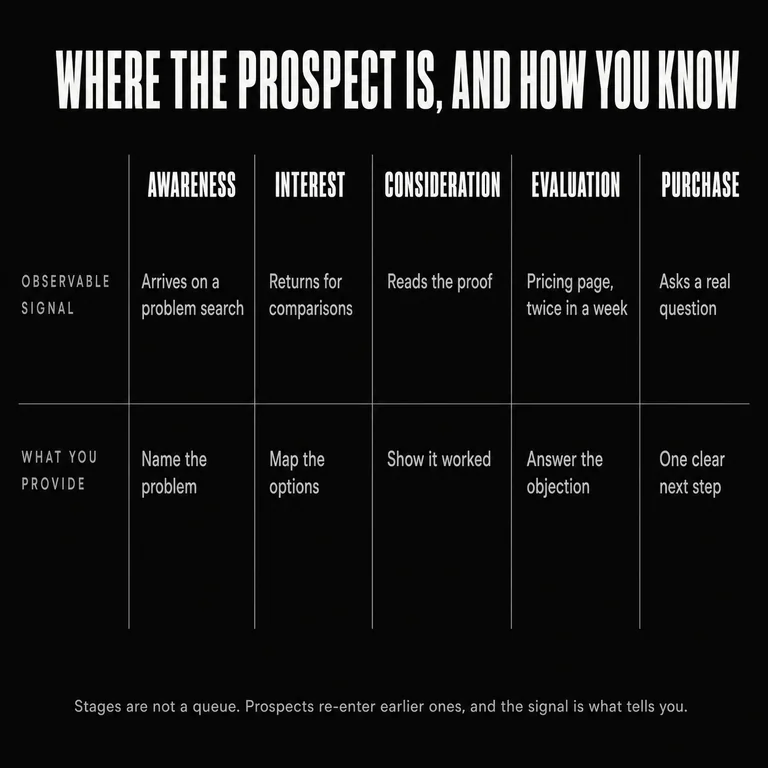
How to choose: Match your nurturing content to the question the prospect is actually asking at each stage—not the question you want them to be asking. You do not have to guess at what that is. Three records already hold it: the search queries people use to arrive on the page, the replies that come back to the sequence, and the first two or three things asked on a sales call. For the first, open the Performance report in Google Search Console, filter Page to the exact URL, and read the Queries tab. Those are the words people brought to the page, not the words you put on it. Collect the recurring questions from all three, then sort each by the stage it belongs to — whether the problem is real is an awareness question; how you differ from a named competitor is an evaluation question. Answer the questions on that list, in the language they were asked in.
Key takeaway: Every stage of the buyer’s journey requires a different kind of signal. One type of content cannot do all the work.
How Should Content Support Lead Nurturing?
Content is the substance of lead nurturing. Every email, article, case study, and video either advances the prospect’s understanding or it doesn’t. The goal is not to produce more content—it is to produce the right content for the right stage.
That means knowing which stage a prospect is in, and the stage is read from behavior rather than from tenure. Take the three most recent actions on the record — pages viewed, assets downloaded, emails clicked — and find the latest one that maps to a stage on the map above. That is the stage. Someone who read two awareness posts last month and opened the pricing page yesterday is in evaluation; the month of awareness reading is history. A later-stage behavior overrides an earlier one and nothing overrides it back, so a prospect only moves when they do something new. Prospects who have done nothing for a quarter have not advanced. They have gone quiet, which is a different problem and takes different content.
A coherent content strategy maps directly to buyer journey stages:
- Awareness content frames problems and possibilities. Blog posts, primers, and introductory guides belong here.
- Consideration content reduces friction and builds proof. Case studies, comparison guides, and detailed explainers do this work.
- Decision content removes final objections. Testimonials, demos, detailed FAQs, and pricing clarity belong at this stage.
The most common mistake is treating all blog content as universally useful. Most blogs are written for top-of-funnel audiences. If you are sending those same posts to prospects who are comparing vendors, you are sending the wrong signal at the wrong time.
Key takeaway: Content strategy and lead nurturing strategy should inform each other directly. If they don’t, you are likely sending the wrong content to the wrong people.
What Role Does Email Play in Lead Nurturing?
Email remains the highest-yield channel for lead nurturing because it is direct, segmentable, and measurable. A well-constructed email sequence maintains relevance across the full journey from initial interest to purchase decision.
The operative word is segmentation. An unsegmented list is not a nurturing asset—it is a broadcast channel, and broadcast does not build relationships.
Effective email nurturing segments by at least one of three variables: behavior (what the prospect has done), stage (where they are in the decision process), or identity (what industry, role, or context they bring). Mailchimp ran the comparison across roughly 11,000 segmented campaigns sent to nearly nine million recipients and found opens 14.31% higher and clicks 100.95% higher than the same senders’ unsegmented campaigns (“Effects of List Segmentation on Email Marketing Stats,” updated 2017). That is one platform’s own account data. And the click gap runs seven times the open gap — the lift lands after the open, on what people do with the mail once they are in it.
The first cut is cheaper than it sounds. Pick one of the three variables and split the list into no more than three or four groups. Make the cut only where different content is already written for each side of the line, since a segment nobody writes differently for is a segment that does nothing. Run that single cut across a full sequence, compare its clicks against the undivided version you were sending before, and add the second variable only once the first has earned it.
A practical sequence for a prospect who downloads a guide might look like this:
- Day 1: Deliver the content they requested, plus one insight that extends it.
- Day 3: Share a relevant case study that shows the idea in action.
- Day 7: Invite them to something that requires their presence—a webinar or live Q&A.
- Day 14: Offer a soft consultation or assessment with a clear, low-friction call to action.
Key takeaway: Segmentation is where relevance stops being a value and becomes a procedure. Automation is only the delivery.
Conclusion
Lead nurturing works when it treats the prospect as an audience with real questions, real concerns, and a decision-making process that moves at its own pace. The programs that convert most reliably are not the ones that send the most emails. They are the ones that send the most relevant signals, at the right time, through the right channels.
Decide what the program is for before you decide what it sends. Get the channels agreeing with each other, because that is the variable that compounds. Build a scoring model only if triage is the actual bottleneck. Then work the mechanics: what each stage of the decision needs, what content answers it, and how the email sequence carries it.
The goal is not to close faster. The goal is to build enough trust and clarity that, when the prospect is ready to decide, the choice already feels obvious.