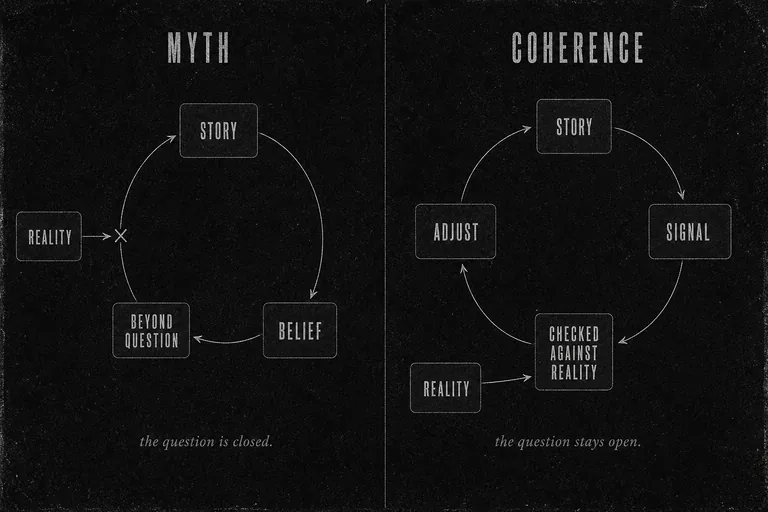
A myth works by closing the question. That is the mechanism rather than a figure of speech, and it is why the branding industry sells them — a story nobody is permitted to interrogate binds an audience fast. The brand myth vs coherence choice turns on what happens after that, when a changing world applies pressure to a story that was built to feel fixed, ancestral, beyond challenge. Coherence runs the other way. It keeps the question open, and the story still agrees with itself under examination. Cohesion built on an unquestioned story is brittle. The brands that hold their meaning over time are coherent, not mythic.
That distinction matters most for the founder who has been told to build a brand mythology. The advice is seductive, and it is half right. Story does carry meaning. The problem is what kind of story you decide to build, and whether you let anyone keep checking it.
What a Myth Actually Does for a Group
What makes a story a myth has nothing to do with its length or its age. A myth is a story that claims to be beyond question, and that claim is the whole mechanism.
Anthropology has been clear about this for a century. Bronisław Malinowski, writing in 1926, described myth as a “charter” for a society: it “expresses, enhances, and codifies belief,” safeguards and enforces morality, and supplies practical rules for conduct. A charter myth does not just explain where a group came from. It justifies how the group should stay. It tells a community who they are, who they are not, and which boundaries are not up for debate.
The literary critic Roland Barthes named the move precisely in Mythologies (1957). Myth, he argued, takes something historical and chosen and makes it look natural and inevitable — it makes “contingency appear eternal.” A decision made by people, at a moment, for reasons, gets re-presented as simply the way things are. Mircea Eliade, working from religious studies in Myth and Reality (1963), described myth as a sacred narrative treated as true and exemplary, a model the present is measured against rather than one the present gets to revise.
These are different traditions, and they do not agree on everything. Barthes read myth critically, as a way of laundering ideology. Eliade read it reverently, as a way of holding meaning. They converge on one feature, though, and it is the feature that matters here: a myth presents itself as settled. It closes the question of why things are the way they are.
That is a powerful thing to do to an audience. It is a dangerous thing to do to a brand.
Why Branding Wants to Be in the Myth Business
The pull toward myth is easy to understand, because myth works.
The canonical case is Margaret Mark and Carol Pearson’s The Hero and the Outlaw (2001), which argued that the strongest brands map to archetypes already running in the audience’s mind — the Hero, the Outlaw, the Sage, the Creator. Find the archetype, express it consistently, and the brand stops being a vendor and becomes a figure people recognize and trust. Scott Bedbury, who led marketing at Nike and Starbucks, put the ambition plainly: a brand, he wrote, is “a metaphorical story that connects with something very deep — a fundamental appreciation of mythology.”
He is right that it connects. A mythologized brand binds an audience the way a founding story binds a tribe: fast, deep, and emotionally. The trouble is what you trade for that speed.
Myth buys cohesion now by borrowing against adaptability later. The bill comes due when the world changes and the story can’t.
A myth earns its authority by claiming to be fixed. The moment a company treats its own narrative as sacred, it inherits the liability that comes with the asset. It has built an audience that expects the story never to move, inside a market that will not hold still. The archetype that fit the company at founding becomes the archetype the company is now obligated to perform, long after it stopped being true.
A Founding Story Is Not a Foundation
The most common form this takes is the founder’s story, frozen and load-bearing.
A founder’s story is useful. It is also, by nature, fixed in time. As the content strategist JB Clark frames it, a founder’s story is “the story of a person,” tied to a particular moment — the early days, the original problem, the inspiration. A brand story is the broader, evolving narrative of what the business is for and who it serves, and it has to be “flexible enough to grow and adapt alongside the company.” When the founder’s origin myth stays in the center too long, Clark notes, it can make it harder for customers to see how the brand serves them rather than the founder.
Calling the origin story a foundation is the category error. A foundation is what you build on and stop revisiting. A brand story is the opposite — it is the part that has to keep agreeing with a reality that moves. Treat the founding story as scripture and you have not laid a foundation. You have set a ceiling.
Coherence Is the Story Still Agreeing With Itself
Here is the alternative: build a story that can be checked. That asks for a stronger story, not a weaker one.
Coherence is the degree to which a brand’s signals agree with each other and with reality over time. It is often confused with consistency, but the two are not the same thing. Consistency is mechanical repetition — the same logo, the same line, the same look. Coherence is alignment. The brand strategist Marty Neumeier draws the distinction directly: alignment, not consistency, is the basis of a living brand. Consistency repeats; coherence holds together while it adapts.
There is a deeper reason coherence is the right standard, and it comes from how people process stories at all. The communication theorist Walter Fisher argued that humans judge any narrative by two tests: narrative coherence (does the story hang together?) and narrative fidelity (does it ring true against my own experience?). An audience is not passively receiving your brand. They are continuously running it against what they already know — testing whether the story still fits the reality in front of them. Jerome Bruner made the broader point in Actual Minds, Possible Worlds (1986): narrative is not a content format laid over thought. It is one of the basic modes of thought, how people make experience mean something.
That is why a brand works less like a myth the audience must accept and more like a pattern they keep checking against reality. When the pattern holds under that pressure, you have coherence. When you forbid the checking — when you insist the story is sacred and the questions are disrespect — you have a myth, and myths do not survive contact with a changing world. They just demand you stop looking.
How Brands Calcify
The failure mode is slow, not dramatic, and it has a name.
In 1999, Donald Sull described why successful companies go bad, and the cause was not laziness. He called it “active inertia,” the tendency to respond to a changing world by doing more of exactly what used to work. The most useful part of his account, for brand work, is the four-stage decay: strategic frames harden into blinders, processes into routines, relationships into shackles, and, most decisively, values into dogmas. The founding story is a strategic frame. Left unquestioned, it becomes a blinder. The values that once gave the brand its edge calcify into things no one is allowed to re-examine.
Dorothy Leonard-Barton found the same paradox from the inside of organizations. The core capabilities that make a company strong have a “dysfunctional flip side” she called core rigidities, and the deepest, most overlooked of them is values. The very thing that holds a brand together can become the thing that keeps it from adapting — if it is held as sacred rather than kept honest.
| Brand myth | Brand coherence | |
|---|---|---|
| Source of authority | Claims to be fixed, ancestral, “beyond question” | The story still agreeing with itself under pressure |
| Relationship to the audience | A congregation that must accept the story | People who keep checking the pattern against reality |
| What it optimizes for | Cohesion now — fast, emotional binding | Adaptability over time |
| Failure mode | Calcifies; stops noticing story and reality have parted | Has to keep earning agreement; no autopilot |
| How it ages | Brittle — breaks when the world moves | Bends without breaking |
That is the real choice behind the brand-myth question. A myth and a coherent brand can look identical on a good day. The difference only shows up when reality applies pressure — and by then, the brand that forbade the questions has no way to answer them.
What This Means for Your Brand
A founding story is not a foundation. Myth binds by closing the question; coherence holds by keeping it open. The brands that try to become unquestionable — older, wiser, sacred — are buying short-term cohesion at the cost of the adaptability that meaning actually requires.
So the work is not to find a more powerful myth. It is to build a brand coherent enough that it does not need one — a story that stays true because it keeps agreeing with reality, not because anyone is forbidden from looking. That is the brand that bends without breaking. It was never pretending to be beyond question in the first place.