

Most brands do not lack content. They lack coherence. The blog posts exist. The social feeds update. The newsletters go out. Yet the brand remains unclear to the people it needs to reach. The problem is not effort. The problem is that effort without structure produces noise, not meaning.
Content strategy is the discipline that connects what a brand believes to what it publishes. When content strategy operates as part of a larger brand system, every piece reinforces the same underlying meaning. When it operates in isolation, or not at all, content accumulates without compounding.
What Is Content Strategy?
Content strategy is the deliberate planning, creation, distribution, and governance of content to express brand meaning across channels. Content strategy determines what a brand says, where it says it, when it says it, and why each piece exists. The goal is coherence, not volume.
A functioning content strategy translates brand identity into repeatable signals. It ensures that a blog post, an email, a video, and a social update all reinforce the same understanding of what the brand stands for. Without this translation layer, brand development remains abstract. The positioning exists in a document. The audience experiences something else entirely.
Content strategy is not the same as content production. Production concerns execution. Strategy concerns intent. An organization can produce enormous quantities of content without any strategy at all. The Content Marketing Institute’s 2024 B2B research found that only 40% of B2B marketers have a documented content strategy — yet among the highest-performing organizations, 64% do. Without that strategic document, content simply accumulates, addressing whatever seemed urgent that week, following whatever trend appeared that month. This approach fills channels but builds nothing durable.
| Element | Content |
|---|---|
| Term | Content Strategy |
| Plain definition | The discipline of planning and governing content to express brand meaning coherently across channels |
| Why it matters | Without strategy, content fragments brand perception instead of reinforcing it |
| Common confusion | Often conflated with content production, editorial calendars, or social media scheduling |
Key takeaway: Content strategy is the system that ensures every piece of content serves the brand’s meaning. Production without strategy is activity without direction.
How Does Content Strategy Connect to Brand Development?
Content strategy operationalizes brand development. Brand development defines what a brand stands for, who it serves, and how it should be understood. Content strategy translates those definitions into tangible signals that audiences actually encounter.
Brand development establishes purpose, positioning, voice, and visual identity. These elements remain latent until they appear in the world. Content strategy determines how and where they appear. A brand that articulates clear values but publishes content that ignores those values has a strategy problem, even if the brand development work was sound.
The relationship works in one direction. Brand development anchors content strategy. Content strategy does not anchor brand development. When organizations attempt to build brand identity through content alone, without first clarifying what the brand means, the result is typically a scattered collection of tactics searching for a unifying idea.
Common failure mode: Treating content production as brand development. Publishing regularly does not clarify brand meaning. Content that accumulates without strategic intent often sends contradictory signals, making the brand harder to understand rather than easier.
In our work, this is one of the most consistent patterns we encounter. Organizations arrive with what they describe as a content problem — channels that feel disconnected, output that isn’t performing, a presence that doesn’t match the brand they’ve built internally. The diagnosis is almost always the same: the content layer is running ahead of the brand development layer. The signals don’t agree with each other because the underlying meaning was never settled. No amount of editorial planning corrects that. Content strategy needs something to translate. When the thing it’s translating hasn’t been built, the strategy becomes a coordination exercise with nothing to coordinate around.
A version of this we see regularly: a mid-size professional services firm, usually in the 50-to-200-employee range, publishing consistently for two or three years. Blog posts weekly, social updates daily, a newsletter that goes out on schedule. By any production metric, they are doing the work. But when we map their content against their stated positioning, the overlap is thin. Half the blog covers industry news anyone could write. The social feed mirrors competitor accounts. The newsletter recycles the blog. Nothing in the content system expresses what makes this firm different from the three others a prospect is also considering. The volume is there. The meaning is not. When that same organization does the foundational work first — settles what it stands for, names the specific positions it holds, defines how it wants to be understood — the content operation changes structurally within a few months. The themes narrow. The editorial calendar starts reflecting actual convictions rather than topics the firm thinks it should cover. The content reads like it comes from a specific organization with a specific point of view, not from a category. That shift is not a production improvement. It is a strategic one.
Key takeaway: Brand development establishes meaning. Content strategy expresses that meaning. The sequence matters.
How Does Content Strategy Support Social Media?
Social media is where content strategy faces its most visible test. Every post, comment, and reply either reinforces or undermines the brand’s meaning. Content strategy provides the structure that keeps social presence coherent even under the pressure of constant publishing.
Social media operates in real time. Trends surface and fade within days. Audiences expect responsiveness. This environment rewards spontaneity, but spontaneity without guardrails produces drift. A brand that responds to every cultural moment, participates in every meme, and pivots with every platform change eventually loses the thread of what it actually stands for.
Content strategy supports social media by establishing themes, boundaries, and priorities. Themes define the recurring subjects the brand will address. Boundaries clarify what the brand will not say or do, even when engagement might reward it. Priorities determine which opportunities warrant response and which can be ignored.
Social media also provides feedback that content strategy can use. Engagement patterns, audience questions, and community conversations reveal what resonates and what falls flat. A content strategy that ignores this feedback becomes rigid. One that changes direction with every metric fluctuation becomes incoherent.
The balance comes from sorting the feedback before acting on it. What audiences ask — the questions and objections that surface in comments, replies, and messages — tells you which themes need more depth. What performs tells you about format, timing, and framing, and nothing about subject. Kept separate, a post that underperforms raises one question — how the idea was presented — and leaves the brand’s position where it was.
The other half of the discipline is a threshold. One comment is an anecdote. In our practice a signal becomes directional when the same question appears three or more times across separate conversations, and theme changes wait for the quarterly review, weeks after the question first surfaces. Daily posting stays free to respond to whatever the day brings. What it reinforces does not move.
Key takeaway: Content strategy gives social media teams structure without rigidity. Themes and boundaries prevent drift. Feedback informs refinement without dictating it.
How Does Content Strategy Relate to SEO?
SEO functions as the gateway to the brand ecosystem. When people search for answers, they encounter the brand through content that search engines surface. Content strategy determines whether that content actually reflects what the brand stands for or whether it merely chases traffic.
Search engine optimization creates tension. The queries people type often differ from the language the brand would naturally use. Topics that drive search volume may not align with brand priorities. An SEO-driven content approach can pull a brand toward generic, commodity answers that any competitor could provide.
Content strategy resolves this tension by treating search visibility as one objective among several. Content should be discoverable, but discoverability alone does not build meaning. A brand that ranks highly for queries but delivers undifferentiated content gains traffic without gaining trust.
The stronger approach treats SEO as distribution, not strategy. Content strategy identifies what the brand should say. SEO identifies how that content can reach people at moments of intent. When these functions align, search-driven content reinforces brand meaning rather than diluting it.
| Priority | SEO-First Approach | Strategy-First Approach |
|---|---|---|
| Content selection | Driven by search volume | Driven by brand relevance, informed by search data |
| Voice and tone | Often generic to match broad queries | Distinctive, even when addressing common topics |
| Depth | Optimized for featured snippets and surface answers | Optimized for understanding and trust |
| Long-term effect | Traffic without differentiation | Traffic that compounds brand meaning |
Key takeaway: Content strategy uses SEO as a distribution mechanism, not a content-selection engine. Search visibility serves brand meaning, not the other way around.
How Does Content Strategy Enable Inbound Marketing?
Inbound marketing converts attention into relationship. Content draws people in. Nurture sequences build familiarity. Conversion pathways guide decision-making. Content strategy provides the connective tissue that makes this progression coherent.
The inbound model depends on content at every stage. Awareness content introduces the brand to people who have not encountered it. Consideration content helps prospects evaluate whether the brand can solve their problem. Decision content provides the clarity and confidence needed to act. Each stage requires different content, but all of it must reinforce the same brand meaning.
Content strategy coordinates this progression. Without coordination, the awareness content promises one thing, the consideration content implies another, and the decision content contradicts both. Prospects feel the inconsistency even if they cannot articulate it. Trust erodes before conversion happens.
Content strategy also prevents the common mistake of optimizing each stage independently. Awareness content that generates maximum reach but attracts misaligned audiences creates friction downstream. Decision content that pressures conversion without earning trust produces short-term results and long-term damage. Strategy ensures that the entire sequence works together.
Common failure mode: Treating content at different funnel stages as separate campaigns rather than connected expressions of the same brand meaning. This produces high top-of-funnel volume that fails to convert because the brand experience feels disjointed.
Key takeaway: Inbound marketing requires content at every stage. Content strategy ensures those stages reinforce each other rather than compete.
How Does Content Strategy Interact with Media Management?
Media management amplifies content through paid distribution. Content strategy determines what deserves amplification and what does not. When these functions align, paid media extends the reach of content that builds brand meaning. When they misalign, paid media accelerates confusion.
Not all content warrants paid promotion. Some content serves narrow audiences. Some addresses temporary concerns. Some exists to maintain presence rather than to attract attention. Paid media applied indiscriminately treats all content as equivalent, wasting budget on material that does not reward broader exposure.
Content strategy provides the criteria for these decisions. Content that clearly expresses brand meaning and serves strategic objectives earns amplification. Content that fills gaps or serves operational purposes does not.
That distinction only holds if it is written down somewhere both functions can read. The artifact is short: a one-page amplification standard naming the two or three tests a piece has to pass before budget goes behind it. Ours are whether the piece expresses a defined theme, whether it says something a competitor could not have published, and whether it will still read as current in six months. A piece that fails any of the three gets distributed organically and nothing more.
The mechanism is a standing monthly review where both functions work from the same candidate list and apply those tests together, while the spend is still a proposal. That review takes under an hour once the standard exists. Without it, the same argument reopens with every campaign and gets settled by whoever is most insistent.
The interaction also works in reverse. Media performance data reveals which content resonates at scale. This information should feed back into content strategy, informing future priorities. A content strategy that ignores performance data becomes disconnected from audience reality. One that follows performance data without reference to brand meaning becomes reactive.
Key takeaway: Content strategy determines what to amplify. Media management determines how to amplify it. Both functions need shared criteria and regular communication.
What Makes Content Strategic Rather Than Reactive?
Strategic content serves predetermined objectives. Reactive content responds to whatever appears urgent at the moment. The distinction lies not in the content itself but in the process that produced it.
Reactive content often looks indistinguishable from strategic content. A reactive blog post may be well-written. A reactive social update may be timely. The problem reveals itself over time. Reactive content accumulates without pattern. Each piece makes sense in isolation. Taken together, the collection sends no coherent signal about what the brand means or why it matters.
Strategic content follows from clear answers to four questions. First, who is this content for? Second, what does this content help them understand, do, or believe? Third, how does this content connect to the brand’s meaning and objectives? Fourth, how will this content interact with other content the brand produces? Reactive content answers only the first question, if any.
The shift from reactive to strategic requires discipline. A 2021 study by Clemens Koob, published in PLOS ONE and covering 263 organizations, found that strategic clarity and commitment were among the strongest predictors of content marketing effectiveness — while distribution channel count and promotion spending showed no significant effect. More channels and more budget do not compensate for absent intent. Most organizations default to reactive content because it feels responsive and efficient. A topic appears, someone writes about it, the piece publishes. The strategic approach requires planning, saying no to opportunities that do not fit, and maintaining systems that connect individual pieces to larger patterns.
This is where a systems-level diagnosis changes the conversation. Most content audits evaluate individual pieces — readability, keyword targeting, engagement metrics. Those measures tell you whether a piece is competent. They don’t tell you whether it coheres with everything else the brand publishes. When we diagnose content problems at Subverse, we start with the relationships between pieces: do they reinforce the same understanding of what the brand stands for, or do they pull in different directions? A brand can publish thoughtful, well-executed content across every channel and still leave its audience unable to say what it means. That gap is structural, and it requires a structural response.
The reactive patterns are consistent once you know what to look for. We will pull 12 to 18 months of published content from an organization and map each piece against the brand’s stated positioning. In a reactive content operation, the map reveals what was actually driving the editorial calendar: a competitor published something similar, a trend surfaced in trade media, the sales team requested a piece on a specific objection, or someone in leadership attended a conference and wanted the brand to weigh in. Each piece had a reason. None of the reasons connected to each other. The diagnostic tells you something that engagement metrics and traffic reports cannot: whether the content system has a center of gravity. Strategic content orbits a defined set of positions. Reactive content scatters. Both can produce individually competent pieces. The difference shows up in the aggregate — whether someone who reads ten of your articles comes away understanding what you stand for, or just knowing that you publish regularly.
Key takeaway: Strategic content follows from explicit criteria that connect individual pieces to brand meaning and objectives. Reactive content responds to stimuli without reference to a larger design.
What Are the Core Elements of a Functioning Content Strategy?
A functioning content strategy includes five core elements: audience understanding, content themes, editorial systems, governance standards, and measurement frameworks. Each element serves a distinct purpose, but none operates effectively in isolation.
Audience understanding identifies who the content serves and what those people need. This understanding should be specific enough to inform content decisions. Vague audience definitions like “business professionals” or “health-conscious consumers” do not provide useful guidance. Useful audience understanding includes the questions people ask, the problems they face, the language they use, and the contexts in which they encounter content. Building that understanding means specific research — reviewing search queries to learn how people describe their problems, interviewing customers to hear the language they actually use, and analyzing support conversations to find where the brand’s promises and the audience’s experience diverge. The output is a reference document that content creators can consult, not a persona slide that gets filed and forgotten.
Content themes establish the recurring subjects the brand will address. Themes should connect to brand meaning while remaining relevant to audience needs. Three to five themes typically provide enough structure without excessive constraint. More than that tends to fragment attention. Fewer tends to limit the brand’s ability to demonstrate range. Developing themes means mapping the overlap between what the brand has earned the right to say and what the audience needs to hear. Each theme should pass a simple filter: can this brand say something about this subject that a competitor cannot? If the answer is no, the theme invites commodity content.
Editorial systems govern how content moves from idea to publication. These systems include planning processes, creation workflows, review standards, and publishing schedules. The appropriate level of formality depends on organization size and publication volume. What matters is that some system exists and that the system supports coherence rather than merely enabling output. In practice, this means a planning calendar with enough forward visibility to connect individual pieces — typically 60 to 90 days. Every piece starts with a brief that ties it back to a specific theme, a target audience, and an intended outcome before drafting begins. A pre-publish review verifies that the piece reinforces brand meaning, not just that it reads well.
Governance standards define quality, voice, and consistency requirements. These standards determine what content looks like when it represents the brand. Style guides, approval processes, and quality checklists all fall under governance. Standards should be clear enough that different people can produce content that feels unified rather than disparate. A useful governance document includes a voice guide with transformation examples — showing how the brand writes and how it does not — a locked terminology list for consistent language, and a short checklist reviewers apply before content publishes. The test: could someone who has never met the brand team produce content that sounds like the brand, using only this document?
Measurement frameworks connect content activity to outcomes. Measurement should include both leading indicators, like engagement and reach, and lagging indicators, like conversion and retention. The framework should also include qualitative assessment of whether content reinforces brand meaning, since quantitative metrics alone cannot capture coherence. A workable framework ties specific metrics to specific questions. Organic traffic by theme cluster answers whether the brand’s topics reach people. Time on page and scroll depth answer whether the content holds attention once they arrive. A quarterly coherence review — sampling 10 to 15 recent pieces across channels and asking whether they reinforce the same understanding — catches drift that numbers miss.
Key takeaway: Content strategy requires audience understanding, themes, systems, standards, and measurement. Missing any element creates gaps that undermine the strategy’s effectiveness.
How Do You Know If Content Strategy Is Working?
Content strategy works when content reinforces brand meaning, reaches intended audiences, and contributes to business objectives. Assessment requires looking at all three dimensions, since success in one without the others represents incomplete effectiveness.
Coherence assessment evaluates whether content reinforces brand meaning. Review a sample of recent content across channels. Does each piece sound like the same brand? Do the messages align? Would someone encountering this content for the first time develop an accurate understanding of what the brand stands for? If the answer to any of these questions is no, the strategy has a coherence problem.
Reach assessment evaluates whether content finds its intended audiences. Are the right people encountering the content? Reach metrics alone do not answer this question. High traffic from misaligned audiences represents waste, not success.
Working out who is actually arriving takes three specific reads. Segment engagement by channel. An organic search visitor and a paid social visitor are different populations, and a site-wide average hides both. Read the queries and referrers that bring people in; a search term describes the problem someone had at the moment they found you, and fifty of them read in sequence will tell you whether those are problems the brand is positioned to solve. Then separate first-time traffic from returning traffic, because the two answer different questions. First-time traffic measures distribution. Returning traffic measures whether the content was worth coming back to.
The second number is the one we watch. On our own site, organic search visitors engage at 41.5%, which is a healthy rate for the category and says the distribution is working. Returning visitors engage at 51% and stay for an average of six minutes and fifteen seconds. That gap is the useful signal. It says the people coming back are reading rather than skimming, and it tells us more about whether the content found the right audience than any impression count has.
Outcome assessment evaluates whether content contributes to business objectives. This assessment varies by objective. For awareness objectives, reach and recognition metrics matter. For conversion objectives, pipeline and revenue metrics matter. For retention objectives, engagement and loyalty metrics matter.
Connecting the two is a procedure, and it runs backward. Start from an outcome the organization already tracks and reports — the number that appears in a board deck or a quarterly review, and would appear there whether or not the content program existed. Name the behavior immediately upstream of it: a form completed, a call booked, a renewal conversation opened. Then name the content that behavior passes through, and check two things about it — whether it exists, and whether anyone reaches it. The chain usually breaks at that last step, where the content a decision depends on was either never written or sits somewhere nobody arrives.
Hold the result in a single table: outcome, upstream behavior, the content that serves it, current performance. Revisit it when objectives change, not when reporting is due. Anything in the content operation that cannot be traced to a row is either building understanding for its own sake, which is a defensible reason to publish, or it is running on inertia. The table forces you to say which one it is.
Content strategy typically requires time to demonstrate results. Coherence compounds gradually. Audiences develop familiarity over repeated exposure. Expecting immediate returns from strategic content investments leads to premature abandonment of approaches that would have worked given sufficient duration.
Key takeaway: Effective content strategy produces coherent content that reaches intended audiences and contributes to business objectives. Assessment requires examining all three dimensions, not optimizing any single metric in isolation.
Conclusion
Content strategy is the system that turns brand meaning into tangible signals that audiences encounter. Without content strategy, organizations produce content that accumulates without compounding. Each piece exists in isolation. The brand becomes harder to understand with each publication rather than clearer.
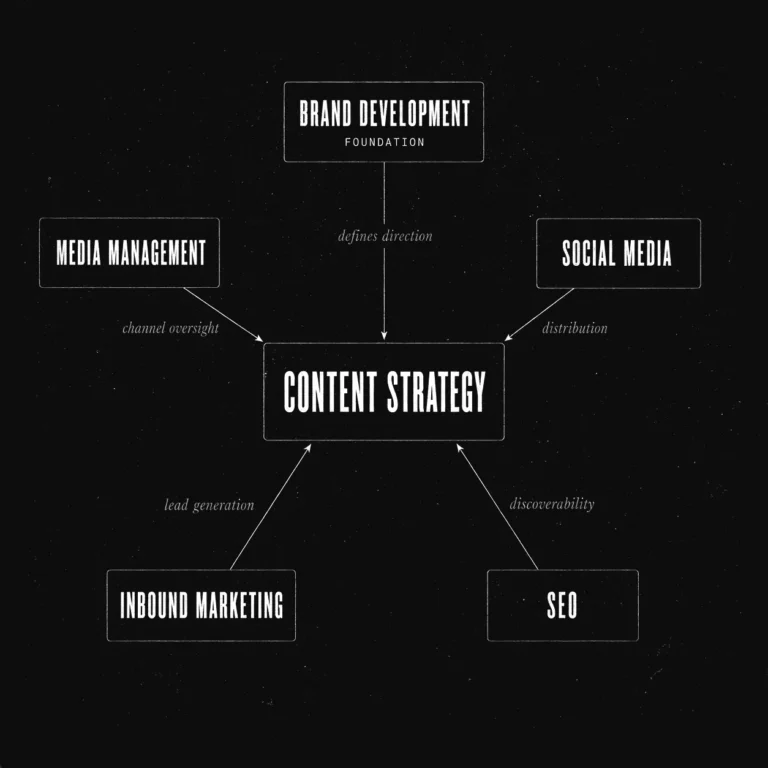
Within the brand ecosystem, content strategy translates brand development into expression, supports social media with structure, uses SEO for distribution rather than direction, enables inbound marketing through coordinated progression, and informs media management about what deserves amplification.
The work is not producing more content. The work is building a system where content reinforces the same meaning across every channel, format, and touchpoint. When that system functions, content becomes an asset that compounds. When it does not, content becomes noise that obscures.
This is how we approach content strategy at Subverse. Content is the primary mechanism through which a brand’s meaning reaches the people it needs to reach. When we work with organizations on content strategy, we start at the layer most strategies skip: whether the brand’s meaning has been articulated clearly enough to give content something coherent to express. The editorial calendar, the channel strategy, the production workflow — those matter, but they are downstream. They work when what’s upstream is settled. When it isn’t, they produce motion that doesn’t accumulate.
The measure of content strategy is not publication volume. The measure is whether audiences understand, faster and more accurately, what the brand stands for and why it matters to them.