

On Monday, 27 January 2025, Nvidia lost about $589 billion of market value in a single trading session. It closed down roughly 17%, at $118.58. That was the largest one-day loss in the history of the US stock market — more than double the previous record, which Nvidia had also set the preceding September (CNBC, Forbes, 27 January 2025).
The cause was a number in a research paper. A Chinese lab had reported training a frontier-class model for $5.576 million, and the market read that as the end of an advantage it had been pricing for two years.
Eighteen months later the advantage is larger than it was that morning. The number was accurate. The reading was wrong. And the gap between those two facts is the most useful thing a business owner can take from the episode, because it is the same gap that opens when your differentiator becomes a commodity — or appears to.
What did the $5.576 million actually measure?
It measured one training run.
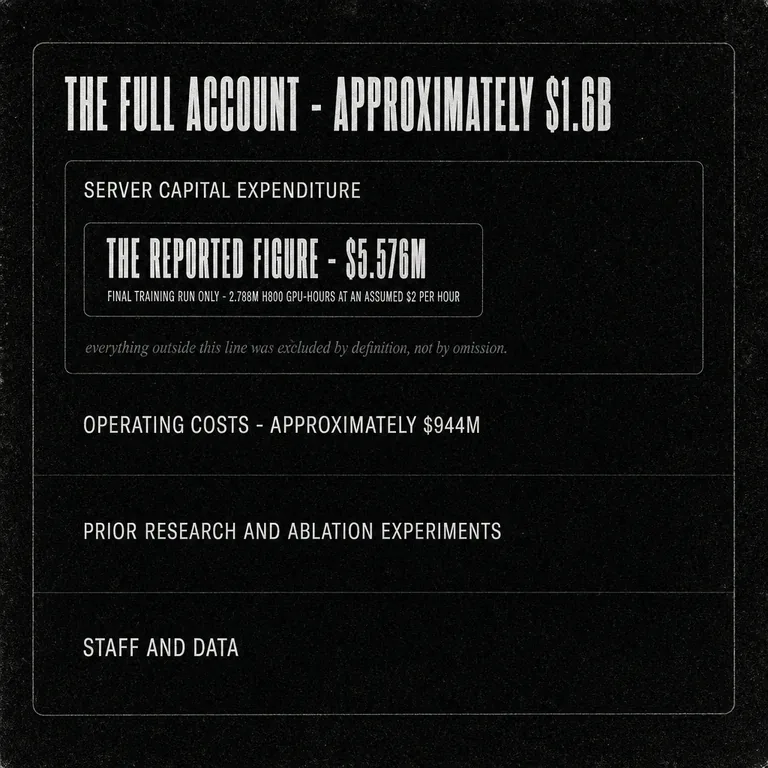
The figure comes from the DeepSeek-V3 Technical Report, published December 2024. The paper reports 2.788 million H800 GPU-hours for the model’s full training, priced at an assumed rental rate of two dollars per GPU-hour. That arithmetic produces $5.576 million.
The paper is explicit about what the arithmetic leaves out, in a sentence worth reading before repeating the number:
Note that the aforementioned costs include only the official training of DeepSeek-V3, excluding the costs associated with prior research and ablation experiments on architectures, algorithms, or data.
Two things follow. The rental rate is assumed rather than paid, so the figure is a construction rather than an invoice. And the excluded research is not a rounding error — it is the part where a lab finds out which architecture to train in the first place.
One more detail got lost in transmission. The $5.576 million belongs to V3, released in December 2024. The model that moved the market was R1, released the following month, and DeepSeek published no comparable training cost for it. The figure everyone quoted in late January was measuring a different model than the one they were reacting to.
None of this makes the paper dishonest. A training-run cost is a legitimate thing to report, and every lab reports narrow figures. It does mean the number answered a narrow question, and was received as an answer to a much larger one.
Why the market read one training run as the whole moat
Because nobody supplied the larger number until after the session closed.
SemiAnalysis published its own accounting four days later, on 31 January 2025. Its estimate: roughly $1.6 billion in total server capital expenditure, around $944 million in operating costs, and access to approximately 50,000 Hopper-class GPUs shared with DeepSeek’s parent company. On the headline figure, the firm was direct — the $6 million in the paper covers the GPU cost of the pre-training run, which is a portion of what the model cost.
Charles Mok, writing from Stanford’s Global Digital Policy Incubator on 5 February 2025, named the error in the comparison itself. Setting a usage-time cost beside a total infrastructure investment is, in his words, “neither a fair or a direct comparison.” He put DeepSeek’s own hardware at roughly $130 million.
This is a coherence problem before it is a financial one. Two signals about the same organization pointed in different directions: a narrow figure that made the lab look impossibly efficient, and a capital position that made it look like a well-funded competitor. Both were true. Only one traveled. The one that traveled was the one shaped like news.
Cost reporting across this industry has that shape by default — labs publish the number that signals competitive position, and the full account of what it costs to build a model like this stays offstage. When the narrow number is the only one in circulation, it becomes the story about the moat, regardless of what the moat is doing.
What actually commoditized, and what didn’t
Something did change in January 2025. It was not the thing the headline named.
The open licence removed proprietary access as an advantage for a class of uses, and per-token prices fell hard. What did not fall was the cost of being at the frontier. Epoch AI puts the growth of frontier training costs at roughly 2.4 times a year from 2016 through 2024, with the largest runs projected to pass a billion dollars by 2027. Its breakdown of where that money goes: hardware at 47 to 67% of development cost, research staff at 29 to 49%, and energy at 2 to 6%. The expensive inputs are chips and the people who know what to do with them, and neither gets cheaper because someone else published an efficient training run. Epoch’s own conclusion is that only a few large organizations can keep up.
The capital numbers since then are not ambiguous:
| January 2025 expectation | What happened by 2026 | |
|---|---|---|
| Frontier training cost | Falls toward the $6M headline | Rose. Epoch AI puts growth at ~2.4× a year, 2016–2024; largest runs projected past $1B by 2027 |
| Hyperscaler capital spending | Gets cut as efficiency lands | Rose. Roughly $475 billion expected across the four largest buyers in 2026 (Bloomberg estimates) |
| Nvidia data-centre demand | Moderates as models get cheaper to train | Rose. FY2026 revenue of $215.9 billion, up 65%; Q1 FY2027 data-centre revenue of $75.2 billion, up 92% year over year |
| Proprietary API position | Displaced by open weights | Capability gap closed; commercial displacement limited (Scott Logic, July 2026) |
| Per-token price | Falls | Fell, and stayed down. This is the one that landed |
Reporting on the first anniversary of the selloff, on 27 January 2026, Carmen Reinicke’s summary was that the fear had “turned out to be largely a mirage so far.”
So the honest summary is narrow and specific. Model access commoditized. Price commoditized. Capital, serving scale, and distribution did the opposite. Anyone who repositioned in February 2025 on the belief that compute had stopped being scarce spent a year defending against the wrong thing.
The difference between losing a differentiator and losing the story about one
These fail in opposite directions and they look identical from inside.
When a differentiator genuinely commoditizes, the evidence is boring and verifiable: competitors ship the same capability, buyers stop asking about it, and it disappears from the reasons people give for choosing you. Procter & Gamble recorded an $8.0 billion non-cash impairment against Gillette in its fiscal fourth quarter of 2019, producing a $5.24 billion quarterly net loss on a business it had bought for $57 billion in 2005. The named drivers were competition from subscription entrants, currency, and declining shaving frequency — and grooming net sales had fallen in 11 of the previous 12 quarters (CNBC, 30 July 2019). Eleven quarters is not a news cycle. It is a trend anyone was free to read.
When the story changes, the evidence arrives all at once and from outside. A competitor’s announcement, an analyst note, a number in a paper. Nothing about your capability moved. What moved is what people believe about it, and belief moves faster than capability ever does — which is why the market can be wrong by $589 billion in an afternoon and take a year to correct.
The distinction is hard to hold because both produce the same feeling, and the feeling arrives before the evidence does.
In our work the pattern is consistent. When a capability stops feeling scarce, the first instinct is to go looking for a replacement capability — something new to be the best at, quickly, before the gap closes. That instinct treats the brand as a container for whatever is currently hard to copy. It is also the reason a brand’s story gets rebuilt every few years and never accumulates anything: each rebuild is answerable to a market condition rather than to a practice, and market conditions expire.
Subverse’s position is that a capability was never the durable part. A brand’s job is to be understood — why it exists, why it matters, and what role it plays for the people it serves. Those three answers survive a competitor matching your feature set, because none of them was about the feature set. What a competitor cannot copy without becoming a different organization is what you refuse, who you decline to serve, and the standard every decision answers to.
Which gives you a test, and it is uncomfortable in the right way. If someone else’s press release can take your differentiator away from you, the differentiator was never the thing you owned. The story about it was.
How to tell which one is happening to you
Four questions, in order. Call it the scarcity check. It takes an afternoon and it runs before any repositioning work.
1. Did anything actually change? Name the specific capability and state what is now true of it that was not true before, as a fact with a date attached. If you cannot write that sentence, you are responding to a story rather than a change. This is the question the market skipped on 27 January, and skipping it cost more than any other question on this list.
2. What did the number measure? Every cost or performance figure answers a narrow question. Find the question before you accept the answer. A figure that excludes prior research describes one run and nothing wider.
3. Who can now do this, and what does it cost them? Scarcity is a fact about the field, not about a headline. Open weights made a class of models free to download and did not make them free to run, staff, or serve at scale. Ask what the second and third costs are, because those are where advantages usually relocate.
4. If this became free tomorrow, what would still be true about why people choose you? Answer honestly and specifically. Whatever survives is what you actually own, and it is where the positioning work belongs.
If question four comes back empty, that is not a failed exercise. It means the repositioning conversation you need is a deeper one than the news gave you. Better to find that in an afternoon than after a year of defending a position that was never there.
Read the number before you rewrite the story
The DeepSeek episode is usually told as a story about AI costs. It is more useful as a story about how quickly a narrow, accurate number becomes a claim it never made — and how expensive that translation is when everyone makes it at once.
The generic advice for a commoditizing category is to move beyond features, build an emotional connection, and own your language. None of it is wrong. All of it skips the step that decides whether any of it applies, which is finding out whether your differentiator has been commoditized or merely reported as commoditized. Advice that arrives without that step is advice you cannot act on, because it fits both cases equally and the cases need opposite responses.
One pitfall worth naming: the check is easiest to run when you do not need it. Run it on a differentiator nobody is currently threatening, and you will find out what your position rests on while there is still time to build something underneath it. Run it during the week of the announcement and you are doing strategy at the speed of a news cycle, which is the speed at which $589 billion moved in the wrong direction. Teams that already have a deliberate way of deciding what to adopt and when tend to be the ones that hold still, and holding still was the correct move.
The capability you are worried about may well be commoditizing. It happens, and it has happened to whole categories of technical work. Find out first. The answer changes what you should do next, and the number in the headline will not tell you.