

A shop window worked on people who were never going to walk in. So did the van, the shelf, the sign — presence accumulating for free, on people not paying attention, while the owner got on with something else. That is the specific thing digital brand building has to replace, and the precision matters, because the disadvantage here is real and almost always misdiagnosed as something larger. What a digital-only brand lost is the passive, cumulative exposure that physical presence used to supply at no cost. It did not lose the ability to build a brand. You rebuild that with coherence, not volume.
Why brand building used to feel effortless
For most of the last century, a brand accumulated familiarity without trying very hard. A box sat on a shelf and was seen by people who came in to buy something else. A sign stood at an intersection. A storefront occupied the same corner for a decade. None of these impressions were bought one at a time. They came as a byproduct of existing in physical space, and they added up.
That accumulation has a name in the research. Robert Zajonc demonstrated in 1968 that repeated exposure to something increases how much we like it, even when we start out neutral. The effect has since been replicated across more than two hundred studies. Its shape matters as much as its existence: the relationship between exposure and preference is a decelerating curve. The first encounters do the heavy lifting, and each one after that adds a little less.
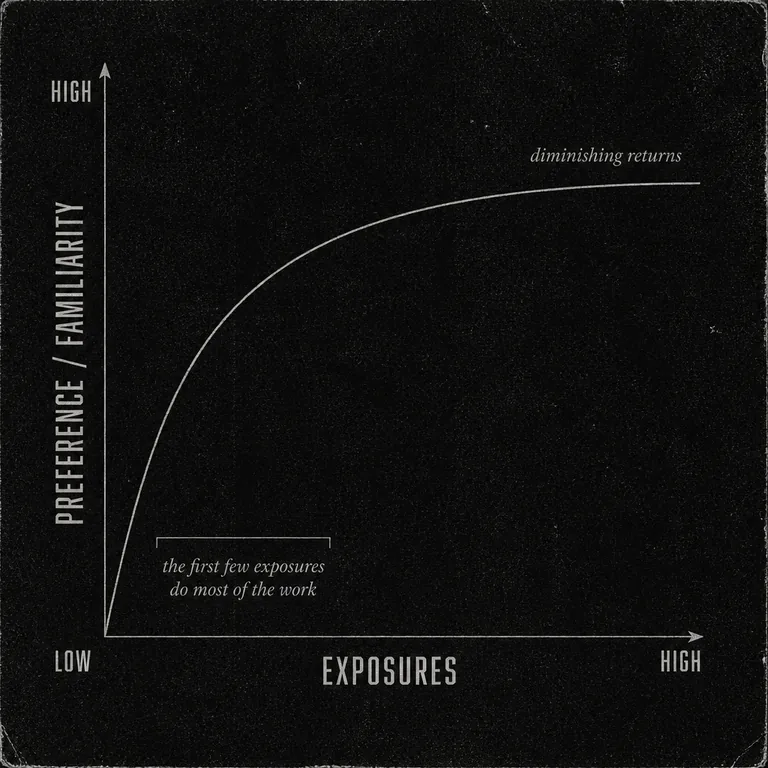
Physical presence was an exposure machine. It ran in the background, it cost nothing per impression once the brand was there, and it built the early, steep part of that curve almost automatically. This is what people mean when they say brand building used to be easier. They are describing a channel that did the repetition for you.
What digital-only brands actually lost
A digital-only brand has none of that ambient repetition. Every impression has to be earned, and it competes inside feeds and search results that are already crowded with everyone else’s impressions. The volume of brand messages a person encounters has multiplied many times over since the 1970s, and the share that gets consciously noticed is small. The practical effect is that exposure no longer accumulates on its own. It has to be designed.
It helps to be precise about what is missing, because two different things get lumped together as “awareness.”
| Brand recognition | Brand awareness | |
|---|---|---|
| What it is | Identifying a brand from a cue: a color, a logo, a shape, a voice | Recalling the brand and knowing what it stands for and offers |
| How fast it forms | Immediate, cue-triggered | Slower, built through understanding |
| What used to build it cheaply | Ambient physical exposure | Deeper engagement |
Recognition is the layer ambient exposure built almost for free. Seeing the same package enough times made it identifiable before a person knew anything about the company. That cheap recognition foothold is precisely what a digital-only brand has to manufacture deliberately, because nothing is repeating the cue in the background.
Why “more touchpoints” is the wrong answer
The standard advice for digital brand building is a volume checklist. Post more. Be on every platform. Stay consistent on your logo and colors. Publish content, find influencers, repeat. The advice has the ingredients right. Where it goes wrong is the mechanism.
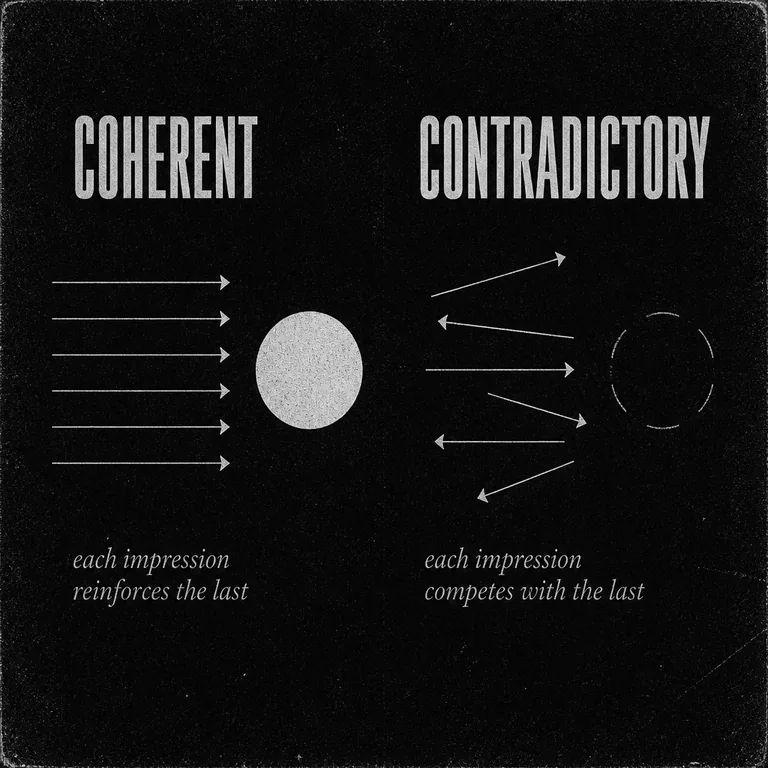
Adding touchpoints does not help if the touchpoints contradict each other. A scarce impression only compounds when it reinforces the last one. When each channel says something slightly different, the exposure scatters instead of stacking, and the brand spends its limited attention budget teaching people something new every time instead of confirming something they already half-remember.
A scarce impression only compounds when it reinforces the last one. Otherwise you are paying for exposure that erases itself.
This is the part the volume checklist misses. The problem was never that traditional brands had more channels. It is that their channels repeated the same thing without anyone having to coordinate them.
What builds recognition when attention is scarce
Coherence does the work physical presence used to do. When every signal a brand sends agrees with every other signal, scarce exposure compounds, and the early steep part of the exposure curve gets built across whatever touchpoints the brand actually has.
The marketing science points the same direction. Byron Sharp and the Ehrenberg-Bass Institute describe brand growth as a function of mental availability: being easy to bring to mind in a buying situation, which requires the brand to be encoded in memory the same way each time. Jenni Romaniuk’s work on distinctive brand assets sharpens the rule. An asset becomes recognizable through two things: fame, meaning how many people link it to the brand, and uniqueness, meaning how exclusively it belongs to that brand. Both are built by reinforcing the same cue consistently rather than by producing more variations of it.
That is the case for treating consistency as the engine of recognition and trust rather than as a tidiness rule. A surveyed group of brand managers estimated that consistent presentation raised revenue by a double-digit percentage, though that figure comes from a vendor survey of self-reported estimates and should be read as a belief in the field rather than a measured law. The defensible claim sits underneath it: coherent signals are what let limited exposure add up to memory.
The fundamental job of a brand is to be understood. Clearly, consistently, over time. Digital-only brands just have to do that part on purpose.
The brands that pulled it off
The digital-native brands that became recognizable did it with a small, coherent set of cues carried identically everywhere. Glossier built a recognizable identity on a soft pink and white palette and a consistent minimal style, repeated across its site, packaging, and social presence; a large share of its early sales came through peer referral, which is coherence compounding through word of mouth. Warby Parker and Allbirds built identifiable, consistent identities online before they had a single store. In each case recognition came from repeating the same meaning, not from being in more places.
And yes, some of them opened stores
Here is the part that complicates the picture, and it is worth stating plainly. Many of those same digital-native brands have moved into physical retail. Warby Parker, Allbirds, and Glossier have all opened stores. The reported reasons are instructive: digital customer acquisition has become expensive and crowded, in-person shopping still accounts for the majority of retail sales in categories like apparel, and a physical space lets a brand show its identity and build trust in ways a feed makes harder, according to reporting from Business of Fashion and CNBC.
This does not refute the case. It confirms the premise. The reason these brands added physical presence is that digital touchpoints are narrow, costly, and attention-scarce. Physical presence still does something digital struggles to do, which is exactly why a brand that has only digital channels cannot afford to let any of them drift out of alignment.
So what this means for your brand
If you run a digital-only brand, the instinct to solve recognition with more output is understandable and mostly counterproductive. The lever is not how many times you show up. It is whether everything you show carries the same meaning, so that each scarce impression confirms the last one instead of competing with it.
That is a strategy problem before it is a production problem. It means deciding what your brand stands for clearly enough that every channel can reinforce it, then holding that line everywhere. This is the work behind narrative branding: building a stable point of view so that individual posts and pages change while the underlying meaning stays fixed. Done that way, a small set of digital touchpoints can build the same cumulative recognition that physical presence used to hand traditional brands for free. It just has to be built on purpose rather than absorbed by default.
What matters most
The disadvantage digital-only brands carry is real, but it is narrower than it feels. You did not lose the ability to build a brand. You lost the channel that used to repeat your brand for you. The replacement is coherence: a clear point of view, expressed the same way across every touchpoint you have, repeated until it sticks. The one mistake to avoid is answering a coherence problem with more volume. That spends the attention you cannot afford to waste.