
Most of the people who come to us start by asking for a logo. They arrive with a color in mind, sometimes a competitor whose look they admire, and a date they need it by. What they rarely arrive with is an answer to the question that decides whether any of it works: what is this brand supposed to mean, and to whom?
That gap is the difference between brand design and brand strategy. The two get used as if they were the same purchase. They aren’t. They answer different questions, and treating one as a substitute for the other is what turns a branding project into a run of expensive do-overs.
What Is Brand Strategy?
Brand strategy is the deliberate definition of what a brand means, who it serves, and how it will be understood. It answers foundational questions: Why does this organization exist? What does it stand for? Who needs what it offers, and why would they choose it over alternatives? Strategy creates the framework that makes all other decisions coherent. That framework is a concrete thing: a set of fixed answers about who we serve, what we stand for, how we differ, and what we will and won’t say. Every later choice gets measured against it. When a headline or a layout comes up for debate, you don’t argue taste — you check it against the framework. Does this reinforce what we’ve already said we mean, or pull against it?
A brand strategy typically includes purpose, positioning, audience definition, competitive differentiation, and messaging architecture. These elements are not decorative — they decide concrete things. Take positioning. A financial advisor positioned around protecting what a client has already built will write, design, and photograph differently than one positioned around aggressive growth. The first calls for restrained typography, measured language, and imagery of permanence. The second calls for sharper type, momentum in the copy, and a visual language of upside. Same service, opposite signals, and positioning is the thing that tells you which set is correct. Without it, every one of those choices is a coin flip.
The goal of brand strategy is alignment. When strategy is clear, every subsequent decision—design, content, experience, product—reinforces the same underlying meaning. When strategy is absent or vague, each decision gets optimized on its own terms: the website team chases conversions, the social team chases engagement, the product team chases feature parity. Every choice is locally reasonable and points somewhere slightly different. That is the mechanism — not sabotage, just a dozen sensible decisions made against a dozen private definitions of the brand. Signals compete instead of compound, and trust erodes. You can diagnose it in an afternoon: pull your last ten touchpoints (homepage, an ad, a sales email, the onboarding flow, a support reply) and write one sentence for each describing what it implies the brand stands for. If those sentences don’t converge, the problem isn’t design. It’s a strategy gap.
| Element | Content |
|---|---|
| Term | Brand strategy |
| Plain definition | The plan that defines a brand’s meaning, audience, and position |
| Why it matters | Without it, execution lacks direction and coherence |
| Common confusion | Often mistaken for messaging or taglines, which are outputs of strategy, not strategy itself |
Key takeaway: Brand strategy is the foundational work of defining what a brand means. It precedes and informs everything visible.
What Is Brand Design?
Brand design is the translation of brand strategy into visual and sensory form. It includes the logo, color palette, typography, imagery style, and graphic elements that make a brand recognizable. Design creates the signals people actually see, creating the first impression and ongoing visual identity.
A complete brand design system typically includes a logo with variants for different contexts, a defined color palette, selected typefaces, guidelines for photography or illustration style, and rules for how these elements work together. These assets appear on websites, packaging, social media, signage, and every other touchpoint where the brand is visible.
Design is not decoration. It’s communication. The colors chosen evoke specific associations. The typography conveys personality. The logo becomes the shorthand by which people recognize and remember the brand. When design is executed well, it makes the strategy visible and memorable. When executed poorly—or without strategy—it becomes noise.
Key takeaway: Brand design translates strategic decisions into visual form. It makes abstract meaning concrete and recognizable.
Why Does Sequence Matter?
Strategy must come first. Design without strategy is guesswork dressed in aesthetics. Strategy-informed design starts from a sharper set of questions. Who is the brand trying to reach, and what do those people need to believe about it in the first three seconds? What does the brand stand for that competitors don’t, and how should that difference show up before anyone reads a word? What should a stranger feel; what must the brand never be mistaken for; which single idea does every asset have to carry? A designer working from those answers makes different choices than one working from a color the founder happens to like. The questions replace personal taste with a brief the work can actually be measured against.
Consider what happens when an organization skips strategy and jumps directly to design. A designer asks: what colors should we use? What feeling should the logo evoke? Without strategy, these questions have no principled answers. The design team either makes assumptions or relies on the founder’s personal taste. Neither approach is grounded in what the audience needs or how the brand should be positioned.
The result is design that looks fine in isolation but fails in context. The logo doesn’t communicate what the organization actually does. The visual identity attracts the wrong audience. The design contradicts the experience people have when they interact with the brand. Incoherence accumulates.
Research and practicing designers consistently confirm this sequence. Design built on strategy solves a specific problem: how to make a defined meaning visible and memorable. Design built on intuition solves a different problem: how to make something that looks good to the people in the room. These are not the same problem.
Common failure mode: Organizations request “just a logo” without articulating what the logo needs to communicate or to whom. This produces design work that must be redone once strategy is clarified.
Key takeaway: Strategy defines the brief. Design answers it. Reversing this order produces expensive rework.
How Do Brand Strategy and Brand Design Work Together?
Strategy and design are interdependent. A strong strategy without design remains abstract—an internal document that never reaches the people it needs to influence. Strong design without strategy lacks foundation—attractive surfaces with nothing meaningful beneath them.
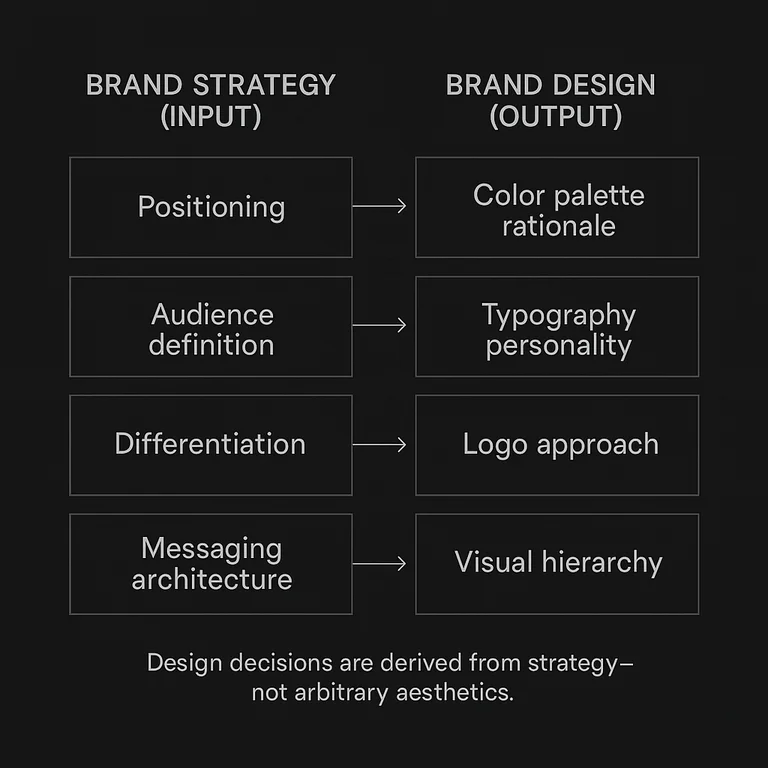
When properly sequenced, strategy creates constraints that make design decisions easier and more defensible. The strategy says: we serve this audience, we stand for this idea, we differentiate in this way. Design then asks: what visual language makes that meaning clear and memorable?
Each element of design traces back to strategy. The color palette reflects brand personality. The typography conveys tone. The logo encapsulates positioning. Every choice is justified not by personal preference but by strategic intent.
This alignment creates something specific, and the word for it matters.
The standard industry goal is consistency: things should look the same across channels. Same colors, same logo placement, same tagline. As a surface standard, consistency works. But in our experience, it stops short. A brand can be perfectly consistent and still fail to build understanding. Every signal matches. None of them mean anything in particular.
Coherence is a higher standard. Coherence means a brand’s signals compound toward the same meaning, not just the same appearance. The visual identity, the language, the product experience, the way the organization handles a complaint all reinforce what the brand stands for, not just what it looks like. That compounding is what produces trust. When someone encounters the brand through advertising, then visits the website, then interacts with the product, each touchpoint reinforces the same underlying meaning. Recognition builds, and trust follows. Research published in the European Management Journal by Šerić, Ozretić-Došen, and Škare confirms the mechanism: perceived consistency in brand communications directly increases both brand trust and brand loyalty. The compounding is structural, not metaphorical.
We see the gap between these two standards constantly. Organizations invest in brand guidelines — color codes, logo lockups, template systems — and wonder why nothing accumulates. The elements match. The meaning drifts. They achieved consistency. What they needed was coherence.
This is what makes the strategy-design relationship structural rather than sequential. Strategy doesn’t just inform design and step aside. Strategy provides the meaning that design makes visible, and that meaning is the standard against which every future decision gets measured. When both are working, every touchpoint coheres even when the formats look nothing alike.
Key takeaway: Strategy provides direction. Design provides expression. Together, they create coherence — not just consistency — across every touchpoint.
What Happens When You Skip Brand Strategy?
Design without strategy produces one of two outcomes: expensive rework or accumulated incoherence.
The expensive rework scenario: an organization invests in brand design, launches it, and discovers the design doesn’t work. It attracts the wrong audience, confuses the value proposition, or simply doesn’t resonate. The organization then invests in strategy, which clarifies what should have been the foundation. The design must be redone. Time and money are lost.
The accumulated incoherence scenario: the organization never invests in strategy. Design decisions are made ad hoc, based on what looks good in the moment. Over time, the brand accumulates contradictory signals. The website conveys one message, social media conveys another, the product experience conveys a third. A Lucidpress survey of more than 400 organizations found that this kind of brand inconsistency costs companies an average of 23% in annual revenue—revenue lost not to a single catastrophic failure but to the steady erosion of recognition that inconsistency produces. The brand becomes harder to understand, easier to forget, and more expensive to fix with each passing quarter.
Neither outcome is desirable. Both are preventable by establishing strategy before design.
Key takeaway: Skipping strategy doesn’t save money. It shifts costs to rework, confusion, or lost trust.
When Should You Invest in Each?
Invest in brand strategy when you need to clarify what your organization means. This applies to new ventures defining their position, established organizations experiencing drift, and any moment when stakeholders disagree about purpose, audience, or differentiation.
Invest in brand design when strategy is clear and you need to make that meaning visible. This applies after strategy is complete, when visual identity is outdated or inconsistent, or when entering contexts that require new applications of the existing visual system.
Some organizations need both simultaneously. A startup launching its first product requires strategy to define what it means and design to make that meaning visible. A rebrand typically includes both: strategy to clarify the updated positioning, design to express it visually.
The key principle: strategy informs design. If design is being created, strategy should already exist. If it doesn’t, that’s the place to start.
Key takeaway: Strategy first, then design. If you’re not sure what your brand means, don’t start designing yet.
Conclusion
Brand strategy defines meaning. Brand design makes meaning visible. Both are necessary. Neither substitutes for the other.
The sequence matters: strategy first, then design. Organizations that reverse this order produce work that must be redone or accumulate incoherence that erodes trust.
When strategy and design work together—when every visual signal reinforces the same underlying meaning—brands become easier to understand, remember, and trust. That coherence is the goal. It doesn’t happen by accident. It happens by design, built on strategy.