
The photo editor is 54. She’s boxing up the last issue of a magazine she helped build for two decades. The masthead used to mean something — to her career, her income, her sense of who she is in the world. Now the print edition is gone, the staff dissolved, and the skills that earned her that identity attract fewer calls every year. Versions of this scene are playing out across every discipline once considered a durable path for experienced creatives.
This is not a moment of isolated industry adjustment. It is a structural reengineering that is compressing faster than any previous occupational shift in living memory — and Gen X is positioned to absorb the worst of it.
What You’ll Learn
- How creative employment has contracted sharply since 2008, and which roles absorbed the heaviest cuts
- Why Gen X faces this disruption with less financial and structural room to maneuver than other generations
- How automation is accelerating displacement across advertising, media, and adjacent creative fields
- What job loss actually costs beyond income — and why standard retraining advice misses the real barrier
- What structural limits older workers face, and which moves have evidence behind them
How Much Has Creative Employment Actually Declined?
Creative employment has not drifted downward — it has collapsed in specific sectors. U.S. periodical publishing employment fell from roughly 149,600 jobs in 2008 to about 69,000 in 2024, a drop of nearly 54%, according to Bureau of Labor Statistics data (NAICS 511120). Newsrooms absorbed those cuts by eliminating copy desks, staff photography teams, and dedicated fact-checking roles — the mid-tier positions that once formed the spine of creative career ladders. The ladder did not get harder to climb. It got shorter.
A 54% reduction in 16 years is not a cycle. It is a restructuring. What once looked like a stable profession with clear progression has been redesigned into a leaner operation with fewer seats at every level. The skills that commanded a full-time salary are now purchased on a project basis, at lower rates, with no expectation of the relationship continuing.
As a general rule: in any sector where headcount has dropped by more than 30% over a decade, mid-career roles absorb disproportionate risk — because they carry the highest salaries relative to replaceable output.
Why Is Gen X Carrying More of This Risk Than Other Generations?
Gen X workers — born 1965 to 1980 — hit this disruption at their peak financial-obligation years, with fewer cushions than their position in a career might suggest. St. Louis Fed data show this cohort carrying sizable mortgage debt. Pew Research Center finds that more than half of Americans in their 40s are simultaneously supporting an aging parent and raising children. AARP documents similar sandwich-caregiving pressures among Medicare-related caregivers. Add college costs that often land in the same window, and the financial margin for reinvention narrows to near zero.
This is the generational timing that matters. Younger workers disrupted by industry collapse have more time ahead and fewer obligations. Older workers are closer to retirement or have already accumulated the savings that provide options. Gen X sits in the structural middle: professional identity built around a disappearing role, peak financial obligations, and 15 to 20 years of earning still required. That combination makes the disruption both more costly and more urgent to address.
Unemployment always hurts. For mid-career creative professionals in 2025, it lands differently — not just as a financial event, but as a threat to the coherence of an entire professional life.
Is This Disruption Different from What Came Before?
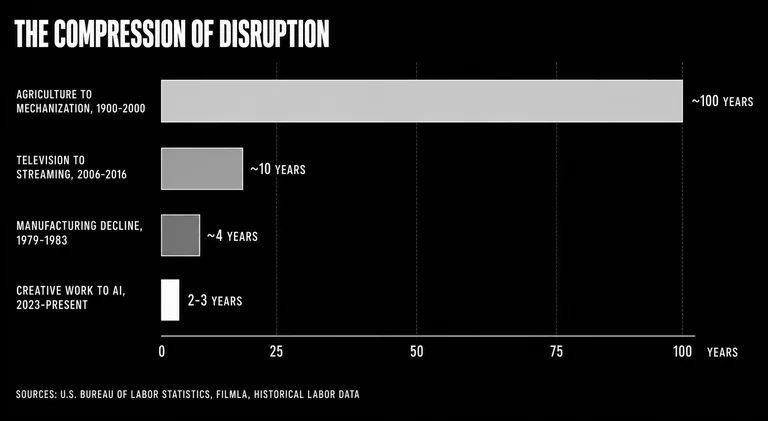
Occupational disruption at scale has a long history, and past transitions did resolve. U.S. farm employment fell from 41% of the workforce in 1900 to 1.9% by 2000, but that shift unfolded over a century. Manufacturing shed more than two million jobs between 1979 and 1983, over roughly four years. Music revenue moved to digital formats by the mid-2010s; film photography ceded to digital; internet publishing revenue surged past $100 billion by 2014. The pattern — rapid change, large reallocation, new winners — is not new.
What is different now is the velocity. Adoption-to-reduction cycles are compressing. Streaming shifted the scripted TV production model within a single decade; in 2015–2016, streaming and cable shows averaged about 9.5 episodes per season, compared with 20–24 for broadcast in the 1990s, per FilmLA data. AI tools began replacing discrete advertising and editorial tasks within two to three years of commercial availability. Prior disruptions allowed generational adaptation because the timeline permitted it. The current wave does not provide the same interval.
The most common failure mode: assuming that because disruption has resolved before, this one will resolve the same way on the same schedule. The precedents are real. The timeline is not the same.
How Is Automation Cutting Into Creative Work Specifically?
Automation is displacing creative professionals in two distinct ways — through direct task replacement, and through workflow consolidation that reduces headcount around automated tools. AI systems now generate copy, produce image variations, and run media-planning scenarios that previously required skilled, experienced humans. Organizations redesign roles around those systems and need fewer people to produce the same output. Forrester projects that by 2030 automation will displace roughly 32,000 U.S. advertising-agency roles — about 7.5% of the workforce — with copywriting, media planning, and related mid-career functions at highest risk.
The advertising sector is one data point. The Writers Guild of America has documented shorter engagements and longer gaps between projects as streaming restructured production. Fewer episodes per season mean fewer paid weeks, less predictable income, and reduced opportunity to build the track record that generates the next engagement. The creative workforce is not experiencing a uniform cut — it is experiencing a redistribution of work toward fewer, more generalist roles supported by tools that once required specialists.
The best practice for assessing your own exposure: map your current daily work against what existing AI tools can already do at acceptable quality. If more than 40% of your tasks fall into that category, your role is likely to be restructured within three to five years.
What Does Losing a Creative Career Actually Cost Beyond Income?
Job loss extracts more than a paycheck. A 2023 meta-analysis published in Frontiers in Psychology links unemployment to reduced social contact, a weakened sense of shared purpose, and disrupted time structure — the three elements psychological research identifies as central to well-being. A separate review finds that when work is central to identity, unemployment damages mental health more severely than when it is not. For career creatives who built professional identity around a craft and an institutional home, the collapse of that work is not simply a financial disruption.
This is where standard retraining advice fails. OECD data identify time constraints from work and family as the top barrier to adult learning, with direct costs ranking second. Recommending retraining to someone carrying caregiving responsibilities and a mortgage is not wrong — it is incomplete. The structural reality is that BLS data from 2021 to 2023 shows 38% of reemployed long-tenured displaced workers earning less than in their prior jobs. The average outcome of displacement is a step down, not a reinvention.
If your professional identity is tightly coupled to a specific role or title, the work of adaptation needs to begin before the role disappears — not after. The internal cost of waiting is compounded by the financial cost of urgency.
What Structural Barriers Actually Block Older Workers from Transitioning?
A 2022 National Academies consensus study identifies four structural limits on opportunity for older workers: age bias in hiring, uneven access to workplace training, caregiving responsibilities, and health factors. These are systemic patterns, not individual failures — and they constrain the available path regardless of motivation or capability. Layered onto the creative-sector contraction, they narrow the options further.
Age bias is documented and persistent. Training access is uneven by design: organizations invest less in developing workers they expect to retire sooner. Caregiving is not a personal choice that can be easily renegotiated. Health factors compound with age. None of these barriers are overcome by advising someone to be more adaptable. The most reliable approach is to address them before they converge — which means building parallel professional identities and broader networks while the current role still provides stability and cover.
Is This Just a Creative-Sector Problem?
No. The forces restructuring creative work are already visible in law, academia, and healthcare — fields long considered insulated by specialized expertise. Software absorbs discrete tasks; organizations redesign roles around those tools and reduce headcount; specialists tied to narrow skill sets find that every efficiency gain represents exposure. As of early 2026, AI tools are actively replacing first-draft legal research, administrative healthcare documentation, and entry-level academic content tasks. The creative sector is not a leading indicator. It is a preview of a pattern that will not stop at media and advertising.
What makes creative professions a useful case study is the speed of the transition and the visibility of the human cost. The workers affected are not abstractions. They are professionals with 20-year track records, active caregiving obligations, and professional identities built around work that no longer needs them at the same scale. Any field where work can be decomposed into learnable tasks and re-executed at lower cost is moving toward the same outcome on a compressed timeline.
What Moves Actually Help?
Three approaches have evidence behind them. First, build parallel professional identities before you need them. Research by Herminia Ibarra supports low-risk experiments in adjacent fields — small projects, freelance engagements, hybrid roles — that develop new options without requiring a full commitment before the current role ends. Identity shifts happen through action, not planning; you do not figure out who you are professionally and then start, you start and discover through the work. Second, inventory skills with cross-sector value: clear communication, project management, and analytical judgment transfer widely, but most people underestimate what they carry across an entire career. Third, build networks deliberately and beyond your current niche — before the moment of need, when contacts can be made from a position of strength rather than urgency.
There’s a parallel here to brand work, and it sharpens what “portable” actually means. In our work at Subverse, the brands that survive disruption are the ones understood for something durable: a clear point of view, a consistent way of operating, an identity that doesn’t depend on any single output. A brand whose recognition lives in its latest campaign spends meaning faster than it builds it; when the campaign ends, the recognition goes with it. A brand understood for what it actually is carries that meaning intact across every change in format, channel, and trend.
A career works the same way. A title is an output. Couple your professional identity to it and you inherit its expiration date. What stays legible through an occupational shift is the through-line underneath the title: the judgment you bring, the problems you can be trusted with, the way of seeing that holds across roles. The practical move is to make that through-line explicit now, while the current role still gives it a place to stand, so it reads as a coherent identity rather than a list of jobs the work has moved past. Skills become portable when they’re organized around something a person is understood for. Scattered across titles, they read as history.
At the policy level, mid-career transition programs, modular credentials, and subsidies that reduce the time and financial cost of retraining address the structural barriers that individual effort cannot. These do not yet exist at the scale the problem requires. Advocating for them matters. Waiting for them to materialize before taking action does not.
The right question is not what needs to change if your current role disappears. It is what you would build if you were starting from your skills instead of your title.
Conclusion
The disruption of creative work is not an event that will pass. It is a restructuring in progress, moving faster than the last one did, and it is not stopping at the industries where it started. Gen X creatives face it at the worst possible moment: when professional identity is established, financial obligations are at their peak, and the structural barriers to transition are most constraining.
The lesson is to move while there is still room to choose. Build the next professional identity alongside the current one. Treat titles as temporary and skills as portable. The same tools reshaping your industry are already reshaping every adjacent one — which means the window to position for what comes next is narrower than it appears.
Move early. The cost of starting is lower than the cost of waiting.