
Your organization means something. Inside the building, nobody has to be told what. The people who work there can explain it to each other in a sentence, because everyone in the room already shares the thing that makes it land.
The trouble starts at the door. The same sentence goes out to a donor, a customer, or a new hire and arrives thinner than it left. When 53 Bordeaux winery operators and 655 people outside the wineries answered the same 45 questions about the region’s shared brand, the two groups disagreed on 25 of them. This is one case from one region, but why brand meaning depends on your audience is visible in it. The description that left the building was accurate, and the frame that made it mean anything had stayed behind.
An object carries no meaning of its own
A product, a name, a visual identity, a list of services: these are objects. Each is a true description of something the organization does. None of them means anything on its own, because meaning is not a property an object can hold but an event. It happens when the object meets a person who already cares about something, and it takes the shape of that person’s existing cares.
The same page of services, read by three people, produces three readings. To one it is reassurance, to another noise, to a third a warning about what this organization will cost them. None of the three is misreading. Viewers on opposite sides of a conflict, shown the same news coverage of it, each judged the footage slanted against their own side, and the better informed saw more slant. One object produced two opposed readings, each defended as accurate, and the difference lies in what each reader brought. There is no version of the page that escapes this, and it is no flaw to engineer out; the reader’s frame is the medium the work happens in.
Why does the explanation work in the room and fail outside it?
Inside a conviction-driven organization, meaning feels self-evident, and the feeling is real, because everyone inside shares the frame that makes the objects legible. The mission statement reads as obvious because the people reading it already hold the conviction it names. This is the curse of knowledge, and it holds under pressure: the economists who named the bias found that market incentives shrink it without removing it.
Outside, that frame is absent; the objects travel without it, and the reader receives a set of accurate descriptions with nothing to attach them to. Nobody assigns meaning from zero. People understand a new thing by connecting it to something they already value, fear, or recognize. In 1972, Bransford and Johnson read people an accurate paragraph describing a familiar procedure without naming it. Listeners told the topic first recalled roughly twice as much as those given no topic, and rated the passage far easier to understand. The paragraph had not changed. The frame had. A message that supplies no attachment point is asking the reader to do the organization’s work, and readers, reasonably, decline.
This pattern lies behind the articulation gap and makes it a frame problem rather than a content one. A third group in the same experiment was told the topic only after the paragraph ended and recalled no more than the group never told at all; a frame that arrives after the objects does nothing. Another paragraph on the About page will not close the gap either, because it is one more object landing where the frame needed to be, and once it is named as a frame problem the gap can be worked on directly.
Doesn’t this hand the brand to the audience?
If meaning is made by the receiver, the objection runs, the organization is no longer the author of its own brand. The audience is. The organization’s job collapses into finding out what people already value and arranging itself to match, and that is how a point of view gets lost, one accommodation at a time. An organization built on conviction means what it means before anyone is listening, and no theory of reception should get to overrule that.
The objection is right about authorship and wrong about what authorship involves. The organization remains the author. But authorship happens in a medium, and the medium is the receiver’s mind, so attention to reception, far from being a concession to the audience, is how authorship gets done; a writer who ignores the medium has made marks on a page and written nothing.
Authority over meaning and attention to reception are not in tension. The second is how the first gets exercised.
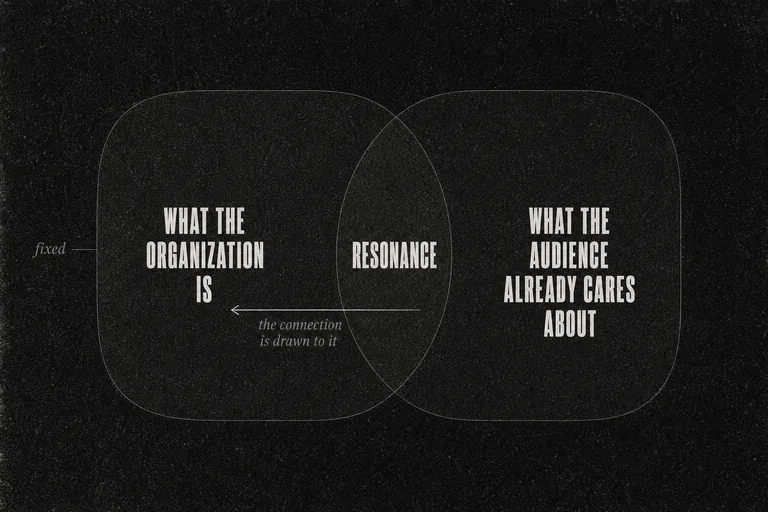
The focus group asks what people want to hear and builds a message to match, a different organization for every audience, and that practice deserves the suspicion it gets. The alternative runs the other way. It starts from what the organization is and asks what the reader would need to already hold for that to be understood, leaving the organization’s meaning fixed and building the connection to it.
Didn’t the strongest brands insist?
The strongest brands in living memory look like counterexamples. Rather than going looking for the meaning their audience was already holding, they insisted on a meaning the audience did not yet have, and the audience came to them. Look at what the insistence consisted of, though, and the counterexample dissolves, because those brands invented no care from nothing. They found one the audience already held that nobody had named, and they named it. Douglas Holt’s study of iconic brands found the same ground under them: each was built on a tension its audience was already living with, not on the benefits on offer. In Holt’s account the icons answered that tension with a story, and the story’s first job, the one this essay calls naming, is where the insistence was. One reviewer of Holt adds that the tension is easy to see once named and hard to specify beforehand, so the naming looks inevitable only in hindsight.
An organization cannot put a meaning into someone that has no place to land. It can find the place, and build the connection from there to what it is. The organization’s conviction goes into the second half of that work, and without the first half nobody outside receives it.
Resonance is not agreement
Resonance is the name for the moment the meaning an organization built meets a meaning the audience was already carrying. It asks less than it sounds like, requiring neither approval nor agreement.
An organization can resonate as the thing someone has been arguing against for years, because the reader knows exactly where it sits on a map they already have. What resonance requires is only that the connection is real, that the reader can locate the organization inside their existing sense of what matters. Whether they then move toward it or away from it is their decision. A brand that is understood has done its job either way, and that standard can be checked where approval cannot.
A catalog gets bigger; a subject gets clearer
When the explanation keeps failing outside the building, the instinct is to add: another service, another credential, another feature, until surely it will land. It does not, because the catalog was never the problem. Adding to a description that lacks a subject makes the object larger and the meaning no clearer.
| Describing the objects | Finding the subject | |
|---|---|---|
| Starts from | What the organization does | What the reader already cares about |
| Grows by | Accumulation toward completeness | Reduction toward the connection |
| Test of done | Nothing left out | Nothing the reader cannot place |
| Fails when | The list is long and still unclear | The connection is not real |
| Produces | An accurate inventory | A brand |
An organization that perfects its catalog has described its objects, and the description is probably true. An organization that finds the subject has a brand. Nothing forces a choice between them; a brand uses the catalog and refuses to stop there.
The conviction that formed inside the building stays as it is. What changes is how much of the receiver’s frame the organization takes responsibility for. The people who were not there when the conviction formed can still come to understand it accurately, which was the goal all along, and it is reachable.