

A brand’s messaging rarely fails because someone chose the wrong words. It fails because the brand never understood what its audience needed to hear. The failure is one of empathy, not craft. Design Thinking exists to prevent exactly that. It inverts the usual sequence: instead of deciding what to say and then hunting for an audience to say it to, it starts with the audience, builds genuine understanding of their reality, and works forward to meaning that resonates.
This article explains why messaging breaks down before a word is written, how Design Thinking’s five stages rebuild it around audience reality, and why coherence, not creative distinctiveness, is the measure that tracks brand health.
What You’ll Learn
- Why most messaging fails as an empathy problem, not a creative one
- What Design Thinking is and why it works as a discipline, not a workshop
- How each of the five stages translates into concrete brand-building work
- Why coherence, not distinctiveness, is the measure of brand health
- Why real prototyping is adversarial — and what happens when it isn’t
- How Design Thinking changes communication strategy
Why Does Brand Messaging Fail?
Messaging fails at the level of empathy. The brand knew what it wanted to say but never understood what its audience needed to hear, and no amount of rewriting fixes that, because the words were never the problem. The gap sits between what the brand assumed and what its audience actually experiences, and that gap is where messaging breaks.
Design Thinking is the discipline built to close that gap. It’s a structured, iterative approach to problem-solving that centers the end user’s perspective at every stage. In branding, that means building meaning from the outside in, starting with what your audience needs, believes, and experiences rather than what your organization wants to communicate. The process runs through five stages — Empathize, Define, Ideate, Prototype, and Test — each one designed to shrink the distance between assumption and reality. Brands that skip stages tend to produce work that reflects their own preferences instead of their audience’s, and that gap is where messaging problems begin.
Definition:
| Element | Content |
|---|---|
| Term | Design Thinking |
| Plain definition | A five-stage, user-centered approach to problem-solving that prioritizes audience understanding before generating solutions |
| Why it matters | Branding built on assumption erodes trust; branding built on genuine audience insight compounds it |
| Common confusion | Often treated as a creative brainstorming format rather than a research-led process |
Key takeaway: Design Thinking is a discipline, not a workshop. Its value comes from rigor in the early stages, not volume in the brainstorming stage.
What Are the Five Stages, and How Do They Apply to Brand Strategy?
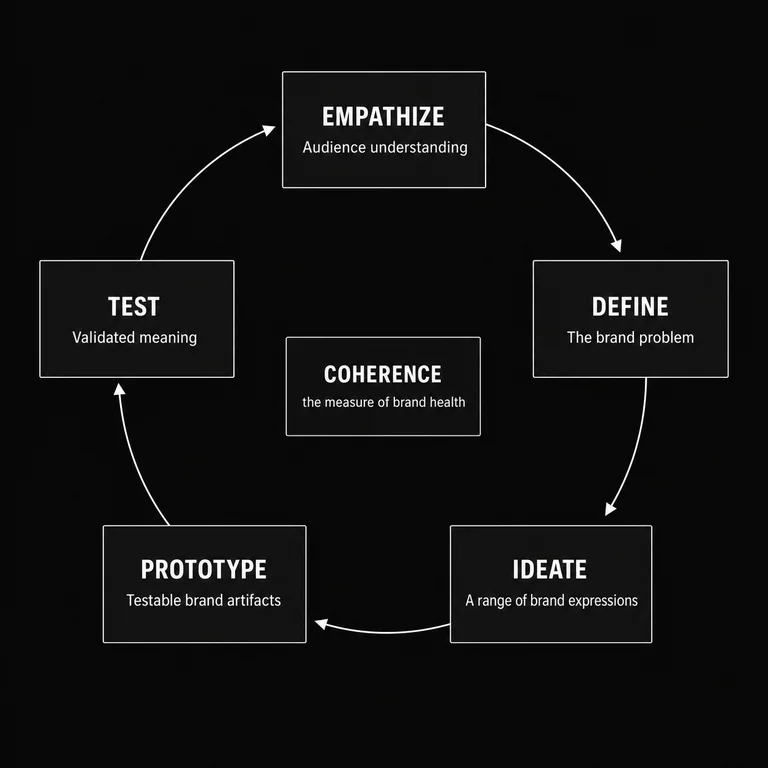
Design Thinking’s five stages map directly onto the core activities of brand strategy. Each stage generates outputs that feed the next, turning a series of disconnected decisions into a reinforcing sequence.
Empathize produces audience understanding, and it carries the most weight. Empathy is the foundation of Design Thinking because no brand can build meaningful signals without understanding the people those signals are meant to reach. The stage runs on direct research — interviews, observation, behavioral analysis — aimed at the audience’s actual needs, frustrations, and decision-making patterns rather than what a brand assumes those to be. Nike’s ability to build distinct meaning for pro athletes and casual runners at the same time didn’t come from creative instinct; it came from sustained investment in understanding how different people relate to sport, performance, and identity. The practical output is a set of user personas — not demographic profiles but behavioral and motivational models that answer one question: what does this person actually need from a brand like ours?
Define turns that raw material into a problem worth solving. The question shifts from “what do we want to say?” to “what does our audience need that we’re positioned to provide?” A well-defined brand problem produces a sharper value proposition — one that aligns what the organization does well with what the audience actually needs.
Ideate is where solutions emerge. Cross-functional teams — designers, writers, strategists, researchers, and where possible, customers — generate a wide range of possibilities for expressing brand meaning. The goal here is volume and diversity; the best ideas rarely come from the most obvious places.
Prototype converts ideas into testable form: visual concepts, messaging frameworks, naming directions, campaign ideas. Prototypes are meant to fail cheaply — the same principle holds whether the artifact is a brand concept or a user-centric product prototype built from research findings. A company testing three logo directions with real audience segments learns more in a week than it would from months of internal debate.
Test closes the loop. Real users interact with prototypes, and their responses — both what they say and what they do — reveal what’s working. Effective testing doesn’t ask users whether they like something. It asks what they understand, what they’d choose, and why.
Common failure mode: teams run one round of research, document it, and never return. Audience understanding becomes a static document rather than a living input, and brand signals drift from audience reality as the document ages.
Key takeaway: the five stages aren’t phases to complete and move past. They’re a cycle. Brands that return regularly to empathy and testing hold their meaning over time; brands that treat the process as a one-time exercise produce strategies that age badly.
How Does Subverse Use Design Thinking?
Design Thinking gives you a way to understand an audience. It doesn’t tell you what to build once you do. That second step is where our work starts.
At Subverse, we practice Narrative Branding: building the stable strategic framework underneath a brand (its point of view, the problem it exists to solve, the role it plays in people’s lives) so every signal the brand sends reinforces the same meaning over time. Design Thinking feeds that framework. The empathy stage surfaces what the audience actually experiences. The define stage names the problem the brand is positioned to solve. Testing shows whether the meaning is landing or drifting. The research is the input. The framework is what makes the output cohere.
This changes what the five stages are for. Run as a campaign engine, Design Thinking produces a better message: sharper, more grounded in research, truer to the audience. Run as a coherence engine, it produces something else — a brand whose signals agree with each other. We treat coherence, not distinctiveness, as the measure of brand health. A striking campaign that contradicts the last one spends meaning. A coherent one compounds it.
That is the practical difference between using Design Thinking to make brand outputs and using it to build a brand. The same five stages run either way. What you do with what they surface is what differs.
Here is how that played out in one engagement. A professional-services firm came to us convinced its problem was wording. The team had rewritten its homepage four times and still felt the message wasn’t landing. We started where Design Thinking says to start: with the people the firm was trying to reach. We interviewed their clients and listened for the moment each one decided to trust the firm. None of them mentioned the capabilities the homepage led with. What they remembered was a specific way the firm had handled a hard conversation early on — direct, unflattering, useful.
That reframed the problem. The firm had been answering “how do we describe what we do,” when the question its audience was actually asking was “can we trust these people to tell us the truth.” We named that as the problem the brand existed to solve and built the strategic framework underneath it from there.
Then we tested it. Rather than debate the new direction internally, we put two framings of the same idea in front of real prospects and watched which one they could repeat back accurately a week later. The version that led with the firm’s directness held; the version that led with expertise blurred into every competitor. We kept the one that survived contact with the audience. That is the empathy-to-test loop doing the work it is meant to do: it surfaces the meaning an audience already holds so the brand can reinforce it, instead of inventing a cleverer message to perform.
Why Is Real Prototyping Adversarial?
Two failure modes appear consistently in organizations that adopt Design Thinking without sustaining it, and both come down to avoiding discomfort.
The first is resistance to the empathy stage. Research is time-consuming and surfaces uncomfortable truths, so teams under deadline pressure compress or skip it, substituting assumption for data. The result performs the structure of Design Thinking without generating the insight that makes it useful. Bringing key stakeholders into the research early — having them observe interviews, engage with personas, and see the gap between internal assumption and audience reality — builds the buy-in that makes the rest of the process credible.
The second is treating prototyping as a validation exercise rather than a testing one. Teams build prototypes that reflect their preferred direction, then design testing to confirm it rather than challenge it. Real prototyping is adversarial: the goal is to find what’s wrong with an idea before committing to it at scale. Organizations that approach testing this way learn faster and produce stronger final work.
Key takeaway: if Design Thinking confirms everything the team already believed, the process isn’t working. Productive testing surfaces surprises.
How Does Design Thinking Change Communication Strategy?
Design Thinking changes communication strategy by shifting the starting point from message to meaning. Starting from user needs means segmenting the audience before developing communication, not after. Generalized campaigns work when an audience is genuinely homogeneous; for most organizations, it isn’t. Identifying distinct segments and developing communication specific to each one raises both relevance and response.
Narrative becomes more precise when it grows from audience insight. Dove’s “Real Beauty” campaign succeeded because it named something specific: the gap between the beauty industry’s representations of women and the reality women lived. That insight came from research — the truth produced the emotion, not the reverse.
Feedback loops keep communication strategies calibrated. Design Thinking treats audience response as an ongoing signal rather than a post-campaign metric. Organizations that build continuous feedback mechanisms — tracking real-time engagement, running post-launch interviews, monitoring where messaging lands differently across segments — can adjust before misalignment compounds.
Key takeaway: communication built on audience understanding creates a different kind of connection than communication built on organizational intent. The former earns trust; the latter asks for it.
Does Design Thinking Work in Practice?
IBM’s transformation offers the clearest large-scale example of Design Thinking applied to branding and communication. In 2012, IBM invested significantly in building a Design Thinking practice across the company, ultimately training more than 100,000 employees in the methodology. The objective was a fundamental shift from technology-centric communication to customer-centric communication.
The results were structural, not cosmetic. IBM simplified how it described complex products, rebuilt how customer-facing teams understood audience needs, and redesigned how it measured communication effectiveness. The outcome was a measurably improved brand perception among enterprise customers — a notoriously difficult audience to move.
The Forrester Research report commissioned by IBM (2018) found that organizations embedding Design Thinking into their strategy processes were 60% more likely to report improved customer satisfaction. Research by the Design Management Institute found that Design Thinking-led companies delivered roughly twice the shareholder returns of the S&P 500 over a 10-year period ending in 2015. Both figures should be read as directional rather than causal. Design Thinking correlates with better outcomes because it’s one component of a broader commitment to audience understanding and iterative improvement.
Key takeaway: Design Thinking produces durable results when it changes how an organization thinks, not just which tools it uses.
Conclusion
Design Thinking doesn’t produce a brand. It builds the conditions under which a brand can be built on something real. The methodology disciplines the process by forcing every decision back to a single question: what does the audience actually need?
That discipline is rare. Brand decisions are usually made from the inside out, based on what an organization wants to communicate. Design Thinking reverses the direction. The brands that understand their audiences most precisely — not just demographically, but behaviorally and motivationally — build meaning that holds up under scrutiny and compounds over time.
Start with the empathy stage. Not with a creative brief, not with a positioning exercise, but with research. What does your audience actually experience? Where does the gap between your current signals and their actual needs show up? That gap is where the work begins.