
A brand is more than its visual identity. It is the underlying system that determines how a business creates meaning, earns trust, and maintains relevance over time. When that system is weak or undefined, even the most ambitious marketing efforts produce mixed signals. Audiences sense the disconnect, and trust erodes before it ever forms.
Brand development is where coherence begins. Every decision a business makes about content, positioning, customer experience, and growth flows from this foundation. Yet most organizations treat branding as a project to complete rather than a system to maintain. That misunderstanding costs them clarity, momentum, and compounding advantage.
Why Brand Development Functions as a System
The most common mistake in branding is treating it as a fixed artifact. A logo is finalized. Guidelines are documented. The work is considered done. But brands exist in motion, not at rest. They encounter new markets, changing expectations, and evolving internal priorities. A static identity cannot absorb that change without fracturing.
Apple offers a useful example. Its brand has maintained remarkable coherence across decades of product evolution, market expansion, and leadership transition. The company has adapted continuously without losing the meaning that distinguishes it. Innovation, simplicity, and premium design remain legible in everything Apple does, even as what Apple does has changed dramatically.
This kind of durability requires treating brand development as a living system. The foundation must be solid enough to provide stability and flexible enough to accommodate growth. When both conditions are met, a brand can scale without diluting what makes it recognizable.
The alternative is reactive rebranding: expensive, destabilizing, and often a sign that the original work was never designed to last.
We call this work Narrative Branding, and the name matters less than what it commits us to. Narrative Branding is the practice of designing what a brand means and keeping that meaning coherent — so people can understand it, remember it, and act on it across contexts and over time. Outputs change. The structure underneath them holds.
We build that structure in four layers. Meaning settles what tension the brand resolves and what its audience has to believe. Language turns that into a working vocabulary — the claims and themes the content keeps returning to. Form is where interpretation gets shaped, in hierarchy, typography, and layout. Then Experience, which aligns behavior with the rest: what the website asks of someone, what happens when something goes wrong. Each layer is answerable to the one above it.
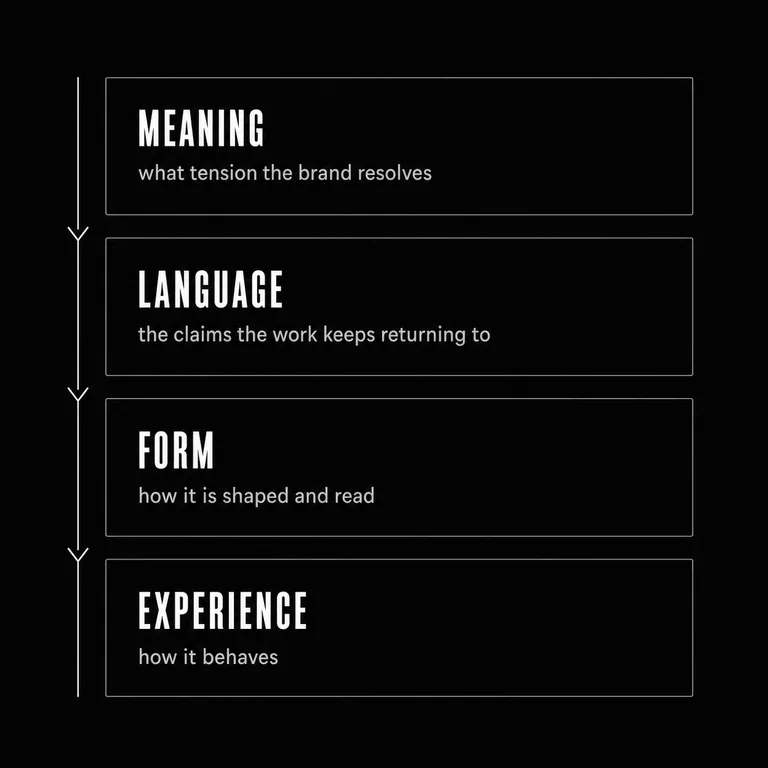
That layering is what makes a brand a system rather than a collection of assets. Assets are static. A logo cannot absorb a new market, and a style guide cannot settle an argument about what the company is for. A structure can, because it tells whoever is making the next decision what the brand already means.
How Brand Development Shapes Everything Else
Brand development does not operate in isolation. It sets the conditions for everything downstream.
When content teams create without clear brand guidance, their work lacks consistency. Individual pieces may be well-crafted, but they fail to reinforce a coherent meaning. Audiences receive mixed signals. Memory formation suffers. Trust builds slowly, if at all.
There is a mechanism under that. Kevin Lane Keller’s “Conceptualizing, Measuring, and Managing Customer-Based Brand Equity” (Journal of Marketing, vol. 57, no. 1, 1993) models brand knowledge as an associative network in memory. What a person holds is not a stored impression of a brand but a web of linked associations, and the brand becomes commercially worth something when those associations are strong, favorable, and unique. Inconsistent work does not simply fail to add to that network. It adds associations that compete with the ones already in it.
Jenni Romaniuk’s Building Distinctive Brand Assets (Oxford University Press, 2018) is the operational version of the same finding. An asset becomes distinctive by being used consistently, for long enough to build the memory link. Design quality is not what does it. Coherence is what lets repetition accumulate instead of cancel.
Search engine optimization depends on clear positioning. The way a business defines its purpose, audience, and value proposition determines keyword strategy, content architecture, and competitive differentiation. Without that clarity, SEO becomes a technical exercise disconnected from meaning.
Social media engagement reveals brand coherence in real time. Every post, reply, and interaction either reinforces or contradicts the identity a business claims. When brand development is underdeveloped, social teams improvise, and the resulting inconsistency becomes visible to everyone watching.
Inbound marketing converts attention into relationship. That conversion requires trust, and trust requires coherence. Audiences move toward commitment when they understand what a brand stands for and see that understanding confirmed at every touchpoint. Confusion produces friction. Coherence produces momentum.
Our own site is the cleanest test of this we have. In September 2025 it registered 130 search impressions for the month at an average position of 35.3, which is page three and effectively invisible. By May 2026 it was drawing 4,174 impressions a month, and by June the average position had moved to 10.5.
None of that came from technical optimization. What we built was a body of work rather than a content calendar, and those solve different problems: a calendar solves scheduling, a body of work solves positioning. We picked territory we could defend and wrote every piece from the same point of view. The systems thinking series is not a run of related topics. Each piece enters one way of seeing from a different angle — feedback loops, leverage points, delays, boundaries — and the criticism we write about marketing culture applies that same lens to a different object.
The visibility followed the coherence rather than producing it. Once the signals agreed with each other, the site could be read as authoritative on that territory because it was. We have watched that order hold in client work; here it ran on a property we control and can measure.
The Shift Toward Dynamic Brand Identity
Branding has undergone significant change in the past decade. The old model treated brand as a message pushed outward through advertising and public relations. Companies controlled the narrative. Audiences received it.
That dynamic no longer holds. Customers now participate in shaping brand perception through social media, reviews, direct engagement, and public discourse. Brand meaning emerges from the interaction between what a company signals and how those signals are interpreted, shared, and sometimes contested.
This shift rewards brands that approach identity as a system capable of dialogue rather than a script to be delivered. Responsiveness, authenticity, and adaptability have become operational requirements. Businesses that cling to command-and-control branding find themselves outpaced by competitors who understand how meaning actually forms.
Looking forward, the demands will intensify. AI-mediated interactions, immersive brand experiences, and personalized customer journeys will raise expectations for coherence across an expanding range of touchpoints. The brands best positioned to thrive are those building systems designed for that complexity now.
Strategic Positioning and Market Differentiation
Every business operates with a brand, whether it has been developed intentionally or not. The absence of strategic brand development does not create neutrality. It creates a vacuum that competitors and market forces will fill on their own terms.
Effective brand development establishes positioning that serves the business across multiple dimensions. A well-positioned brand can command pricing that reflects quality, expertise, or exclusivity. It can differentiate in crowded markets where products and services appear functionally similar. It can build emotional connection that translates into loyalty and advocacy.
Without that positioning work, businesses default to competing on price or convenience alone. Those are difficult battles to win and nearly impossible to sustain.
Scaling Without Losing Identity
Growth challenges brand coherence. Expanding into new markets, launching additional product lines, or increasing visibility all introduce complexity that can fragment identity if the foundation is not built to support it.
Some organizations fear that scaling will inevitably dilute their brand. That fear is reasonable but not inevitable. When brand development is approached as system design, growth becomes an extension of meaning rather than a threat to it. The core identity provides constraints that guide expansion while preserving what makes the brand recognizable.
This does not require massive upfront investment. A business can start with clear fundamentals: defined purpose, articulated voice, coherent value proposition. Those elements provide the structure necessary for evolution. Without them, growth produces entropy. With them, growth produces compounding clarity.
The three are easy to name and harder to finish.
| Element | What it settles | It is set when |
|---|---|---|
| Defined purpose | Why the organization exists, in language that holds up outside the building | Someone new says it in their own words instead of reciting it |
| Articulated voice | How the brand sounds when no one is reviewing the copy | Two writers file work that reads like one |
| Coherent value proposition | What the brand is for, and who it is for | Sales and marketing describe it the same way without coordinating |
The Psychology of Brand Meaning
Brands operate at the level of meaning, not just messaging. People do not simply purchase products. They adopt identities, align with values, and signal belonging through their choices. The brands that understand this create experiences that resonate beyond functional benefit.
Consider why customers develop loyalty that borders on advocacy. Patagonia’s audience is not merely buying outdoor gear. They are participating in environmental values and a particular relationship with consumption. Nike’s customers are not just purchasing athletic equipment. They are adopting a stance toward effort, perseverance, and self-improvement.
These associations do not happen by accident. They emerge from sustained, coherent brand development that connects purpose to experience at every point of contact. Businesses that neglect the psychological dimension of branding create forgettable transactions instead of meaningful relationships.
Scale is not what produces that attachment, though the examples above make it look that way. In our work the brands that earn it are the ones whose purpose, voice, and value proposition have been saying the same thing long enough that people can rely on it. That kind of agreement is available to a business of any size. The budgets behind the companies above are not.
Common Failures and How to Avoid Them
Brand development fails in predictable ways.
Inconsistent messaging is perhaps the most common. When different channels, teams, or campaigns communicate conflicting signals, audiences cannot form stable impressions. The brand becomes a moving target that no one can quite pin down.
Overemphasis on visual identity is another frequent mistake. A compelling logo and polished design system matter, but they cannot compensate for unclear positioning, undefined voice, or absent values. Visual identity without strategic foundation is decoration, not branding.
Reactive rebranding drains resources and erodes familiarity. Companies that rebrand without strategic clarity typically find themselves facing the same problems within a few years. The cycle continues until someone addresses the underlying system rather than its surface expression.
Failure to differentiate produces brands that appeal to everyone and resonate with no one. Trying to avoid alienating any potential customer often results in an identity too generic to attract genuine engagement.
Each of these failures traces back to the same root cause: treating brand development as a task to complete rather than a system to build and maintain.
Building Brand Development That Lasts
Brand development is the heartbeat of business growth. It shapes content strategy, customer relationships, scalability, and competitive positioning. It determines whether marketing efforts compound into lasting advantage or dissipate into noise.
The businesses that approach brand development as living system design position themselves for sustained relevance. They build foundations strong enough to support growth and flexible enough to accommodate change. They create meaning that audiences can understand, remember, and trust.
That is the test we hold our own work to. A brand system is finished when the team can use it without us in the room — when the question of whether something fits has an answer they can reach on their own. Decisions get lighter. The explaining stops.
If your brand development is not guiding your business, the market is guiding it for you. The strength of that foundation will determine everything else.