

The question marketers keep asking—are demographics still relevant?—is the wrong question.
Demographics haven’t become irrelevant. They’ve become insufficient. That’s a different problem, and solving it requires a clearer understanding of what each data type actually does, where it falls short, and what you lose when you treat them as substitutes for each other.
This article examines how demographics and psychographics function in audience analysis, why psychographic data can’t fully replace demographics, and what it takes to use both effectively in brand strategy.
What You’ll Learn
- How demographics and psychographics differ in what they measure and what they predict
- Why the shift toward psychographic data doesn’t make demographics obsolete
- Where each data type creates genuine strategic value
- What the combination of both enables that neither achieves alone
- How to apply this framework to practical brand and marketing decisions
What Are Demographics and Psychographics in Marketing?
Demographics are statistical data about population characteristics: age, gender, income, education, geography, household size, and occupation. Psychographics describe the psychological and behavioral characteristics of an audience: values, beliefs, attitudes, lifestyle patterns, and motivations.
The core distinction is between what people are and why they act. Demographics describe observable, verifiable attributes. Psychographics describe internal states that drive decision-making.
Both matter. They answer different questions.
| Data Type | What It Measures | What It Predicts | Primary Limitation |
|---|---|---|---|
| Demographics | Who the audience is | Market size, reach, purchasing power | Not why they buy |
| Psychographics | Why the audience acts | Motivation, preference, decision-making | Harder to collect at scale |
Key takeaway: Demographics and psychographics are not competing frameworks. They operate at different levels of the same question: who is your audience, and what moves them?
Do Demographics Still Matter in Modern Marketing?
Demographics remain essential, but their role has shifted. They are most useful for sizing markets, setting reach targets, and establishing baseline context. They are less useful for predicting what messages resonate or what drives purchase decisions.
For decades, demographic segmentation was the dominant framework in marketing. The logic was practical: age, income, and geography were measurable at scale, relatively stable, and strongly correlated with product categories and media consumption. Knowing that a product’s likely buyers were, say, homeowners in a particular age and income band was often enough to build a media plan and a product offering with reasonable confidence.
That correlation has weakened. Data fragmentation, shifting cultural norms, and the growth of individualized media consumption mean that demographic segments now contain wide variation in preferences and values. Two 40-year-olds with the same income and education level may have almost nothing else in common. McKinsey & Company’s Next in Personalization 2021 report found that 71% of consumers now expect companies to treat them as individuals, and 76% are frustrated when that doesn’t happen—an expectation that demographic averages, by their nature, can’t satisfy. Netflix made the point bluntly years ago: VP of product Todd Yellin told Wired in 2016 that “geography, age, and gender? We put that in the garbage heap,” and the company started grouping viewers into taste-based clusters that cut across demographic lines instead of predicting what they would watch from age and zip code.
This doesn’t make demographics worthless. It makes them a starting point rather than a strategy.
Demographics still determine things that psychographics can’t: regulatory requirements in healthcare and financial services, affordability constraints, physical accessibility, and language. A brand entering a new market still needs to understand the demographic composition of that market before it can do anything else.
Key takeaway: Demographics establish who can be reached. Psychographics help determine what will resonate. Removing demographics from the equation doesn’t add precision—it removes the structural context that psychographic data requires to be useful.
What Does Psychographic Data Tell You That Demographics Don’t?
Psychographic data tells you why people make decisions, not just what decisions they make. It surfaces the values, motivations, and belief systems that shape how an audience interprets a brand and whether they’re inclined to trust it.
Consider the limits of demographic data alone. Two individuals with identical demographic profiles—same age, income, education, and zip code—can have entirely different relationships to a brand depending on their values and identity. One prioritizes status and efficiency; the other prioritizes environmental impact and community. The demographic data predicts very little about how either will respond to a given message.
Psychographic data closes that gap by explaining the why behind behavior. It identifies which values an audience acts on, which anxieties they carry, and which aspirational identities they’re trying to embody. That understanding is what makes brand messaging feel specific rather than generic.
This is where psychographic insight directly supports brand strategy. Narrative Branding—building a coherent system of meaning that runs through every signal a brand sends—requires understanding what meaning the audience is already making, and what they’re looking for. Demographics tell you they’re 28- to 35-year-olds in urban markets. Psychographics tell you they measure success through experiences rather than possessions, distrust institutions, and make purchasing decisions based on brand alignment with their identity.
Those are very different strategic inputs.
Common failure mode: Brands invest in psychographic research, then use it primarily to inform creative tone rather than to reshape the underlying brand strategy. The language gets warmer or edgier, but the meaning stays the same. The result feels like a costume change rather than a genuine repositioning.
Key takeaway: Psychographic data is most valuable when it informs what the brand stands for, not just how it speaks. Using it only for messaging optimization understates its strategic potential.
How Do You Use Demographics and Psychographics Together?
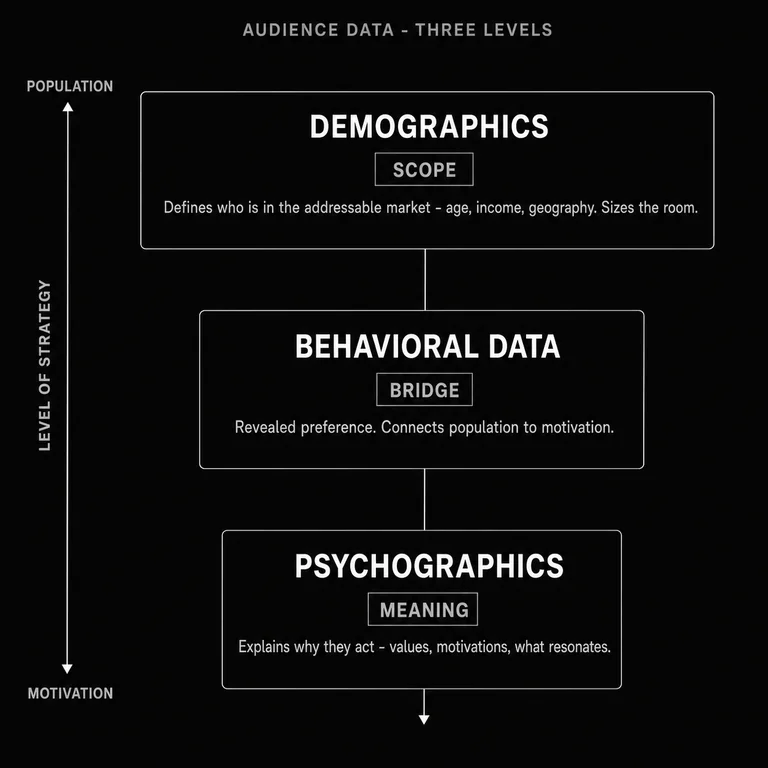
Effective audience analysis uses demographic data to define the population and psychographic data to understand what moves them. The two sets of information operate at different levels of strategy and require different approaches to collect and apply.
A practical framework for integrating both:
- Start with demographic scope. Define who is actually in your addressable market—the population for whom the product is relevant and affordable. This is the boundary condition. Psychographic targeting outside that boundary is waste.
- Segment psychographically within that population. Within your demographic scope, identify distinct clusters by values, motivations, and decision-making patterns. These clusters often cut across demographic lines in ways that matter for messaging and positioning.
- Test messaging against both. Demographics tell you whether you’re reaching the right people. Psychographic data tells you whether your message lands with the people you reach. A message that reaches the right demographic but doesn’t connect to their values will underperform on every downstream metric.
- Use behavioral data as the bridge. Purchase behavior, content engagement, and retention patterns are observable evidence of psychographic alignment. Behavioral data connects the population-level view (demographics) to the motivation-level view (psychographics) through revealed preference.
In our own work, integrating the two usually changes the decision rather than just informing it. A regional service brand came to us sure its next move was reach: widen the demographic target and pull in a younger band of buyers the data showed was large and underserved. The instinct was reasonable. The demographics backed it.
Then we mapped the psychographic clusters inside the audience the brand already had. The customers who stayed, referred others, and rarely negotiated on price weren’t grouped by age or income. They shared a particular conviction about why the category was worth paying for, and that conviction ran straight across the demographic lines the expansion plan was built on. Reaching more people in the target age band would have meant spending the budget on people who didn’t hold it.
So the strategy inverted. Same demographic scope, narrower psychographic focus. Instead of chasing a larger audience, the brand deepened its hold on the one already aligned with what it stood for. Demographics had sized the room; psychographics told us which people in it were actually listening.
Spotify’s audience strategy illustrates the integration. Age and location data determine which markets to operate in and which licensing arrangements to prioritize; its core listeners skew 18 to 34. Listening behavior and playlist patterns reveal the psychographic landscape on top of that scope: what people value, how they use music, what identity they’re expressing through their choices. The payoff is visible in the product. In Spotify’s own surveys, 81% of users name personalization as their favorite feature, and the Wrapped campaign reached 300 million engaged users in December 2025. Neither demographic scope nor psychographic depth alone would support personalization at that scale.
Key takeaway: Demographics and psychographics should inform different phases of audience strategy. Demographics scope the market. Psychographics explain the meaning the market is making.
What Are the Practical Limits of Psychographic Data?
Psychographic data is powerful but difficult to collect accurately, easy to misinterpret, and constrained by privacy regulations that are reshaping what brands can know about their audiences.
Collecting demographic data is relatively straightforward: age, income, and education can be inferred or directly collected with reasonable reliability. Psychographic data is more opaque. Self-reported values don’t always predict behavior. Survey responses reflect how people want to see themselves, not always how they act. Behavioral proxies—what someone watches, reads, or buys—are more reliable but require inference.
This creates a persistent accuracy problem. Psychographic profiles derived from behavioral data can capture patterns while missing the meaning behind them. Knowing someone watches documentaries, donates to environmental causes, and reads long-form journalism tells you something about their values, but it’s still a model of a person, not a person.
Privacy regulations add a structural constraint. The EU’s General Data Protection Regulation (GDPR, enforceable since 2018) and California’s Consumer Privacy Act (CCPA, effective 2020) changed what data can be collected, how long it can be retained, and what consent is required. Third-party data—the foundation of much large-scale psychographic segmentation—has become less available as platform policies tighten: Mozilla’s Firefox began blocking third-party tracking cookies by default in 2019, and Apple’s Safari, through its Intelligent Tracking Prevention feature, blocked them outright in 2020. Brands that relied heavily on third-party psychographic profiles are increasingly dependent on first-party data, which requires building the kind of direct audience relationships that generate it.
The implication: psychographic analysis works best when it’s built from direct engagement with actual customers—through qualitative research, community observation, and first-party behavioral data—rather than purchased profile data that approximates what you actually need to know.
Key takeaway: Psychographic profiles built from first-party data are more reliable than those derived from third-party sources. The brands with the most accurate psychographic understanding of their audiences are typically the ones with the deepest direct relationships with them.
Conclusion
Demographics and psychographics are not competing tools. They answer different questions at different levels of strategy.
Demographics tell you who your audience is and whether they can be reached. Psychographics tell you what they value and whether your brand connects to it. Neither is sufficient on its own. The combination, when used well, creates the kind of audience understanding that makes marketing feel specific rather than generic and brand-building feel coherent rather than assembled.
The question worth asking isn’t whether demographics are still relevant. It’s whether you understand your audience well enough to build meaning that holds together across every signal you send.
That’s the work. The data types are just tools for getting there.