

Most small businesses approach brand voice the wrong way. They treat it as a style preference—friendly or formal, playful or professional—when the real question is whether every signal a business sends reinforces the same meaning. Brand voice is not a tone filter. It’s the verbal layer of a coherent brand system.
This article explains what brand voice actually is, how to define it with enough precision to be useful, and how to sustain it across every channel without needing a dedicated marketing team.
What You’ll Learn
- Why brand voice is structural, not stylistic
- How to identify the audience your voice is actually built for
- What makes a voice guide functional rather than decorative
- How small businesses sustain consistency without large teams
- Common failure modes and how to avoid them
Brand Voice Is Structural, Not Stylistic
Voice is structural. It is the verbal layer of a coherent brand—the consistent personality a business carries across every communication, from website copy to customer emails to social media. For a small business it is also one of the few signals you fully control, and it shapes how audiences read credibility, relevance, and trust into everything else you do.
A distinctive brand voice does more than communicate information. It shapes how audiences interpret everything else about a business. When the voice is coherent, even a routine email from a one-person operation can carry the weight of a company twice its size. When the voice is inconsistent, audiences sense instability—even when they cannot articulate why.
Small businesses often assume that brand voice requires large teams or significant budgets to define and maintain. Neither is true. Voice is a choice, and choices can be documented, practiced, and refined without headcount.
Key takeaway: Brand voice is the verbal layer of a coherent brand. For small businesses, getting it right is less about resources and more about clarity of purpose and consistent execution.
What Is the Difference Between Brand Voice and Brand Tone?
Brand voice is the stable personality that stays constant across all contexts. Brand tone is how that personality adjusts to a specific situation—a customer complaint, a product launch, a casual social media post. Voice does not change. Tone adapts. Nielsen Norman Group’s Kate Moran, in “The Four Dimensions of Tone of Voice,” maps tone along four sliding scales (humor, formality, respectfulness, and enthusiasm) that move with the moment while the underlying voice stays fixed. The split is easy to see: the dials are tone; the hand on them is voice.
Think of it the way a person communicates. A skilled professional might speak directly and confidently in a boardroom, more warmly in a one-on-one conversation, and more playfully at a company event. The personality is the same. The register shifts to fit the context.
For small businesses, the most common mistake is treating tone variation as voice inconsistency. Adjusting how you communicate to fit a situation is not a failure of brand coherence—it’s what coherence looks like in practice. What should not change is the underlying set of values, the vocabulary preferences, and the way the brand frames problems for its audience.
Rule of thumb: If your voice sounds fundamentally different across channels, that’s a voice problem. If the warmth of a customer service response differs from the directness of a product description, that’s tone doing its job.
How Do You Identify Who Your Brand Voice Is Actually Built For?
Before defining a voice, a small business needs to understand who it is communicating with—specifically enough to make real choices. A voice built for “small business owners” is too broad to be useful. A voice built for independent contractors who distrust corporate language and respond to direct, practical advice is specific enough to guide decisions.
Audience clarity shapes every aspect of voice: vocabulary complexity, sentence rhythm, the degree of formality, and the kinds of problems the business chooses to address directly. A brand selling professional services to senior executives operates differently from one selling handmade goods to design-conscious consumers. Both differences are voice decisions.
Two practical steps produce useful audience clarity:
- Listen before you speak. Review customer emails, social media responses, and testimonials. The language your customers use when they describe your product or service is often the best guide to how your brand should speak.
- Build a specific persona. Not a demographic profile—a description of how a real person in your audience makes decisions, what they distrust, and what earns their attention. Write one. Make it specific enough to be useful.
Key takeaway: Audience clarity is not market research. It’s understanding how a specific person makes sense of what you do, and letting that understanding shape how you speak.
How Do You Actually Define a Small Business Brand Voice?
Defining a brand voice requires three concrete outputs: a vocabulary list, a writing principles statement, and real examples. Without all three, a voice guide is decorative rather than functional.
Start with what your brand is and is not. List five adjectives that describe your voice, then pair each with a counter-adjective that defines the boundary. “Direct” becomes useful when paired with “not blunt.” “Warm” stays functional when distinguished from “informal.” Without the boundary, the adjective is aspirational but not actionable. We call this the Boundary Method, and it is the part most voice guides leave out: define each trait as a pair—the quality you want, set against the failure mode beside it. The boundary is also what keeps the voice coherent. A trait with a boundary holds its shape when the tone shifts from a sales page to a support reply; a trait without one drifts a little with every sentence.
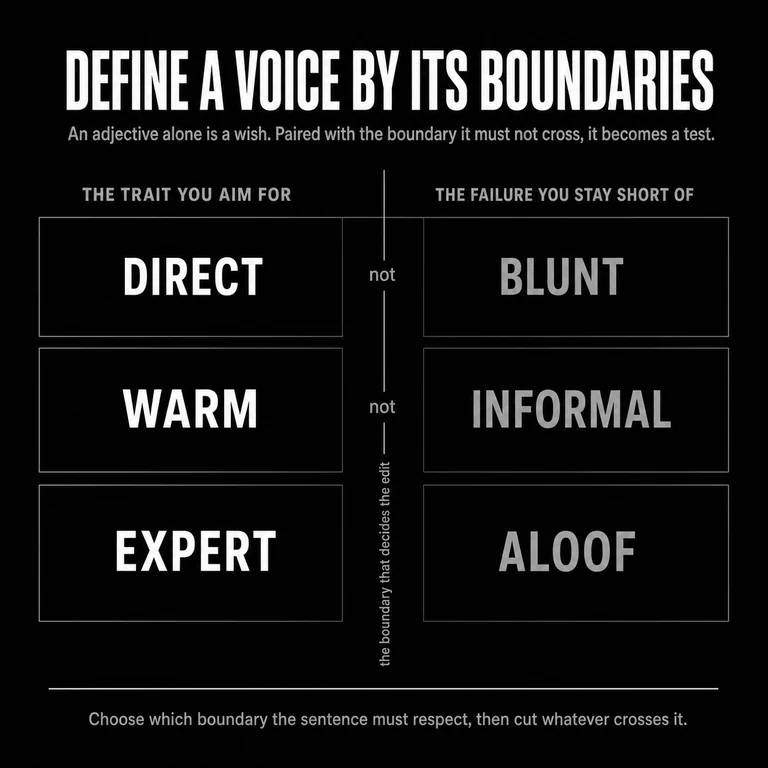
Build a short vocabulary guide. Identify the specific words your brand prefers—and the ones it avoids. If your business values expertise over approachability, “we advise” might serve you better than “we suggest.” If it values clarity over sophistication, short sentences do more work than elaborate construction. These are small decisions that accumulate into a recognizable voice.
The most important element is examples. For every principle, show what it looks like in practice. Not abstract guidelines—actual sentences. This is the step most small businesses skip, and it’s the reason most voice guides end up unused.
Here is the same principle applied to three sentences a small business writes all the time. In each case the boundary (the adjective and the counter-adjective beside it) is what decides the edit:
- Direct, not blunt. Before: “Unfortunately, we are unable to accommodate that request at this time.” After: “We can’t take that one on—but here’s what we can do instead.” The no stays direct; the alternative is what keeps it from landing as blunt.
- Warm, not informal. Before: “Hey! Thanks so much for reaching out, you’re the best!!” After: “Thanks for reaching out—glad you did. Here’s where things stand.” The warmth carries through. The exclamation points and over-familiarity that read as informal do not.
- Expert, not aloof. Before: “We suggest you might want to consider updating your plan when you get a chance.” After: “We advise updating your plan this quarter, and here is why it matters now.” “We advise” holds the expertise the hedged version gives away, without talking down to the reader.
None of these rewrites is longer than the original. The work is deciding which boundary the sentence has to respect, then cutting whatever crosses it.
Key takeaway: A functional brand voice guide defines principles and shows them applied. If you cannot write an example sentence that demonstrates your voice, the principle needs more work.
What This Looks Like in Practice
In our work, the difference between a voice guide that gets used and one that gets filed comes down to one thing: whether it was built from real decisions or borrowed adjectives. A client of ours, a small bookkeeping firm serving independent contractors, came to us with the borrowed kind. Their guide described the voice as “friendly, professional, and approachable.” Every word was true. None of it helped anyone write a sentence.
We rebuilt it with the Boundary Method. “Friendly” became warm, not casual: the firm respected its clients’ time and wasn’t going to pretend invoicing was fun. “Professional” became precise, not stiff. They knew their numbers cold and wanted that confidence to show without reading like a tax form. “Approachable” became plain, not chatty—short answers, no filler, the kind of clarity an anxious owner needs at tax time. Each pair turned a feeling into a test the team could actually apply.
The change showed up in the copy right away. Their services page had read: “We’re passionate about helping small businesses thrive and reach their full financial potential.” We rewrote it to: “We keep your books accurate and your filings on time, so you can stop thinking about them.” Same firm, same service. The first sentence performs warmth. The second demonstrates it, and it passes the plain, not chatty test the first one fails.
A reminder email gave us the second rewrite. It had opened with “We hope this message finds you well!” and three sentences of throat-clearing before the actual ask. The new version led with the point: “Your quarterly documents are due Friday—here’s what we need from you.” That is precise, not stiff on the page: it treats the reader’s time as the priority instead of opening with a script.
The outcome wasn’t a number we can put on a slide. It was that a two-person team stopped rewriting each other’s emails. The boundaries did the deciding. When the owner wasn’t sure a sentence fit, she had a test (is this precise, or just stiff?) instead of a feeling. That is what a voice guide is for: it makes the next sentence easier to write.
How Do Small Businesses Write Authentically Without Sounding Forced?
Authentic brand voice does not mean casual or confessional. It means the language a brand uses reflects genuine clarity about who it is and what it values—not a performance of friendliness, expertise, or relatability. The brands that sound forced are usually trying to signal something they have not yet decided to actually commit to.
Narrative is one of the most effective tools available. Not in the sense of brand origin myths, but in the sense that all strong communication places the audience in a situation, clarifies the stakes, and offers a direction. When a small business articulates a customer’s problem precisely before describing its solution, that precision signals understanding. Understanding builds trust without needing to announce it.
Where small businesses go wrong is in importing language from larger brands without adapting it. Corporate jargon distances audiences. Borrowed warmth reads as hollow. The goal is to find the register that fits—direct when the audience values efficiency, more expansive when they want to understand—and stay in it.
Key takeaway: Authentic voice comes from commitment, not performance. Decide what the brand actually values, and let that decision show up in every sentence.
How Do You Maintain a Consistent Brand Voice Across Platforms?
Consistency requires a reference document and a review habit—nothing more. Many small businesses assume consistency demands a full communications team. What it actually requires is that everyone who writes for the brand has access to the same examples and applies the same principles.
A brand voice guide that fits on two pages is more useful than one that fills a binder. It should cover core vocabulary, tone boundaries for different contexts, and at least three example rewrites—a before and after that shows the principles applied. Anyone who writes a customer email, a social post, or website copy should be able to apply it in under five minutes.
The review habit is what most teams skip. A quarterly check of recent communications—comparing them against the guide—catches drift early. Voice drift happens gradually. A word that slips in once becomes a pattern. A sentence structure borrowed from a competitor begins to appear consistently. Regular audits keep the system working.
Common failure mode: A business defines its voice once, publishes the guide, and never returns to it. Six months later, the communications sound like three different companies.
Key takeaway: Consistency is maintained by reference and review, not memory. A short, practical voice guide plus a quarterly audit is enough for most small businesses.
Conclusion
Brand voice is not a personality choice. It’s a structural commitment to how a business communicates its meaning across every channel it touches.
For small businesses, the opportunity is real and the barrier is lower than it appears. A clear understanding of your audience, the Boundary Method for how you speak, and consistent application across communications—that combination builds the kind of recognition that marketing spend cannot buy.
The brands that resonate are not the loudest. They’re the ones that know what they mean and say it the same way, every time.