

Demographic segmentation gave marketers a workable shorthand for decades. Sort people by age, income, and geography. Build a message for each bucket. Run the campaign. The logic was straightforward, and for a long time, it held.
It is holding less well now. Not because the data is wrong, but because it was never answering the right question. Demographics describe who someone is. They say almost nothing about what someone believes, what problem they are trying to solve, or what story they are already living inside. That gap between category and meaning is where demographic marketing keeps failing.
This article examines why demographic segmentation is losing effectiveness as a primary strategy, what has replaced it, and what the shift demands from anyone building a brand.
What You’ll Learn:
- Why demographic segmentation is a structural limitation, not just a tactical one
- How behavioral and psychographic data change what targeting actually measures
- Why the most effective segmentation targets meaning, not identity
- What this shift demands from brand strategy
What Is Demographic Marketing, and Why Did It Dominate?
Demographic marketing is the practice of segmenting audiences by quantifiable personal attributes age, gender, income, education level, geographic location, and household composition and tailoring messaging for each group. It dominated marketing strategy for most of the 20th century because those were the only reliable data points widely available.
When your primary information sources are census records, television ratings, and print circulation figures, you work with what you have. Demographics provided plannable, repeatable categories. A luxury car brand targets high-income individuals over 45. A children’s toy company focuses on parents with children under 12. A retirement fund runs ads during the evening news. The targeting was blunt, but so was the media environment. Mass reach required broad categories, and demographic buckets were the most accessible way to define them.
That logic made sense when data was scarce and media was centralized. It holds less well when you can know what someone read at midnight, what they searched for and then abandoned, what they purchased twice and what they returned, and what content they watched for four minutes before scrolling away.
Key takeaway: Demographic marketing was a rational response to limited data. Its limitations are structural, not incidental and they become more visible as better data becomes available.
Why Is Demographic Marketing Losing Effectiveness?
Demographic categories predict behavior less reliably than behavioral data does, because demographics describe a person’s position rather than their motivation. Two 45-year-old women with similar household incomes may make entirely different purchasing decisions based on values, life circumstances, and beliefs that their demographic profile does not capture.
The core problem is that demographics tell you what box someone fits into. They do not tell you why someone buys, what they are afraid of losing, what they are trying to become, or what narrative they are using to make sense of their options. A person’s age and zip code predict their life stage with moderate accuracy. They predict their motivations poorly.
The gap shows up even in the targeting demographics are supposed to be best at. Nielsen’s Digital Ad Ratings found that across computer and mobile, ads aimed at a specific age-and-gender audience reached the intended demographic only 63% of the time on average. A tool that misses its own stated target almost four times in ten is a weak instrument for predicting what moves a purchase: motivation. Comparisons of behavioral against demographic targeting bear this out, with behavioral signals outperforming demographics across most product categories. The exceptions are narrow: age-restricted products, income-constrained purchases, and services with genuine geographic constraints. Outside those cases, what someone does predicts what they will do next far more reliably than who they are on paper.
There is a cultural dimension here too. Consumers have become attuned to the difference between a message built for someone like them and a message built for them specifically. Messaging that reads as generic that addresses a demographic type rather than a person registers as indifferent. In an environment where personalization is both possible and expected, demographic targeting can actively signal that a brand does not know its audience.
Common failure mode: A brand identifies the right demographic profile, builds messaging around an aspirational identity associated with that profile, and wonders why engagement is flat. The category is right. The motivation is wrong.
Key takeaway: Demographics predict eligibility and category membership. They do not reliably predict motivation, belief, or readiness to act. That gap is where targeting fails.
What Has Replaced Demographic Segmentation?
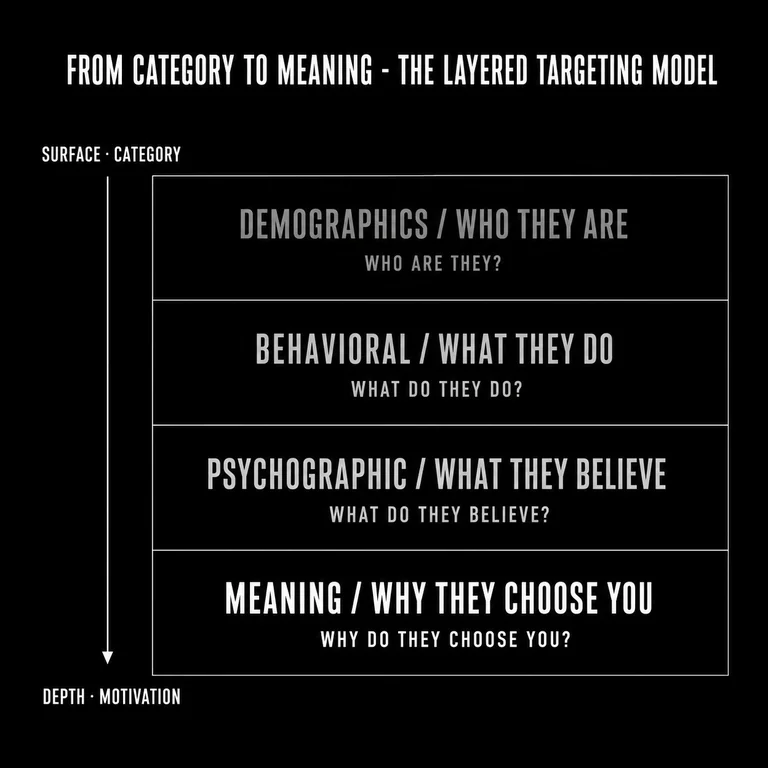
Behavioral and psychographic segmentation have largely replaced demographics as the primary signals in modern audience strategy though demographics still function as useful filters and constraints.
Behavioral targeting uses actual actions as its signals: what content someone consumes, what products they research, what sequences of behavior precede a purchase, and how someone engages after first contact. These signals are more predictive because they reflect current intent rather than stable identity. Netflix’s recommendation engine is not built around demographic profiles. It is built around viewing patterns, completion rates, and behavioral sequences. Netflix’s own engineers, Carlos Gomez-Uribe and Neil Hunt, reported in a 2015 paper in ACM Transactions on Management Information Systems that roughly 75% of what members watch comes from those recommendations, and that personalization and recommendation save the company more than $1 billion a year in retention. The result is personalization that feels accurate because it is drawn from behavior, not assumption.
Psychographic segmentation goes further, targeting by values, beliefs, attitudes, and lifestyle orientation. A psychographic approach asks not “who is this person?” but “what do they believe, and how does that shape what they want?” Two people with identical demographics and different psychographic profiles will respond to entirely different messages. Two people with different demographics and similar psychographic profiles may respond nearly identically. The targeting variable is orientation, not category membership.
The most effective current approaches combine all three. Demographics set the parameters and identify reach constraints. Behavioral data identifies intent and timing. Psychographic data shapes message and frame. Together, they do what demographic data alone could not: locate the person inside the category.
Definition: Psychographic Segmentation
| Term | Psychographic segmentation |
| Why it matters | Psychographic alignment predicts message resonance more reliably than demographic category membership |
| Plain definition | Targeting audiences based on values, beliefs, attitudes, and lifestyle orientation rather than demographic attributes |
| Common confusion | Often conflated with behavioral targeting; psychographics describe orientation, behavioral data describes action |
Key takeaway: Behavioral data tells you what someone is doing. Psychographic data tells you what they believe. Demographics tell you who they are. In most purchasing contexts, the first two are more predictive than the third.
Should Brands Abandon Demographics Entirely?
No. Demographic data plays a legitimate role in brand strategy but as a filter and constraint, not as the primary targeting signal.
Demographics remain useful in three specific ways. First, they define eligibility boundaries where those boundaries are real: age-restricted products, income-constrained purchases, and geographically bound services all have demographic parameters that matter. Second, they function as a reach benchmark knowing the demographic profile of your audience is relevant for channel selection and media planning even when it is not the primary targeting variable. Third, at scale, demographic data provides a useful sanity check on behavioral modeling. If a behavioral model produces an audience that looks implausible demographically, the model may be overfitting.
What demographics should not do is substitute for understanding. A brand that knows the age and income distribution of its audience but cannot articulate what those people believe, what they want, or what story they are living inside does not know its audience. It knows a census approximation of its audience.
If your primary targeting is demographic, ask what motivated the last 20 customers who found you most valuable. If the answer is not reducible to their demographic characteristics if the answer is about what they were trying to solve, what they were trying to become, or what they already believed before they found you then your segmentation is working at the wrong level.
Key takeaway: Demographics are a legitimate input, not a sufficient strategy. Use them to set parameters; use behavioral and psychographic data to define meaning.
What Does This Shift Mean for Brand Strategy?
The decline of demographic marketing as a primary strategy reveals something that was always true: the brands with the most durable audiences are not built on demographic proximity. They are built on shared meaning.
When demographic targeting works, it works because demographic categories happen to correlate with meaning clusters with groups of people who share values, priorities, or life circumstances. The demographic targeting is a proxy for the meaning alignment underneath it. When demographic targeting fails, the proxy broke down: the demographic box contains people with very different motivations who respond to the same message differently.
The goal is not to find the right demographic. The goal is to articulate a clear meaning a position, a set of values, a way of seeing something with enough precision that the people who already hold it can recognize themselves in it. Demographic data may help you find where those people congregate. Behavioral data may tell you when they are ready. But the meaning has to come first.
We see this in our own work. A client came to us with a sharp demographic picture of their buyers and flat results to show for it. They knew the age, the income band, the region. What they could not say was why anyone chose them over the option sitting right beside them. Once we stopped sorting their audience by attributes and started naming the belief their best customers already held, the targeting got simpler and the message got sharper. The people who shared that belief recognized themselves in it. The demographic data had been describing the crowd. The belief was what moved them.
Brands that build coherent systems of meaning, where every signal across every touchpoint reinforces the same understanding, attract audiences with genuine alignment. Those audiences are more loyal, more resistant to competitive offers, and more likely to bring others who share the same orientation. They are smaller than a demographic bucket and more valuable.
This is the work we call coherence, and it is the practice our Coherence Framework is built to govern. Coherence is the degree to which a brand’s signals agree with each other: strategy, language, design, and the way the brand behaves over time. When those signals align, people understand what a brand is for, and that understanding is what holds an audience together. Demographic data can tell you where similar people are sitting. It cannot tell you whether your own signals add up to something those people can recognize and trust. The Coherence Framework starts from that second question, because it is the one that decides whether an audience forms at all.
The question that demographic marketing could never answer was always the same: not “who is in our audience?” but “why do they choose us, and what does that tell us about what we actually represent?” Behavioral and psychographic data get closer to that answer. A clear, coherent brand narrative gets closest of all.
Key takeaway: Demographic data tells you where people are. Meaning tells you why they stay. Build for the second thing.
Conclusion
Demographic marketing is not disappearing. The data is too available, the systems are too established, and in some contexts it still does useful work. But its era as the primary language of audience strategy is ending not because the data is bad but because it was always measuring a proxy for the thing that actually mattered.
The most important question in brand strategy has never been “who is our audience?” It has been “what do they believe, and why does that make them ours?” Demographic data could approximate the first question. It could barely touch the second.
Build your audience strategy around meaning around the values, motivations, and beliefs that connect people to what you offer. Use demographics to find where those people are. Use behavioral data to know when they are ready. But start with a clear account of why they choose you. That account, made visible and coherent across every signal your brand sends, is the most durable segmentation strategy available.