
Your audience already knows. They read it off your pricing, your frame, your case studies — rudely, by implication, in the version where nobody had the nerve to say it out loud. That is the real alternative to telling customers who you don’t serve: not discretion, just a worse delivery of the same message. Saying it plainly does something the silence can’t. It brings the audience you claim back into line with the offer you actually have. The strongest version of the sentence is “not for you yet.” Said honestly, it works as a roadmap. Said as cover, it’s a softer way of saying never, and readers can tell the difference.
Why do brands stay silent about who they don’t serve?
The silence feels safe. Naming who you’re not for looks like closing a door in public, and closing doors costs customers. So the door stays propped open in the language while the offer shuts it.
That produces one of two readings, both bad. The first is false openness: the words welcome everyone while the price, the process, and the proof say otherwise. The second is accidental exclusion: a whole segment bounces off the frame and nobody decided they should. Either way the gap between what the marketing says and what the business does is already there. The only question is whether you named it or let the reader find it.
This is a coherence problem before it’s a marketing one. Coherence is the degree to which a brand’s signals agree with each other. A welcome that the offer can’t honor is two signals pulling in opposite directions, and audiences feel that contradiction long before they can explain it.
Refusing to name who you don’t serve doesn’t keep the door open. It just leaves the reader to infer your limits from your pricing and your portfolio, which they will.
Isn’t deciding who you don’t serve just basic positioning?
Choosing a narrow audience is established positioning practice. Saying it in public is the rarer move.
The internal decision has a long pedigree. Al Ries and Jack Trout built The 22 Immutable Laws of Marketing (1993) around what they called the Law of Sacrifice: the essence of positioning is giving things up, including a wider target market, to own a specific position. April Dunford’s Obviously Awesome (2019) makes the operational version of the same case, telling companies to position around best-fit customers, the ones who get the most value from what you do. Seth Godin’s idea of the “smallest viable audience” (2022) goes furthest: make the work specifically for a defined group, because work built to please everyone gets sanded down to average.
What none of that requires is telling people. You can pick your segment, build for it, and never state the boundary. The public act is a separate decision, and a steeper one. Youngme Moon’s Different (2010) describes the brands that take it: “hostile” brands that put up deliberate barriers to consumption and let the people they’re not for walk away on purpose. Patagonia ran the clearest example as a headline. Its “Don’t Buy This Jacket” advertisement, placed in The New York Times on Black Friday in 2011, told a slice of would-be buyers not to purchase at all. The strategy was internal; the sentence was public.
How is “not for you yet” a position rather than a brush-off?
“Not for you yet” is a falsifiable claim, and a falsifiable claim is one worth making. A position that cannot fail is decoration. “Not for you yet” can fail: either the smaller, cheaper, or simpler version eventually ships and proves the word, or it doesn’t and the honest move becomes dropping the qualifier and saying “not our market.”
“Not for you yet” is the rare brand promise that can be proven wrong. That is what makes it worth saying.
The phrase also tells three different people something true at once. It tells the excluded reader where they stand instead of letting them waste a sales cycle finding out. It tells the served reader that the brand knows its own boundaries. And it converts a vague class signal into a decision someone clearly made on purpose. The door was already shut for that buyer. “Not for you yet” puts a handle on it and a date on when it might open.
When is “yet” honest, and when is it a lie?
“Yet” is honest when a real intention and a real timeline sit behind it. It’s a lie when it’s a permanent soft no dressed up as a maybe.
The honest version has a famous template. In 2006 Elon Musk published “The Secret Tesla Motors Master Plan,” which laid out the sequence in plain order: build an expensive sports car first, use that money to build a more affordable car, then use that to build an even more affordable high-volume car. Early Roadster buyers were told, in effect, that the cheaper car wasn’t for everyone yet. Tesla then shipped the Model S and the Model 3. The “yet” was load-bearing because the company actually built the smaller instrument.
The dishonest version is the one software has a name for. Vaporware is a product announced and promoted as coming soon, then postponed again and again, and often never shipped. A “yet” with no roadmap behind it is the brand equivalent, and it carries a quiet penalty: when the smaller instrument never ships, the word stops meaning anything and so does the brand that kept using it.
| Honest “yet” | Dishonest “yet” | |
|---|---|---|
| Intention | A real plan to serve the segment later | No plan; “yet” softens a permanent no |
| Evidence | A roadmap, often with a date | Endless “coming soon,” no ship |
| Effect over time | Credibility compounds when it ships | The word, and the brand, lose meaning |
| Example | Tesla’s 2006 master plan → Model S, Model 3 | The vaporware pattern |
Key takeaway: The test for “yet” is simple. Point to the instrument you’re building for the people you’re turning away today. If there isn’t one, you mean never, so say never.
Why does naming a limit make the rest of your claims more credible?
Naming what you can’t do is a cost, and a cost is a signal. Research on communication finds that incurring an observable cost to send a message, including a cost to your own reputation or revenue, reads as a sign of honesty, because it’s hard to fake (Chaudhry and Wald, Current Opinion in Psychology, 2022). Turning away a buyer is exactly that kind of self-imposed cost.
There’s a related finding in consumer research. A study by Ein-Gar, Shiv, and Tormala in the Journal of Consumer Research (2012) found that disclosing a minor drawback alongside a product’s strengths can raise preference rather than lower it, under specific conditions: the negative has to be genuinely minor, it has to follow the positive, and the audience has to be processing casually rather than scrutinizing closely. The effect weakens or reverses when people evaluate effortfully. It’s real but bounded, so the lesson isn’t “admit weaknesses and win.” The lesson is narrower. A brand willing to say where it stops gives the reader a reason to believe it about everything it claims it can do. The brand that tells you plainly it can’t serve you at your scale is the brand you believe about everything else.
This is where the move pays a business owner back. You are not buying a clever line. You are buying coherence: the stated audience and the actual offer finally describing the same company. That alignment is the thing brand work is for, and it’s the foundation narrative branding is built to hold in place across every signal you send.
How do you audit the gap between who you welcome and who you can serve?
Run the gap directly. The point is to compare who your words invite against who your offer can actually satisfy, and to act on the difference.
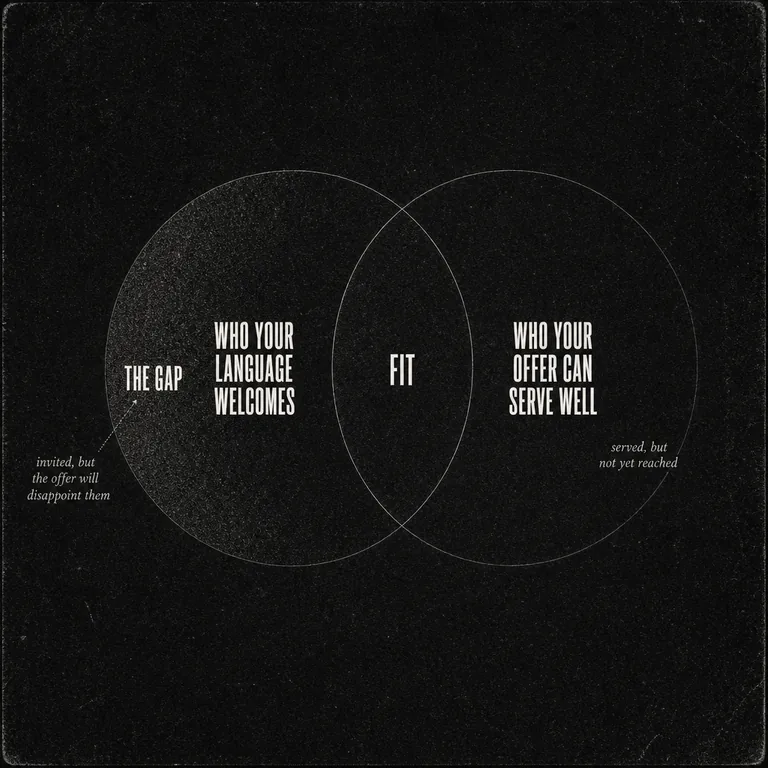
- Inventory who your language welcomes. Pull your homepage, your ads, and your onboarding copy. List every audience the words imply you serve, by use case, budget, skill level, and values.
- Map who your offer can serve well. List the segments you deliver real, differentiated value to, plus the conditions the offer genuinely needs: a price floor, a level of skill, a scale, a time commitment.
- Find the delta. Anyone in the welcome set but outside the serve set is the gap, a buyer your marketing invites and your offer will let down.
- Name the anti-persona. Anti-persona practice formalizes this: write down who you’re not for and why (“the buyer under this budget,” “the team that needs daily hand-holding”). Glocalities and others treat it as a focusing tool, not a way to actively turn people away at the door.
- Decide per gap: extend, narrow, or name it. Either build the offer out to serve them, narrow the language so you stop inviting them, or state the limit in public (“this isn’t for you if…”).
- Validate every “yet.” Where you say “not yet,” put the instrument you’ll serve them with on a roadmap. No roadmap, no “yet.”
Defining the audience well also means defining it by behavior and fit rather than flattering demographics, a distinction worth its own read on demographics versus psychographics.
When is naming who you don’t serve the wrong move?
It’s the wrong move when you don’t yet know your best-fit customer, when the exclusion is theater, or when it strays into who people are rather than what they need.
A company still searching for product-market fit can foreclose the very customers it would have learned from, so loud exclusion is premature there. The credibility effect also reverses when it’s performed: a brand striking a “we’re not for everyone” pose with no real cost behind it is making a fakeable signal, and discerning buyers read it as posturing. And there’s a hard line. Excluding people based on who they are rather than how they intend to use the work isn’t positioning, it’s a legal and ethical problem; keep any “not for you” rooted in fit and behavior, and get real counsel before it goes near anything else.
So name your floor when you know it and mean it. Don’t name it to look exclusive, and never name it in terms of who someone is.
What to do with this
Pick the one sentence you’ve been avoiding: the buyer you keep accepting and underserving. Decide which lever applies, then build the offer to fit them, narrow the language so you stop inviting them, or say “not for you yet” and put the instrument you’d serve them with on a roadmap. The pitfall to avoid is the empty “yet,” the one with no date and no plan, because it spends the credibility you were trying to build. If you want a second set of eyes on where your language and your offer have drifted apart, that’s the kind of gap a brand strategy engagement is built to close.