

A sales team hits its quarterly targets after management introduces a commission accelerator. Six months later, deal quality has cratered, support is buried under bad-fit clients, and three senior reps have quit. The incentive worked exactly as designed. The design was the problem.
This is what happens when organizations treat motivation as a lever instead of a system. The lever view says find the right reward, attach it to the right metric, and output rises. Sometimes it does. More often it introduces a distortion that takes months to surface and costs more to unwind than the original problem.
Workplace motivation runs on two engines. Intrinsic motivation is the drive that comes from the work itself: the engineer debugging code at midnight because the problem is compelling, the designer refining a layout because the craft matters. Extrinsic motivation responds to external signals like bonuses, titles, promotions, or the avoidance of consequences. Neither is superior by default. Both exist in every team, often in the same person on different tasks. What matters, and what most management advice skips, is the system surrounding them: whether the signals an organization sends reinforce one meaning or cancel each other out.
The Problem Most Managers Create Without Realizing It
Here’s where conventional management thinking breaks down. Organizations frequently treat motivation as a lever to pull rather than a system to understand. They assume that adding rewards will increase output, or that removing friction will unlock engagement. Sometimes that works. Often it creates new problems.
The research on this is not new, and it is unusually well replicated. In a now-classic 1973 field experiment, psychologists Mark Lepper, David Greene, and Richard Nisbett—reporting in “Undermining Children’s Intrinsic Interest with Extrinsic Reward” (Journal of Personality and Social Psychology, 1973)—found that children promised a reward for drawing, something they already did for fun, later spent far less time drawing than children who were never rewarded. They named the mechanism the overjustification effect. Edward Deci had documented a parallel result two years earlier, showing that paying people to work on puzzles they found genuinely interesting reduced how willingly they returned to those puzzles once the payment stopped. Decades of replication confirmed the pattern: Deci, Koestner, and Ryan’s 1999 meta-analysis of 128 experiments (Psychological Bulletin, 125(6), 627–668) found that tangible, expected rewards undermined free-choice intrinsic motivation with an average effect size of d = –0.40 for engagement-contingent rewards. When you introduce external rewards for tasks people already find interesting, you risk undermining their intrinsic motivation. The effect takes hold when the brain recategorizes an activity from “something I want to do” to “something I’m being paid to do.” The shift is subtle but consequential. Once work becomes transactional, the internal drive weakens.
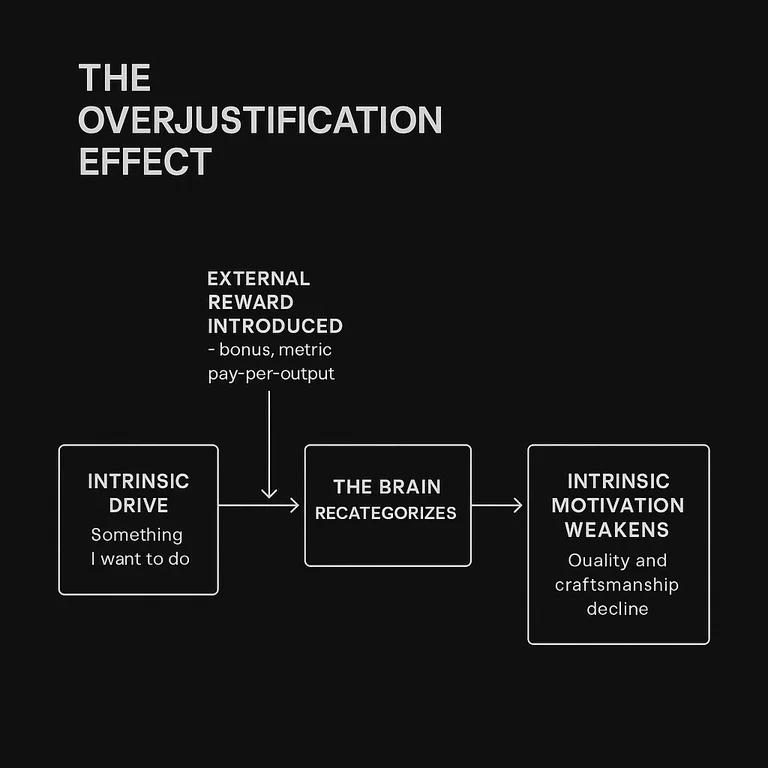
This dynamic explains why some incentive programs backfire. A software team that prizes elegant code might lose interest in craftsmanship when management starts paying per feature shipped. The metric becomes the goal, and the underlying purpose fades. Quality declines not because people care less, but because the signal system changed.
The inverse problem exists as well. Teams operating purely on intrinsic motivation can stall when external validation is absent. Without structure, recognition, or tangible markers of progress, even passionate people lose momentum. Motivation needs reinforcement, and that reinforcement can take many forms.
What Drives Performance When Intrinsic Motivation Is Present
When people are intrinsically motivated, several performance indicators improve measurably. Creativity increases because the focus shifts from completing the task to exploring possibilities within it. Persistence strengthens because setbacks become problems to solve rather than reasons to disengage. Job satisfaction rises because the work itself becomes the reward.
This pattern shows up across industries and roles. A 40-year meta-analysis by Christopher Cerasoli, Jessica Nicklin, and Michael Ford—“Intrinsic Motivation and Extrinsic Incentives Jointly Predict Performance” (Psychological Bulletin, 2014), drawing on more than 200,000 people across school, work, and physical settings—found that intrinsic motivation is a medium-to-strong predictor of performance, and that its importance holds whether or not external incentives are also in play. Intrinsically motivated employees exhibit more proactive behavior, demonstrate higher resilience under pressure, and achieve superior long-term outcomes. The mechanism is straightforward. When someone cares about the work for its own sake, they invest more attention, take more risks, and recover faster from failure.
Google’s 20% time policy serves as a useful case study. Employees spend one day per week on projects of their choosing, unrelated to their core responsibilities. The program has generated significant returns, including Gmail, Google News, and AdSense. These weren’t accidents. They emerged because people had permission to pursue problems they found intrinsically compelling, without needing to justify ROI upfront.
The takeaway is not that organizations should eliminate structure and let people work on whatever interests them. Most business problems require coordination, deadlines, and accountability. The lesson is that creating space for intrinsic motivation within those constraints produces outcomes that pure extrinsic pressure cannot.
When External Rewards Work (And When They Don’t)
Extrinsic motivation has its place. For tasks that are inherently uninteresting but necessary, external rewards can drive completion. Commission structures work well in sales because the activity itself often involves repetitive processes that few people would choose to do without financial incentive. Performance bonuses can push teams to meet short-term goals when urgency matters more than innovation.
The challenge is knowing when extrinsic motivation becomes a liability. Overreliance on external rewards creates dependency. People stop asking whether the work is worth doing and start asking whether it pays enough. This shift narrows focus. Instead of optimizing for quality, teams optimize for whatever metrics trigger the reward. In competitive environments, this can fragment collaboration as individuals prioritize personal achievement over collective outcomes.
The other risk is inflation. Once extrinsic rewards become expected, their motivational power diminishes. What began as a bonus becomes a baseline. The next incentive needs to be larger to generate the same effect, creating an unsustainable cycle.
Effective use of extrinsic motivation requires precision, and most incentive programs fail on at least one of three criteria. The reward has to match what the person actually values, which means asking rather than assuming. A recognition program where employees choose their own reward form (development budget, schedule flexibility, or cash) outperforms a uniform bonus because it meets individual drivers instead of averaging across them. The criteria also have to be published and applied consistently: what specific behaviors or outcomes earn the reward, visible to every person in every role. When the rules are informal or manager-discretionary, the system selects for visibility and politics rather than performance. And the rewarded behaviors must be the ones leadership celebrates publicly and tolerates privately, a coherence check explored below. When all three hold and the reward reinforces an existing intrinsic driver rather than substituting for it, extrinsic motivation compounds with intrinsic instead of competing against it.
| When extrinsic rewards help | When they backfire |
|---|---|
| The task is necessary but inherently dull — repetitive outreach, manual processing — work few would choose unpaid. | The task is already intrinsically compelling. Paying for it triggers the overjustification effect and erodes the internal drive. |
| Speed matters more than originality, and the goal is hitting a clear short-term target. | Quality and craftsmanship are the goal. The reward becomes the metric, and the underlying purpose fades. |
| Criteria are transparent and applied consistently, so people know what earns the reward. | Criteria are opaque or arbitrary, breeding resentment and confusion about priorities. |
| Rewards recognize collective success alongside individual contribution. | Rewards are zero-sum, pushing people to optimize for personal achievement over collaboration. |
| The reward complements an existing intrinsic driver — it reinforces, it doesn’t replace. | The reward substitutes for intrinsic interest, creating dependency: people stop asking whether the work is worth doing and start asking whether it pays enough. |
| Reward levels stay stable and meaningful over time. | Rewards inflate. What began as a bonus becomes a baseline, and each new incentive must grow to produce the same effect. |
Building Systems That Support Both Forms of Motivation
The most effective approach treats motivation as a system, not a switch. Different people respond to different inputs, and the same person may need different forms of motivation depending on the task, context, and timing. Managers who understand this build frameworks that allow both intrinsic and extrinsic motivation to coexist and reinforce each other.
The foundational work here belongs to psychologists Edward Deci and Richard Ryan, whose self-determination theory holds that intrinsic motivation depends on satisfying three basic psychological needs—autonomy, competence, and relatedness (Ryan and Deci, “Self-Determination Theory and the Facilitation of Intrinsic Motivation, Social Development, and Well-Being,” American Psychologist, 2000). Daniel Pink later popularized a workplace-friendly version of the same idea in Drive, framing the drivers as autonomy, mastery, and purpose. Autonomy means control over how work gets done, not just what work gets done. Mastery involves progress toward skill development and measurable improvement over time. Purpose connects individual effort to outcomes that matter beyond the immediate task.
Organizations can structure work around these needs without loosening accountability. Autonomy means defining the deliverable, the quality standard, and the deadline, then stepping back from prescribing the method. A manager who says “have the competitive analysis ready by Thursday, structured so the exec team can act on the first two pages” gives the person doing the work room to invest in the result. Dictating the research process and the template removes that investment before it starts.
Mastery is harder because it depends on feedback quality, not frequency. The SBI method (Situation, Behavior, Impact) gives managers a format that stays behavioral: “In Tuesday’s client call, you let the silence sit after the pricing objection, and the client talked themselves into the next tier.” That carries more development value than “great job on that call” because it names the specific behavior worth repeating.
Purpose connects at the task level. A team lead who opens a project by naming the specific person or outcome the work serves (“This audit determines whether the client renews, and that renewal funds the two roles we need to backfill”) makes the line between effort and meaning concrete enough to act on. Grand mission statements rarely do this. The connection has to be visible from where the person sits.
On the extrinsic side, effective reward systems share common features. They are transparent, so people understand what behaviors lead to what outcomes. They are fair, meaning the criteria for earning rewards are applied consistently across individuals and teams. They are balanced, recognizing both individual contributions and collective success to prevent competition from undermining collaboration.
The principle shows up in specific structural choices. Atlassian runs quarterly 24-hour hackathons called ShipIt Days: any employee, from last week’s hire to the CEO, drops regular work, forms a small team, and prototypes a solution to any problem they choose. Teams present three-minute demos at the end, and finalists compete for peer-voted awards including a customer-selected prize. The mechanism works because the reward (peer feedback, public visibility, occasional product adoption of a prototype) amplifies the intrinsic driver (solving a problem the person chose) rather than replacing it. Contrast that with a flat cash bonus for closing the most support tickets: same organization, same employees, but the second structure narrows focus to a count and kills the diagnostic thinking the first structure creates. The difference is not the presence of external incentives (ShipIt has awards) but whether the incentive points in the same direction as the internal drive or substitutes for it.
A Coherence Lens for Motivation
This is where our own work sharpens the picture. We run a narrative branding studio, and most of what we do is keep a system of signals pointed in the same direction so the people on the receiving end can trust what they’re seeing. Motivation inside a team is the same kind of system, so we read it through the same three properties we look for in any brand: coherence, resonance, and cadence. They work as a diagnostic rather than a motivational program: a way to see why drive leaks out before you start adding incentives to plug the hole.
Coherence is whether your signals agree with each other. That is a different thing from consistency. Consistency is doing the same thing on repeat; coherence is every signal reinforcing the same underlying meaning. A team feels the gap instantly when leadership says it values careful work and then rewards raw volume, or praises collaboration and promotes the person who hoarded the win. Those contradictions are where intrinsic motivation drains away, because people can’t commit to a target that keeps moving. What we’ve found is that most motivation problems are coherence problems wearing a disguise. Before you design a single incentive, list what you say matters, what you actually reward, and what you tolerate. The gaps between those three are your real diagnosis.
Resonance is whether the system connects to what people genuinely care about rather than what leadership assumes will move them. You can’t manufacture it. It is earned by staying relevant to the drivers people already have (the autonomy, mastery, and purpose described above) instead of bolting on rewards that compete with them. A bonus aimed at the wrong driver does more than underperform. It tells people you misread them, which costs more than the bonus was worth.
Cadence is the rhythm of reinforcement. Trust and motivation both come from a signal that shows up reliably, in recognizable form, often enough that people start to count on it. A one-time incentive is an event; recognition that arrives on a dependable rhythm becomes part of how the work feels. It is also why inflated rewards backfire. They break cadence, training people to wait for the next, bigger spike instead of trusting the steady signal.
Used together, the lens is practical. Diagnose for coherence first and fix the contradictions before spending on incentives. Tune for resonance by aligning rewards to the drivers people actually have. Then hold a cadence so reinforcement is reliable rather than dramatic. It turns “motivation as a system, not a switch” from a slogan into something you can actually audit.
We saw this play out with a mid-sized services firm we worked with on their brand. Leadership kept telling the team that thoughtful, original work was what set them apart. Internally, though, every performance review came down to volume — deliverables shipped, proposals sent, hours billed. The team read the real signal quickly. They stopped investing in the work that took longer but actually differentiated the firm, and started optimizing for throughput. Quality flattened. The best people, the ones who cared most about the craft, disengaged first.
When we mapped the signal environment, the diagnosis was immediate: a coherence failure. What leadership said they valued and what the reward structure actually reinforced were pointing in opposite directions. The team wasn’t unmotivated. They were responding rationally to contradictory signals — and the extrinsic ones won because those were the ones attached to consequences.
The fix was not a new incentive program. It was alignment. The firm restructured its review process around the work that actually drove client retention and referrals — depth of thinking, clarity of communication, client outcomes over a longer horizon. Volume didn’t disappear as a metric, but it stopped being the metric. Within two quarters the shift was visible: people were spending time on the hard problems again, collaborating instead of protecting individual numbers, and bringing ideas forward that had been sitting in drawers because no one thought they’d be rewarded for them.
That is the coherence lens in practice. The team’s intrinsic motivation had not gone anywhere. It was still there, underneath the transactional layer the incentive structure had built on top of it. Removing the contradiction did not create motivation. It stopped suppressing it.
Applying This to Your Team
Implementation begins with the coherence diagnostic described above. List what leadership says it values, what the reward structure actually measures, and what behavior gets tolerated. The gaps between those three tell you where motivation is leaking — and they tell you something more specific than “people aren’t motivated.” They tell you which signals are contradicting each other.
Once you see the gaps, the fixes are structural. Four places where most teams carry generic intentions that need to become specific practices:
Replace micromanagement with outcome-based check-ins. Define the deliverable and the deadline, then let people choose their methods. A weekly fifteen-minute standup where each person reports what they shipped, what’s blocked, and what they need — not how they spent their hours — gives managers the visibility they want without collapsing autonomy. The test is simple: can you describe what each person is responsible for delivering without describing how they should deliver it? If not, you’re managing process, not outcomes, and the intrinsic-motivation tax is real. The people who care most about their craft disengage first, because method is where craftsmanship lives.
Make the connection between individual work and organizational direction explicit in every one-on-one. Ask one question: “What part of what you’re working on right now connects to something the organization needs this quarter?” If the person can answer clearly, the signal path is intact. If they can’t, that’s not a performance gap — it’s a coherence gap. The work exists but the line between effort and meaning is invisible. Managers who surface this connection regularly don’t just improve motivation; they build the resonance layer — making sure the intrinsic drivers people already have meet something real in the organization’s direction.
Build a structure for productive failure instead of just tolerating it. Tolerance is passive. Structure is useful. Run after-action reviews within forty-eight hours of any significant miss, and separate the two questions that matter: “Was the decision process sound given what we knew?” and “What did we learn that changes the next attempt?” If the process was reasonable and the learning is real, name the failure as productive — publicly, in front of the team. This is where cadence matters. A single post-mortem is an event. A regular rhythm of them — same format, same two questions, same public acknowledgment — trains the team to treat failure as data instead of evidence of incompetence. The psychological safety research is clear on this: teams that report more mistakes outperform teams that report fewer, because reporting is a proxy for learning, and learning is a proxy for trust.
Audit the reward system against the coherence diagnostic, not against engagement survey results. Surveys tell you how people feel about incentives. The diagnostic tells you whether incentives are reinforcing or contradicting the signals leadership sends everywhere else. Three specific checks: First, for each reward criterion, ask whether it measures the behavior leadership publicly celebrates — or a different behavior entirely. Second, track what earns informal recognition (shoutouts in meetings, messages from leadership) and compare it to what earns formal rewards. If they diverge, people will optimize for whichever carries real consequences, and the other signal becomes noise. Third, look at the reward cadence — how often recognition lands and whether the interval is predictable. Sporadic, outsized rewards train people to wait for the spike. Steady, proportional recognition builds the reliable signal that compounds into trust.
The goal is not to pick the right incentive. It is to make the entire motivation system tell one story. Every signal — what you reward, what you tolerate, how you check in, how you respond to failure — either reinforces the same meaning or introduces contradiction. When people sense coherence across those signals, intrinsic and extrinsic motivation stop competing and start compounding. When they sense contradiction, no single incentive will compensate.
Measuring What Matters
Motivation cannot be managed without measurement, but the metrics matter. Employee satisfaction surveys reveal how people feel about their work and whether they perceive autonomy, mastery, and purpose in their roles. Performance data shows whether motivation is translating into outcomes. Retention rates indicate whether the motivational environment is sustainable over time.
One-on-one conversations provide qualitative depth that surveys cannot capture. They reveal individual drivers, surface concerns before they become turnover risks, and allow managers to tailor their approach to different team members.
The most important metric, though, is behavioral. Are people taking initiative? Are they investing in quality beyond the minimum required? Are they helping colleagues succeed even when it doesn’t directly benefit them? These signals indicate whether the motivation system is working at a deeper level than compliance or short-term output.
What This Means for How You Lead
Managing motivation requires more than applying frameworks. It requires ongoing attention to how people respond to different inputs, willingness to adjust when something isn’t working, and clarity about what tradeoffs you’re willing to make.
Some managers prioritize short-term results over long-term sustainability. They rely heavily on extrinsic pressure because it produces immediate output, even when it damages intrinsic motivation over time. Others overcorrect, creating environments so focused on employee satisfaction that accountability weakens and performance suffers.
The balance point is different for every organization, team, and moment. What works for a startup racing toward product-market fit may not work for an established company optimizing operations. What motivates a team through a crisis differs from what sustains them during periods of stability.
The constant is the need for coherence, the first property in the lens above. Your approach to motivation should align with your organizational values, reinforce the behaviors that drive your strategy, and adapt as circumstances change without losing its underlying logic. Resonance and cadence keep it honest over time: relevant to what people actually want, and reliable enough to be trusted.
Motivation is not a problem to solve once and forget. It’s a system to build, maintain, and refine. When you get it right, productivity follows naturally. When you get it wrong, no amount of pressure or incentive will compensate.