
When Knowledge Stops Differentiating
The collapse of technical labor is not the death of strategy. It is its rebirth. AI has erased the protective walls of scarcity — knowledge, execution, and data-driven insight have become infinitely replicable. The economics make this concrete: Stanford’s 2025 AI Index found that the cost of running a system at GPT-3.5’s level of capability fell more than 280-fold between November 2022 and October 2024. When capability gets that cheap that fast, it stops being a moat. What machines cannot do is choose what matters. They can mimic tone, but not conviction. They can present correlations, but not meaning.
Into that vacuum steps perspective: the human act of seeing the world through a particular lens, carrying contradictions, and staking judgment. As a general rule, when knowledge becomes a commodity, the thing worth paying for shifts from what you know to how you see.
What Makes Perspective Different from Knowledge?
Perspective differs from knowledge the way a compass differs from a map. Knowledge inventories facts; perspective chooses direction. Knowledge tells you what has happened; perspective tells you what it means and where it leads.
Knowledge is everywhere now — interchangeable, cheap, and available to anyone with a capable AI. The pattern predates the AI boom. Writing in Harvard Business Review, Clayton Christensen, Dina Wang, and Derek van Dever traced how the proprietary knowledge and standardized methods that once made consulting indispensable steadily commoditized: the classic high-end strategy work that defined the industry shrank from 60–70% of engagements to roughly 20% over three decades. Perspective is interpretation. It’s scarce because it’s built from lived experience, idiosyncratic observation, and the courage to commit to a claim. Insights decay as fast as markets shift. A strong perspective endures because it reveals the worldview through which change is navigated. It’s portable intellectual capital that travels across industries, contexts, and decades. Clients don’t invest in perspective for certainty. They invest in it for clarity in the fog of ambiguity.
The most reliable way to distinguish knowledge from perspective: knowledge can be replicated; perspective can only be built.
What Are the Elements of a Genuine Point of View?
Perspective is not polish or posture. It’s a composite of four elements that no algorithm can replicate.
The first is lenses: the mental models, metaphors, and heuristics that filter perception. Every distinct point of view begins with a characteristic way of framing problems. The second is context — meaning drawn from lived experience, culture, and history, the raw material machines cannot access. The third is idiosyncrasy: the quirks and contradictions that make a point of view recognizable and memorable. Generic analysis is forgettable; the strange, specific details are what stick. The fourth is courage — the willingness to commit to a claim, to be wrong in public, and to adapt with grace.
Together, these elements form not just a perspective, but a worldview: a way of engaging with reality that is both explanatory and aspirational. Lose any one of them and what remains is opinion, not perspective.
The most common mistake here is treating perspective as a presentation skill rather than a cognitive one. Perspective is built before the room, not in it.
How Do You Build a POV Engine?
A POV engine is the system that transforms observations and experience into portable, repeatable intellectual capital. It requires four components: deliberate inputs, a synthesis cadence, durable artifacts, and distinctive language.
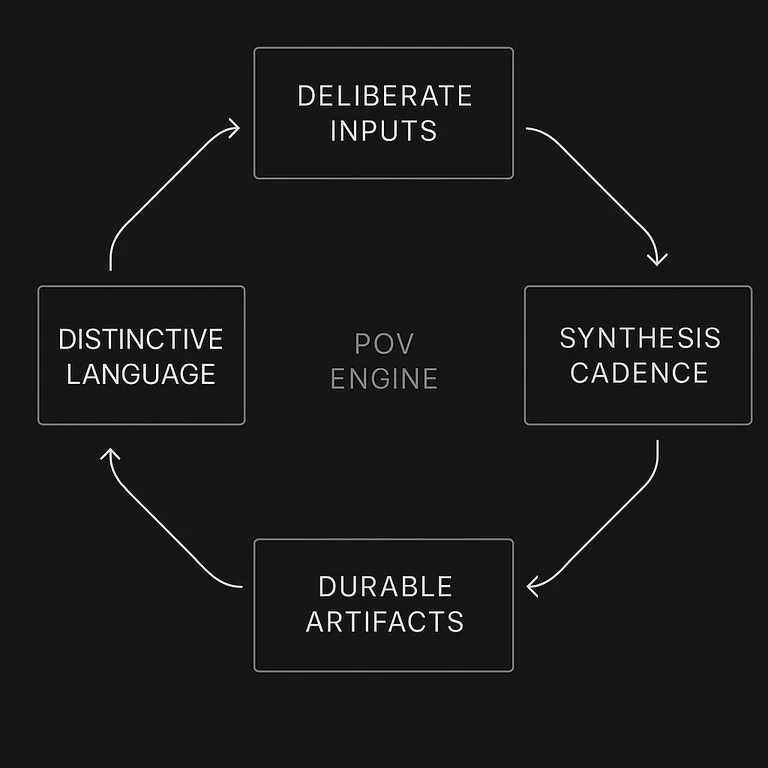
Begin with deliberate inputs rather than whatever crosses your desk. Three sources carry most of the signal: client conversations, project retrospectives, and the field itself — industry events, customer interviews, and the comment threads where your market argues with itself. Cadence is what makes them usable. Capture each observation within a day, while the detail is still sharp, in a single running log: the date, what you saw, and one line on why it might matter. Conversations, fieldwork, and direct observation give you raw material no dataset can supply, but only if you catch it before memory smooths it into something generic.
Set a fixed time to make sense of what you’ve gathered. Once a week, read back through the log and write a short synthesis memo against a standing template: the pattern you’re seeing, the evidence under it, why it matters now, and the bet it implies. Four headings, one page, every Friday. The schedule is the point. The discipline of regular synthesis is what separates advisors who have interesting thoughts from those who hold a coherent point of view. A pattern that survives four weeks of memos is no longer an impression; it’s a position.
Distill those memos into artifacts a client can hold onto. The workhorse is the one-page diagnosis: the situation, the tension nobody is naming, the implication, and the recommended bet, in that order, on a single page. The constraint does the work, forcing the cut from everything you know down to the one thing that changes the decision. A diagnosis that fits on a page travels into rooms you will never enter.
Name what you find. When a pattern recurs across several diagnoses, give it a label: a short, memorable phrase like “the commodity trap” or “borrowed conviction” that compresses the idea into something repeatable. Language is the mechanism by which your lens reshapes others’ worlds. When clients start using your term in a meeting you are not in, your perspective has become part of how they think.
We run a version of this engine at Subverse, where the work is helping organizations build and hold a coherent point of view. In our practice a brand is a perspective made structural: the worldview through which every signal an organization sends either reinforces the same meaning or pulls against it. Most of the brands we work with already know who they are. What they lack is the discipline that turns that knowing into something that holds under pressure and travels across the organization without drifting. The synthesis cadence and the named patterns do that work. They are how a point of view stops being private conviction and becomes shared infrastructure — the difference between a brand that has to explain itself and one that doesn’t.
Deliver perspective where choices are made: boardrooms, strategy memos, operational standups. Perspective unseen is perspective unpaid.
How Should You Price and Package Perspective?
If perspective is the new margin, its value must be structured accordingly — which means moving from deliverables to direction. Clients are not buying slides. They are buying clarity and conviction.
Outcome-linked pricing reflects this: charge not for hours spent, but for the bets your perspective enables. Ongoing interpretation is more valuable than one-off analysis. Perspective is a service of continuity, not punctuality, which is why retainers for ongoing attention outperform project-based engagements when the work is fundamentally about judgment.
If the value you deliver is primarily informational, commodity pricing is appropriate. If the value you deliver is fundamentally interpretive, price it as intellectual capital, not as labor.
What Does It Mean to Go Gonzo with Guardrails?
Perspective requires subjectivity, and with it, exposure. Going “gonzo” means embracing bias and contradiction as features, not flaws. But subjectivity without discipline is indulgence. The guardrails that preserve credibility are not limitations on perspective — they’re what make it trustworthy enough to act on.
Show your receipts: the data, the field notes, the scars. Sketch how A leads to B, however provisional. Steelman objections before they arrive. State what to monitor, when to adapt, and how to pivot. These are not hedges. They’re evidence that your perspective has been stress-tested.
A discipline, not a declaration. That’s the difference between a strong point of view and an exposed opinion.
Conclusion
Execution is automated. Insight is commoditized. What remains is judgment — the leap into subjectivity that no machine can take on your behalf. To build something durable in that environment means risking your own worldview: consciously subjective, idiosyncratic, and courageous enough to be tested in public.
The choice is not subtle. Flattened or future-proof? In an era of abundant knowledge, the only defensible margin is perspective. Those who build it deliberately will not merely survive. They will define the horizon others navigate by.