

We want to believe the brands that seem to care. In the moment, their words sound right. The tone matches the cultural mood. The message feels sincere. For a while, it seems like they’re part of something bigger than business.
But time reveals intent. What begins as connection hardens into strategy. The sincerity that felt real starts to sound rehearsed. And audiences, even when they can’t articulate why, feel the shift.
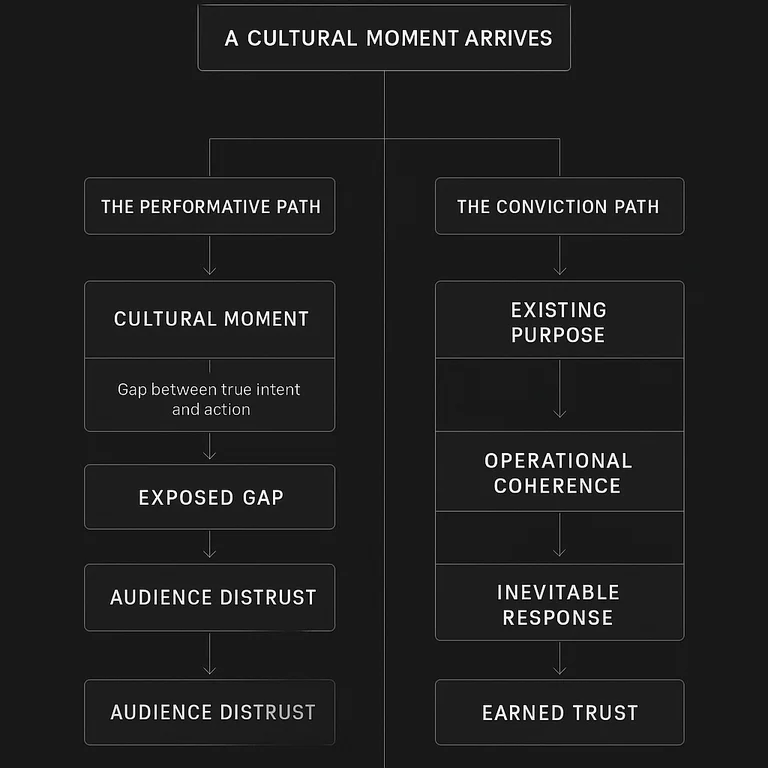
This pattern repeats because most brands misunderstand how meaning works. They treat cultural moments as opportunities to attach themselves to emotion rather than express something they already believe. The result, often refered to as performative branding, is a gap between what a company says and what it stands for. That gap may not be visible at first, but it grows.
Two Cautionary Examples
Dove’s “Real Beauty” campaign, when Unilever launched it in 2004, looked like progress. Built on The Real Truth About Beauty: A Global Report, a 2004 study led by Nancy Etcoff and Susie Orbach that found only 2 percent of women described themselves as beautiful, it set out to challenge narrow beauty standards and reshape the conversation about how women see themselves. For a moment, it felt like a meaningful shift.
But the campaign never evolved as the world did. What started as a gesture toward something real became a formula. The message stopped growing. The feeling stopped ringing true. The brand kept saying the same thing long after the world had moved on, and what once felt like leadership began to feel like repetition.
Pepsi made the opposite mistake. Its 2017 “Live for Now” ad, which echoed the imagery of Black Lives Matter protests, was not subtle or stagnant. It was brazen. The ad collapsed a deeply painful social moment into a stage set, complete with lighting and choreography, as if justice could be achieved through product placement. The result was not unity but alienation. The image of Kendall Jenner handing a Pepsi to a police officer became shorthand for the way marketing can flatten meaning into decoration, and as NPR reported the following day, Pepsi pulled the spot and conceded it had “missed the mark.”
Both examples point to the same underlying failure. When empathy becomes aesthetic, care turns into currency. Emotion without conviction cannot hold. Audiences feel the gap between signal and substance, even when they lack the vocabulary to describe it.
The Question Every Brand Must Answer
How does a brand participate in the world without exploiting it? How can it respond to cultural moments without pretending to belong to them?
The answer lies in reflection, not reaction. A brand that knows who it is does not need to borrow emotion. It recognizes when the world is already speaking its language. That recognition is the difference between presence and performance.
This kind of awareness requires something most brands avoid building: a clear, durable sense of purpose that exists before the cultural moment arrives. Not a tagline. Not a mission statement written by committee. A genuine understanding of what the brand believes and why it exists, expressed through every signal it sends.
What Coherent Conviction Looks Like
Patagonia can speak about the climate because its entire structure depends on caring for it. In 2011, it ran a full-page ad in The New York Times on Black Friday that read “Don’t Buy This Jacket,” detailing the environmental cost of producing a single fleece. The company’s supply chain, its product decisions, its willingness to tell customers not to buy things they don’t need, all reinforce the same meaning. When environmental issues rise in public consciousness, Patagonia does not scramble to find a position. It is already standing where it has always stood.
Ben & Jerry’s operates the same way. The company can talk about justice because it has spent decades doing the work behind the message. In 2015, ahead of the United Nations climate summit in Paris, it launched its “Save Our Swirled” campaign, pairing a new flavor with a petition — which ultimately gathered over 3.5 million signatures — pressing world leaders to commit to 100 percent clean energy. Its relevance was not manufactured in response to a trending topic. It was earned through consistent action over time.
These brands do not borrow conviction. They express it. And because their systems reinforce their meaning, their responses to cultural moments feel inevitable rather than opportunistic.
Building from the Inside Out
The real path forward is structural, not reactive. This is what Narrative Branding is built to produce, and it follows a specific sequence, not a set of aspirations.
First, map the signals. Every brand sends them constantly: language, visual identity, pricing, hiring practices, partnerships, customer experience, the decisions that happen when no one is watching. Most organizations have never cataloged what they are actually communicating across all of these channels at once. The inventory alone is clarifying. It shows where signals agree with each other and where they contradict.
Second, extract what the brand is actually claiming. Not the tagline or the mission statement committee language, but the position implied by the full signal set. When you read every signal together, what story does the brand tell about itself? Often, what the brand thinks it is saying and what the signals collectively communicate are two different things.
Third, test for the word–action gap. For each signal category (messaging, operations, design, experience), compare the claim against the behavior. Where they diverge is where performative risk lives. Most brands skip this step because it requires asking uncomfortable questions: does the pricing model contradict the stated values? Do the internal communications carry the same tone as the external ones? Does the hiring process reflect the culture the brand promises?
Fourth, align the signals to the meaning, starting with the highest-visibility ones: the signals audiences encounter first and remember longest. The goal is not consistency for its own sake. Consistency repeats; coherence reinforces the same underlying meaning across different signals. That reinforcement is what builds trust.
Fifth, reinforce through cadence. Coherence compounds through return — the experience of a brand showing up repeatedly, in recognizable form, often enough that its presence becomes expected. A single alignment pass is not enough. The signals have to hold under pressure, across time, through the decisions that test whether the organization meant what it said.
We see this in our work all the time. An organization comes in with genuine conviction — they care about something real, and they want their brand to reflect it. But when a cultural moment arrives that touches what they care about, they freeze. They don’t know how to respond without sounding like everyone else responding. Their instinct is right, but the infrastructure to act on it doesn’t exist yet. So they either say nothing, or they produce something that sounds borrowed: the same cadence and vocabulary and emotional register as every other brand weighing in that week. They haven’t built the system that would make their response distinctly theirs.
What changes that is the structural work described above: the signal inventory, the gap test, the alignment sequence, all executed long before any cultural moment arrives. When the signals are mapped, the gaps are surfaced, and the alignment holds across operations, language, and experience, response stops being a scramble. The brand doesn’t manufacture relevance. It notices where its meaning already intersects with what’s happening in the world.
Relevance earned this way is harder to lose. It does not depend on catching the right moment or saying the right thing. It depends on being the same thing, again and again, while the world keeps moving.
That is what separates brands that participate in culture from brands that exploit it. Not a single moment of resonance, but the quiet consistency of showing up with coherence, over time, in ways the audience learns to trust.