
AI was supposed to take work off your plate. For a lot of knowledge workers, it put more on.
A survey of nearly 1,500 full-time U.S. workers, conducted by Boston Consulting Group and the University of California, Riverside, found that 14 percent of employees now experience what researchers are calling “AI brain fry” — mental fatigue from excessive interaction with AI tools that exceeds cognitive capacity. Workers with brain fry reported 33 percent more decision fatigue and 39 percent more major errors than their peers. Not typos. Substantive mistakes in analysis and judgment.
The fatigue isn’t emotional. It’s cognitive. Working memory is running out before the workday does.
What You’ll Learn
- Why AI tools expand workloads instead of reducing them, based on two major 2026 studies
- How constant AI oversight drains working memory and degrades decision quality
- What “brain fry” looks like in practice and which roles it hits hardest
- Why high performers burn out on AI first
- How to build an AI practice that doesn’t outrun the body’s capacity to keep up
Why Does AI Make Us Work More Instead of Less?
AI doesn’t reduce work — it intensifies it. That’s the central finding of an eight-month ethnographic study by UC Berkeley Haas researchers Xingqi Maggie Ye and Aruna Ranganathan, published in Harvard Business Review in February 2026. The researchers embedded at a 200-person technology company where employees had broad access to generative AI tools. They conducted over 40 interviews and observed daily workflows in real time.
What they found was a pattern of voluntary escalation. Employees worked faster, took on broader tasks, and extended work into more hours of the day without being asked. Product managers started writing code. Researchers took on engineering roles. The scope of what counted as “my job” widened for nearly everyone.
Ye and Ranganathan identified three mechanisms driving that expansion. First, task scope grew — AI made unfamiliar work feel accessible, so people absorbed responsibilities that previously belonged to specialists. Second, natural stopping points dissolved. Employees would send prompts during lunch, before meetings, in the evening. AI made it easy to start tasks, and the environment never signaled when to stop. Third, multitasking compounded. Workers ran multiple AI processes in the background while reviewing code, drafting documents, and attending meetings. Both the human and the machine stayed in constant motion.
The rule of thumb here: when a tool makes more work feel possible, more work gets done — and the cost shows up later, in the body.
What Is AI Brain Fry and What Does the Research Show?
AI brain fry is mental fatigue that results from the volume of cognitive cycling AI-assisted work demands. The BCG/UC Riverside study, published in Harvard Business Review in March 2026, gave the phenomenon its name after surveying nearly 1,500 employees across industries.
The numbers are specific. Workers experiencing brain fry reported a 33 percent increase in decision fatigue compared to those who didn’t. They made 39 percent more major errors. And 34 percent were actively considering leaving their jobs, compared to 25 percent among workers without brain fry symptoms. Using more than three AI tools simultaneously caused measured productivity to drop, not rise. A high degree of AI oversight predicted 12 percent more mental fatigue on its own.
The mechanism isn’t mysterious. Each interaction with an AI tool creates its own miniature work cycle: prompt, evaluate, correct, decide, move on. Every output requires verification. Every verification is a judgment call. Those cycles don’t register as “work” in the way writing a report does, but they consume the same cognitive resource — working memory. Stack enough of them across a day, and the capacity to make good decisions degrades.
As a general rule, the fatigue isn’t coming from AI doing too much. It’s coming from the human doing too much supervising.
How Does AI Multitasking Drain Working Memory?
The brain confuses activity with progress. A well-known Stanford study examined frequent media multitaskers and found they performed worse at filtering distractions, organizing information in memory, and sustaining attention — even though they reported feeling highly productive. That research, by Ophir, Nass, and Wagner in 2009, predates generative AI but describes the exact cognitive trap AI workers now fall into.
AI intensifies the trap. Where traditional multitasking involved switching between a few applications, AI-assisted work runs multiple generative processes in parallel. One tool weighs technical decisions. Another generates drafts. A third summarizes information. The worker bounces between all three, double-checking outputs, making corrections, switching context. The experience doesn’t feel like overload — it feels like momentum.
Melissa Perry, Dean of the College of Public Health at George Mason University, described the dynamic in Psychology Today as a “bottomless bowl” problem. Digital work environments, like AI-assisted workflows, are structured without natural stopping points. When the bowl keeps refilling from the bottom, the brain never gets the signal that enough has been consumed. The same logic applies to cognitive work. When every task that took twenty minutes now takes twenty seconds, the worker moves immediately to the next cognitively demanding task. The natural pauses that once allowed recovery disappear.
The most common mistake here is assuming that faster execution means lower cognitive cost. Speed compresses the recovery intervals between demanding tasks, and compression is where fatigue compounds.
What Does AI Brain Fry Look Like in Practice?
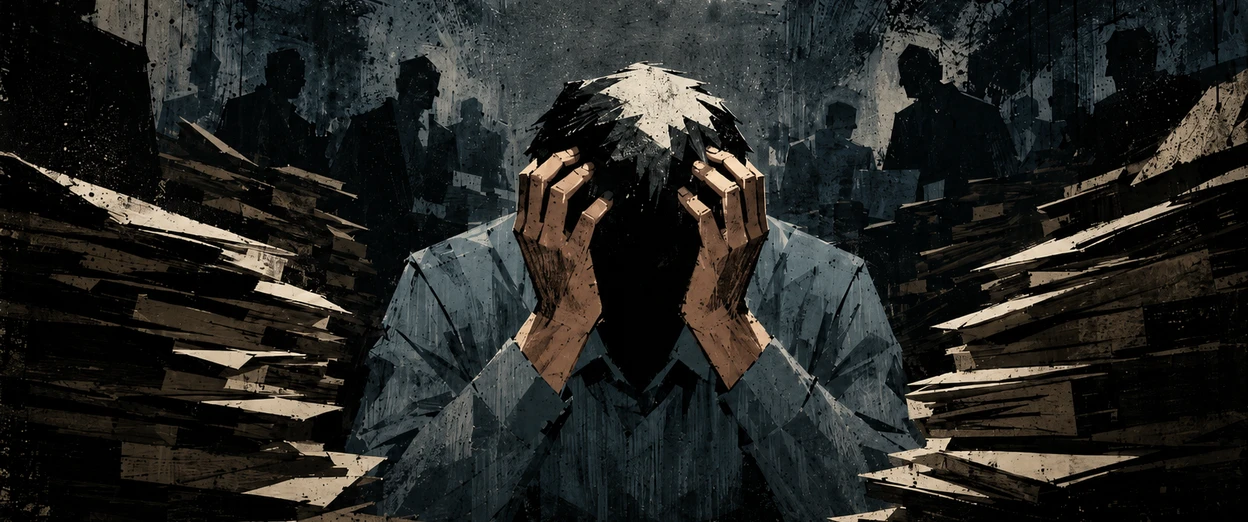
Workers in the BCG study described the experience with consistent language: a “buzzing” sensation, mental “fog,” headaches, slower decision-making, and a strange sense that their thinking had become “crowded.” One senior engineering manager put it this way in the Harvard Business Review report: their brain felt like it had a dozen browser tabs open, all fighting for attention. The thinking wasn’t broken — it was noisy. Like mental static.
The prevalence is highest in roles that use AI most intensively: marketing, software development, human resources, finance, and information technology. These aren’t jobs where AI replaces work. They’re jobs where AI adds layers of oversight to existing cognitive demands.
Jack Downey, Head of Strategy, Operations and Product at Webster Pass Consulting, described the texture of the problem to CBS News: the constant waiting and gear-changing, tasks completing at irregular intervals — five seconds for one, fifty for another, five minutes for a third — while running several windows simultaneously. The capacity of AI feels endless, so it becomes hard to know when to stop pursuing the next improvement.
If you reliably hit a wall after a full day of AI-assisted work and the exhaustion feels different from normal tiredness, that’s the signal. It’s not laziness. It’s your working memory encountering a pace of cycling it wasn’t built to sustain.
Why Do High Performers Burn Out on AI First?
The BCG researchers noted that brain fry disproportionately affects high performers. The reason is structural, not personal. High performers are the ones who push tools to their limits. They adopt faster, use more tools simultaneously, and absorb broader scope. AI rewards that instinct in the short term — more output, more capability, more visible contribution. The feedback loop feels productive.
The UC Berkeley study observed the same pattern. Work intensification didn’t come from management pressure. It came from within. Employees voluntarily expanded their workloads because AI made expansion feel manageable. That feeling is real in any given moment. The problem is cumulative. Each day’s expanded output resets expectations. What was once discretionary effort becomes standard performance. The vicious cycle forms: increased capability leads to increased output, which leads to higher expectations, which pressures further expansion.
This is the productivity paradox at its sharpest. The people who get the most from AI are the first to be consumed by it. Not because the tool is malicious, but because the human reward system — novelty-seeking, momentum, the satisfaction of visible output — runs in the same direction as the tool’s capacity to generate more work.
How Do You Build an AI Practice That Doesn’t Fry Your Brain?
The Berkeley researchers proposed the concept of an “AI practice” — not a set of productivity hacks, but a deliberate approach to rhythm and boundaries. Three elements define it.
First, intentional pauses. Brief, structured moments before major decisions to surface counterarguments or connect a choice back to its original purpose. Speed is not the enemy, but unreflective speed is. When every AI-generated output arrives instantly, building in even a thirty-second gap between receiving and acting on it changes the quality of the response.
Second, sequencing over constant reactivity. Instead of responding to every AI output the moment it appears, batch non-urgent work, protect focus windows, and let projects move through coherent phases rather than staying in a permanent state of interruption. The BCG study found that workers whose managers were intentional about AI use reported less brain fry. Structure imposed externally works when internal structure hasn’t formed yet.
Third, human grounding. Protect time for conversation, shared reflection, and work that doesn’t run through a machine. Perry’s Psychology Today analysis reinforced this: even in AI-rich environments, conversation remains one of the most effective tools for refining ideas and maintaining cognitive resilience. When work becomes entirely solo and tool-mediated, the feedback loops that catch errors and rebuild perspective disappear.
The best approach is not to use AI less but to build stopping points that the technology won’t build for you. AI environments are designed for throughput, not recovery. The human has to supply the boundaries.
Conclusion
The crash that follows deep AI work is not personal weakness. It’s the body encountering a pace of cognitive cycling it was not built to sustain indefinitely. AI expands what is possible, but human attention, memory, and recovery remain finite. The central question is not whether AI makes us more productive, but whether we can build practices, boundaries, and rhythms that prevent the feeling of possibility from outrunning the body’s capacity to keep up.
Possibility itself has become a form of exhaustion. The organizations and individuals who recognize that early will build the practices that sustain performance. The ones who don’t will keep accelerating until the fog sets in.