
I’ve spent my career helping brands build meaning. What I didn’t expect was how often I’d have to rebuild my own reasons for doing it.
To work in design, branding, and strategy today is to occupy an uncomfortable position. We create meaning in a world drowning in message. Our work builds perception, forges identity, and shapes how people understand what an organization stands for. It can also cover rot. That contradiction doesn’t resolve itself. It gets heavier when you care.
The Ethical Weight of Design Work
Design has no built-in ethics. Neither does branding, or marketing, or any discipline built to communicate. A vessel doesn’t choose what fills it. But designers choose their clients, their standards, and their complicity — and that’s where the weight comes in.
I’ve taken high-paying projects that left me hollow. I’ve watched genuine missions flatten into buzzwords — a housing nonprofit whose actual, daily work was getting people off the street, reduced in its own messaging to “empowerment” until you could no longer tell from the brand what they did all day. I’ve helped launch organizations with real vision, only to see them calcify into clichés. The system we work inside isn’t neutral ground. It shapes what gets funded, which stories get told, and what counts as success. To operate within that system — as most practitioners do — is to carry some portion of responsibility for what it produces.
The honest question isn’t whether design can be used for harm. It clearly can. Mike Monteiro put the harder version of this plainly in his 2019 book Ruined by Design: the world isn’t broken, it’s working exactly as it was designed to, and the people who designed it own some of that. I don’t follow him all the way to his conclusions, but the demand underneath them — that “why” and “no” are core design skills, not interruptions to the work — is one I have never managed to argue my way out of. The honest question is whether design can still be used for something worth doing.
As a general rule, the ethical difficulty of design work doesn’t come from the tools — it comes from the choices made by the people holding them.
What Design Actually Is
Design is a vessel. Filled with intention and guided by genuine listening, it becomes something rare: a discipline of care. A way to make complexity legible. A method for showing up rather than showing off.
The same is true for branding. Branding is an act of communication, not manipulation by nature. In any functioning society — even one far healthier than this one — we would still need ways to signal, to connect, to make meaning clear. The most common mistake here is conflating the tool with its misuse, which leads practitioners to either abandon the discipline entirely or stop questioning how they’re using it. Both are failures of a different kind.
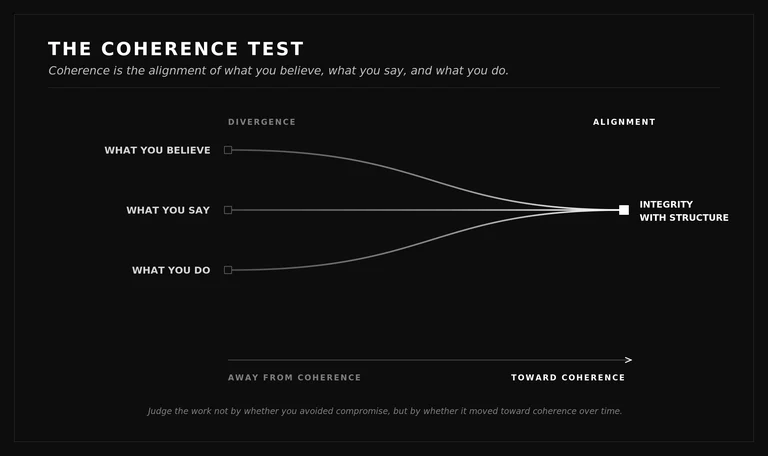
Authenticity has become a tactic. Coherence is harder to fake. Coherence requires alignment between what you believe, what you say, and what you do. That’s not a brand strategy. That’s integrity with structure.
Why Design Is Still Worth Doing
I return to this work because I’ve seen it do real things. Not consistently — but genuinely. I’ve helped organizations find their voice rather than perform one. I’ve seen strategy used to surface truth rather than smooth over it. I’ve watched a brand’s clarity become the thing that held a team together through real difficulty.
Those moments don’t erase the compromises. But they establish what the work can be, which matters when the work is something less.
The most reliable approach is to measure not whether you avoided compromise — you won’t — but whether the work moved toward coherence or away from it. That distinction, made repeatedly, is how a body of work develops integrity over time.
The ethical path isn’t always clear. Anyone who claims otherwise is selling certainty they don’t have. But choosing it — imperfectly, repeatedly, with full awareness of the costs — is how integrity actually functions. Not as a declaration. As a discipline.
What Comes Next
This essay builds on my earlier reflection, The Philosopher-Builder, and opens a three-part series on the personal, ethical, and professional foundations of this work.
Part II examines systems thinking — how design functions not as a linear process but as a dynamic, interconnected way of seeing and shaping the world.
Part III addresses applied responsibility: what it means to build with care, navigate compromise, and lead with integrity when the answers aren’t obvious.
This is where I begin again.