

Module 0: Introduction to Systems Thinking – Lesson 3
This lesson is just one part in our series on Systems Thinking. Each lesson reads on its own, but builds on earlier lessons. An index of all previous lessons can be found at the bottom of this page.
Frustration is data. Most people treat it as a personal failing — a signal to try harder, work longer, or care more. Systems thinking treats it as structural evidence: proof that a feedback loop exists, and that it can be redesigned.
This lesson shows you how to read frustration as a diagnostic signal, locate the structural levers producing it, and run small experiments that change recurring patterns. The approach applies whether you’re dealing with a habit that won’t stick, a team that keeps missing deadlines, or a civic problem that resists every intervention.
What You’ll Learn
- Why recurring problems are structural, not personal
- How the iceberg model — events, patterns, structures, mental models — surfaces hidden leverage
- How to apply systems thinking to personal habits, business operations, and large-scale challenges
- How to run a one-week experiment that starts shifting a pattern today
- The three misconceptions about systems thinking that consistently stall progress
What Is a Recurring Problem, Really?
A recurring problem is a feedback loop that hasn’t been interrupted. It recurs because the structure producing it remains unchanged — not because the people involved lack effort or will.
Most teams and individuals respond to recurring problems at the event level: the missed deadline, the argument, the late-night scroll. That response isn’t useless, but it doesn’t change the pattern. The pattern lives one level deeper, in the rules, information flows, delays, and capacities that make the event predictable. Identify the structure, and you identify the leverage. Change one structural element, and the loop can shift permanently.
This is the central claim of systems thinking: people rarely cause problems. Structures do.
How Does the Iceberg Model (Events, Patterns, Structures, Mental Models) Work?
Systems thinking calls this diagnostic the iceberg model, and the metaphor does most of the explaining: the event is the tip above the waterline, and the mass that produces it sits below, where nobody is looking. Four levels, read top to bottom. Events are individual moments — the late shipment, the skipped workout, the argument. Patterns emerge when you scan back across weeks or months. Structures are the rules, information flows, delays, and capacities that make the pattern predictable. The Donella Meadows Project publishes a one-page version of the iceberg model worth keeping open the first few times you work through one.
The fourth level is the deepest part of the iceberg: mental models — the beliefs that drive structural choices. You can interrupt a pattern by changing any structural element, but the change holds longest when you also surface and test the belief sustaining it.
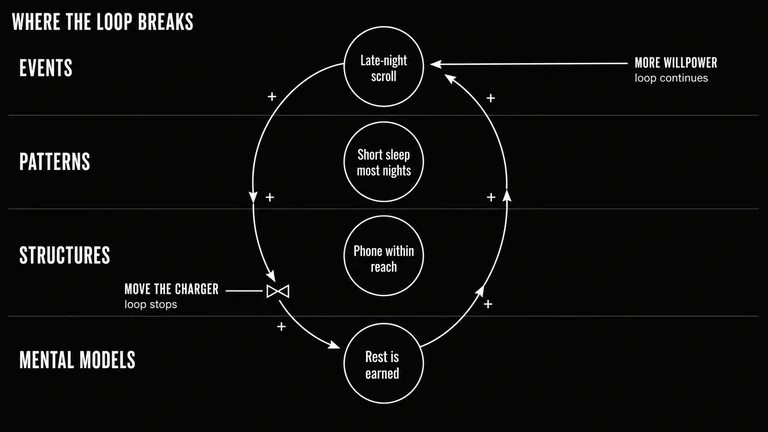
The five-minute diagnostic: name the event, scan for the pattern, write one sentence identifying a structural element (one rule or metric, one information flow, one delay or capacity), write one sentence naming the belief behind those choices, and choose a single lever to test this week.
Example: Late-night scrolling produces short sleep, which produces low energy, which produces more scrolling after work. Moving the phone charger across the room changes a structural variable — friction. Setting a fixed news window at 6 p.m. changes information timing. Adding a 20-minute wind-down changes the transition into sleep. Each move reshapes the loop without demanding extraordinary willpower. Results appear within days because the loop loses the fuel it needs.
How Do You Apply Systems Thinking to Personal Habits and Relationships?
Environment and timing shape behavior more reliably than intent. The most effective personal interventions redesign context rather than demand more effort.
For sleep: a caffeine cutoff at 2 p.m. removes a structural input to the delay problem. An evening ritual creates a reliable signal that the day is ending. Logging sleep start time for one week provides the pattern data needed to intervene accurately.
For relationships: a 10-minute weekly check-in interrupts the accumulation loop where small frictions compound unaddressed. Listing invisible tasks on a shared board makes hidden information visible. Adopting an “ask before infer” norm changes the default decision rule when something is ambiguous.
Every one of these moves edits a structural variable — information visibility, timing, rules, or friction. The most common mistake at this level is redesigning motivation instead of redesigning context. Motivation is an event-level variable. Context is structural.
How Does Systems Thinking Apply to Business Operations?
In most organizations, the response to delivery slippage is to add oversight. More oversight removes maker time. Less maker time produces more slippage. The loop tightens, and the intervention makes the original problem worse.
Three structural moves interrupt this pattern: replace status meetings with an async daily update before 10 a.m. (changes information flow and timing), define a directly responsible individual for each decision (changes the accountability rule), and switch one local metric to an end-to-end outcome such as lead time or first-contact resolution (changes what the system optimizes toward). Teams optimize whatever leaders measure — behavior follows measurement quickly, often in directions no one intended. Picking metrics that capture end-to-end outcomes rather than local ones is the core challenge of measuring a systems thinking initiative at the organizational level.
Supply chains run a recognizable archetype: stockout triggers expedite fees, budget pressure prompts supplier cuts, and cuts produce more stockouts. Hau Lee, V. Padmanabhan and Seungjin Whang traced the amplification in “The Bullwhip Effect in Supply Chains” (MIT Sloan Management Review, 1997), following Procter & Gamble’s Pampers line: consumer demand held steady while orders swung wider at every step back toward the supplier. Nobody in that chain was behaving irrationally. Each was reading a distorted signal and forecasting from it. The most reliable approach is to interrupt the loop at its most accessible point — typically through dual-sourcing rules, demand smoothing windows, and shared forecast visibility with suppliers. Each intervention targets a different structural variable within the same reinforcing loop.
How Does Systems Thinking Apply to Large-Scale Social Problems?
Large societal systems are not fundamentally more complicated than personal or organizational ones. They repeat the same structural archetypes at greater scale, with more stakeholders, longer delays, and harder-to-observe feedback.
In education: short instructional time produces learning gaps, remediation crowds out mastery time, and gaps persist into the next cycle. Structural interventions include funded instructional days, mastery-based advancement that breaks the time constraint, and real-time progress dashboards that make the pattern visible to students and families before it compounds.
In justice systems: fines and fees accumulate debt, license suspensions reduce employment, reduced income leads to nonpayment, and nonpayment extends the cycle. A randomized experiment in Oklahoma County tested that loop directly. “Criminalizing Poverty: The Consequences of Court Fees in a Randomized Experiment” (Devah Pager, Rebecca Goldstein, Helen Ho and Bruce Western, American Sociological Review, 2022) waived all court debt for 295 misdemeanor defendants between 2017 and 2019 and left 311 owing. Twelve months on, relief had changed nothing about new charges, convictions or jail bookings. What it changed was exposure: the group still carrying debt drew new warrants, wage and refund garnishment, and private collectors, and the court recovered under 5 percent of what it was owed. The debt was not deterring crime and was not funding the courts; it was running a loop. Ability-to-pay scaling, default payment plans, and automated record sealing each interrupt a different node in it.
Urban heat follows the same logic: low tree canopy raises exposure and energy costs, which reduces capacity for mitigation, which sustains low canopy. Robert McDonald and colleagues measured that gap across 5,723 US communities in a 2021 PLOS ONE study: in 92 percent of the hundred largest urbanized areas, low-income blocks carry less tree cover than high-income ones — 15.2 percent less on average, and 1.5 °C hotter. Targeted canopy programs, cool roofs on public buildings, and shade standards for transit stops reduce exposure where risk concentrates most.
If the recurring pattern is structural, the leverage point is structural — not behavioral. Policy and design can interrupt loops that willpower and education cannot.
What Are the Most Common Misconceptions About Systems Thinking?
“Systems thinking leads to analysis paralysis.” The opposite is true when you constrain the model. Use the smallest model that explains the pattern and reveals one lever. Build just enough structure to identify one test. Ship it and iterate.
“You need perfect data before acting.” Directional data plus one reliable signal is enough to start. The most common mistake is waiting for complete information in a system where information only becomes available through action. Improve measurement during the run, not before it.
“People cause most problems.” Incentives, access to information, and delays drive behavior across roles and organizations. When the same problem recurs with different people in the same positions, the structure is the cause. Redesign context before issuing new warnings, changing personnel, or adding policies.
How Do You Run a One-Week Systems Experiment?
Pick one frustration from work or life. For each layer below, write one sentence. Then start the experiment today.
Event: The specific painful moment.
Pattern: Where and when it repeats — scan back across the last month.
Structure: One rule or metric, one information flow, one delay or capacity that makes the pattern predictable.
Belief: One sentence naming the assumption driving those structural choices.
Lever: Choose one variable to change — information flow, rule or metric, delay or capacity, or goal. Make the smallest change that tests the belief.
Track one signal daily. Set one guardrail so the experiment doesn’t create new problems. Run it for seven days and assess the pattern, not just any single event.
Team example: Replace a weekly status meeting with a five-minute async update before 10 a.m. Track cycle time across three sprints. Prohibit weekend work as a guardrail. At the end of three sprints, you’ll have pattern data — not just impressions.
From our own work: We ran this diagnostic on ourselves in 2025. The event was easy to name — another article published, another month where almost nobody found it. The pattern sat one line down: everything we had put out to that point existed, and the site was still effectively invisible in search. The structure underneath was our own content calendar. A calendar answers a scheduling question, so it optimizes for cadence, and cadence was the one thing we already had. What held it in place was a belief that visibility follows volume.
The lever we changed was what the system pointed at: a defined territory instead of a publishing date. We named the ground we could actually hold — systems thinking applied to organizations and brands, structural critique of marketing culture — and then wrote in clusters, each piece entering the same framework from a different angle. Monthly search impressions went from 130 in September 2025 to 4,174 the following May, and average position moved from 35.3 to 10.5. That was eight months and one structural change, with no keyword targeting and no technical fixes. Our run took longer than a week because search feedback arrives on a delay, which is its own kind of structure. The loop had never been short on effort. It was pointed at the wrong variable.
What to Carry Forward
Frustration signals structure. When a problem recurs, the cause is not effort or intent — it is the architecture of the system producing the outcome. Name the loop, identify the deepest practical lever, and run a small test. The same diagnostic applies to personal habits, business operations, and civic challenges. Patterns shift when information, rules, timing, and capacity change. Practice this lens consistently, and future problems take less time to diagnose and less effort to address.
Course Index
- Module 0: Introduction to Systems Thinking
- Module 1: Components of Systems
- Module 2: Feedback Loops and Causality
- Module 3: Mental Models and Paradigms
- Module 4: Leverage Points and Change
- Module 5: Systems Archetypes
- Module 6: Applying Systems Thinking to Your World