

Module 2: Feedback Loops and Causality – Lesson 3
This lesson is just one part in our series on Systems Thinking. Each lesson reads on its own, but builds on earlier lessons. An index of all previous lessons can be found at the bottom of this page.
Most people manage outcomes. Systems thinkers manage accumulations. That distinction sounds small. It isn’t. When you focus only on outcomes — sales figures, follower counts, a brand’s visibility — you’re looking at stocks. You can want them to change, but wanting does nothing. Stocks change only through flows: the rates of gain and loss that build or drain them over time. Understanding this is not a semantic exercise. It is the difference between pushing on a system and actually moving it.
What Are Stocks and Flows?
A stock is any quantity that accumulates over time: money in an account, water in a reservoir, trust between two people, the reputation of a brand. A flow is the rate at which a stock fills or drains: income and expenses, rainfall and evaporation, customer acquisition and churn. Stocks are the state of the system at any given moment. Flows are what change that state. If you can freeze a system in time and still measure something, that something is a stock. If it only makes sense tracked across time, it is a flow.
Stocks give a system memory. They carry yesterday’s decisions into today’s constraints and tomorrow’s possibilities. This is what makes them both stabilizing and, at times, stubborn. A stock does not respond to intention. It responds to flow.
The Bathtub Model
The clearest model is a bathtub. The water level is the stock. The faucet is the inflow; the drain is the outflow. Open the faucet and the level rises — but not instantly. Close the drain and the level holds — but what came before still shapes what’s there now. The level shifts only as water accumulates or escapes, never in response to announcements or intentions about the level. This lag is precisely why promises and policies so often take far longer to manifest than their architects expect. The system is not ignoring you. It is waiting for the flows to move.
How to Identify Stocks and Flows in Any System
Identifying stocks and flows is a discipline of precise observation. Start by asking: what builds up? Stocks are almost always nouns — trust, attention, backlog, inventory, reputation, capacity. Then ask: what makes it rise or fall? Flows are the verbs — earning and spending, hiring and quitting, publishing and deleting, connecting and losing touch. The bathtub test applies to any abstraction: can you imagine this thing filling up or draining away? If yes, it is a stock. Brand loyalty feels intangible until you picture it as a reservoir losing volume every quarter that goes without renewal.
Behavior-over-time graphs make the distinction visible. Stocks appear as smooth, gradual curves — the level shifting as flows accumulate. Flows appear as sharp spikes or shifts — the rate of change, not the state itself. Sketch the trajectory of any business metric and you can usually identify whether you’re looking at the reservoir or the faucet.
Why Stocks and Flows Matter for Strategy
The practical implications of stocks-and-flows thinking cut across every domain of strategy, and most of them run against intuition.
Stocks act as buffers. They absorb the impact of changing flows, which is why organizations rarely pivot overnight and why ecosystems recover slowly. This buffering is a feature, not a flaw — it creates stability. But it also means that urgency applied to a stock level accomplishes nothing without changing the underlying flows. “We need more revenue” is a statement about a stock. The leverage lives in the flows: acquiring more customers, reducing churn, increasing transaction frequency. Stocks respond to flows. They do not respond to demand.
Because stocks embody memory, their problems outlast their causes. Debt persists after spending is cut. A damaged reputation outlives the incident that damaged it. The stock carries the imprint of what flowed through it — and does not release that imprint easily. As a general rule, rebuilding a depleted stock takes longer than depleting it did, because the inflows that refill it must overcome both the deficit and the ongoing outflows that continue throughout recovery.
Small, sustained changes in flows compound into large shifts in stocks. A modest reduction in customer churn, held consistently for two years, can reshape the trajectory of an entire business. The most reliable path to a different stock level is not a dramatic intervention — it is a small adjustment in the right flow, maintained long enough to accumulate. Systems reward patience and consistency far more than spectacle.
Every stock also has a ceiling. A reservoir can only hold so much water before overflowing. Human attention reaches saturation. Recognizing these capacity constraints prevents the waste of effort applied beyond a system’s limits and grounds strategy in what is structurally possible.
Real-World Examples
- Nature: A reservoir’s water level (stock) rises with rainfall (inflow) and falls through evaporation or consumption (outflow).
- Economics: A household’s bank balance (stock) grows through deposits and shrinks through expenses.
- Organizations: Employee headcount (stock) shifts with hiring (inflow) and attrition (outflow).
- Personal life: Knowledge (stock) builds with practice and study (inflow) but decays without reinforcement (outflow).
Branding and Marketing: Reputation as a Stock
In branding, reputation is the most consequential stock most organizations possess. It fills through inflows — positive customer experiences, earned media, the consistent delivery of what the brand signals, and the coherence between what the brand says and what it does. It drains through outflows — service failures, inconsistent signals, neglected communication, or a gap between promise and reality. The critical property of reputation as a stock is that it cannot be conjured by a single campaign. A viral advertisement spikes awareness. It does not fill the reservoir of trust.
This reframes what brand strategy is actually for. The most common mistake here is treating brand-building as an event — a launch, a rebrand, a campaign — rather than as a flow management problem. Campaigns are bursts of inflow. They matter. But a burst does not compensate for a steady outflow of inconsistent signals, broken promises, or absent follow-through. Brands with strong reputations are not brands that had better campaigns. They are brands that maintained better flows, for longer. The reservoir filled because the faucet ran consistently and the drain was managed carefully.
Behavior-over-time graphs of reputation reveal this clearly. Resilience forms through steady inflows, not dramatic ones. Erosion happens through unchecked outflows, not single failures. For those responsible for building a brand, this perspective reframes success: not a headline, but a flow design.
Notation
To formalize these concepts, we move from causal loop diagrams to stock-and-flow diagrams:
- Stocks are drawn as boxes, representing what accumulates.
- Flows are double-lined arrows with valve symbols, showing the rates that fill or empty the stock.
- Information links are single arrows, indicating influence without direct movement.
- Behavior-over-time graphs accompany diagrams, tracing how stocks shift as flows change.
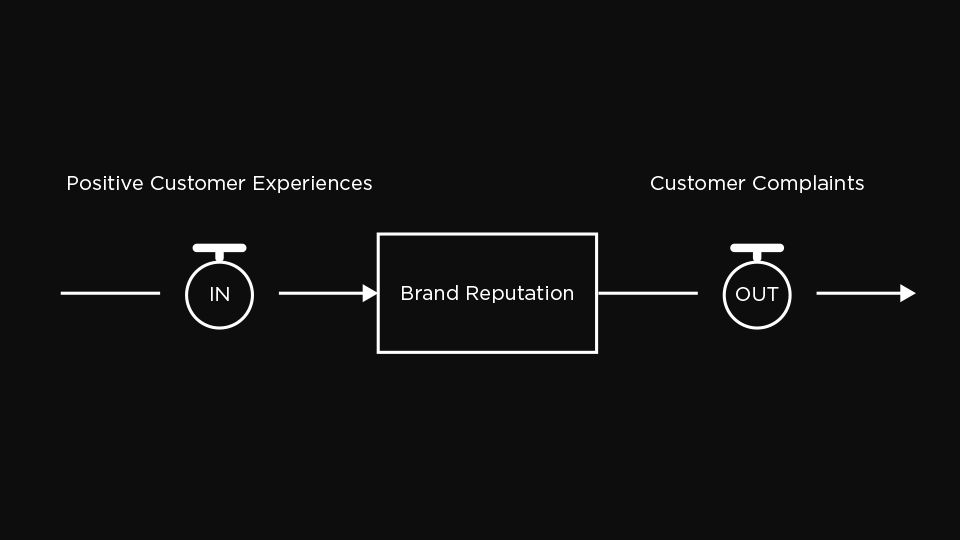
Together, this notation lets us see not only who influences whom, but what builds, what persists, and what leaks away.
Conclusion
Stocks and flows ask us to trade the drama of the moment for the discipline of accumulation. Resilience builds drop by drop. Decline is almost always a slow leak, not a sudden collapse. Leverage lives in the everyday rhythms of inflow and outflow — not in the announcements made about where the level should be. For brands, this means understanding reputation, awareness, and loyalty as reservoirs: valuable, slow to build, faster to drain, and entirely dependent on the quality and consistency of the flows feeding them. The most important thing is not what you intend for a stock. It is what you do about the flows.
Course Index
- Module 0: Introduction to Systems Thinking
- Module 1: Components of Systems
- Module 2: Feedback Loops and Causality
- Module 3: Mental Models and Paradigms
- Module 4: Leverage Points and Change
- Module 5: Systems Archetypes
- Module 6: Applying Systems Thinking to Your World