

Brands face a recurring problem. Audiences change. Markets shift. New conversations emerge. The pressure to respond is real and, in many cases, legitimate. But the brands that handle this well don’t do it by reacting faster. They do it by having a clear enough sense of meaning that they can distinguish what they should absorb from what they should ignore.
That distinction separates brands that evolve with purpose from brands that drift.
In our work with brands navigating this tension, we’ve found the difference rarely comes down to better trend forecasting. It comes down to whether a brand knows its own meaning well enough to tell signal from noise.
This article explains how to identify genuine shifts in audience meaning, how to respond without losing coherence, and how to recognize when holding your position is the right move.
What You’ll Learn
- Why most brands confuse trend cycles with genuine meaning shifts
- How to distinguish surface preference changes from deeper value changes
- What methods effectively measure shifts in audience sentiment
- What coherent adaptation looks like in practice
- When holding position is the right response to changing preferences
- How to communicate change without triggering a trust breakdown
What Are Consumer Preferences, and Why Do They Change?
Consumer preferences are the choices audiences make based on their needs, beliefs, and values at a given moment. They reflect how people understand the world around them — something a demographic snapshot can’t capture — and they shift as that understanding changes. Preferences are not just about taste. They are signals about meaning.
Four forces consistently drive preference change. Societal movements reframe what audiences consider acceptable, admirable, or trustworthy. Economic pressure shifts what people prioritize when choices feel costly — McKinsey’s 2024 State of the Consumer survey found that 77 percent of Americans had taken some trade-down action in the prior three months. Technology changes not just how people buy but what they expect from brands in terms of speed, personalization, and transparency. Cultural change, the slowest and most durable of the four, alters the values against which brands are measured.
The important distinction is between changes that affect how meaning is expressed and changes that affect what audiences fundamentally want from a brand. Most preference shifts fall into the first category. Brands that treat them as the second end up in cycles of reactive repositioning that never quite stick.
Key takeaway: Consumer preferences are meaning signals, not just market data. Responding well requires reading what they actually indicate.
How Can Brands Tell Whether a Preference Shift Is Meaningful or Temporary?
A preference shift is meaningful when it reflects a change in the underlying values or beliefs of a brand’s core audience, not just a change in surface behavior. Meaningful shifts persist across multiple signals over time. Temporary trends spike, plateau, and fade.
Three questions help distinguish them. They’re the ones we walk clients through when a shift has them anxious to react. First: is the change showing up across your audience broadly, or is it concentrated in a vocal subset? Broad, sustained shifts across segments indicate genuine movement. Loud, concentrated signals often represent a moment, not a trend. Second: does the shift challenge how the brand expresses its meaning, or does it challenge what the brand means? The first requires adaptation. The second requires a harder conversation about whether the brand’s position still holds. Third: what is driving the shift? Surface behavior changes, like a preference for a new format or channel, are easier to absorb. Shifts in underlying belief, like a change in what audiences consider credible or trustworthy, require deeper attention.
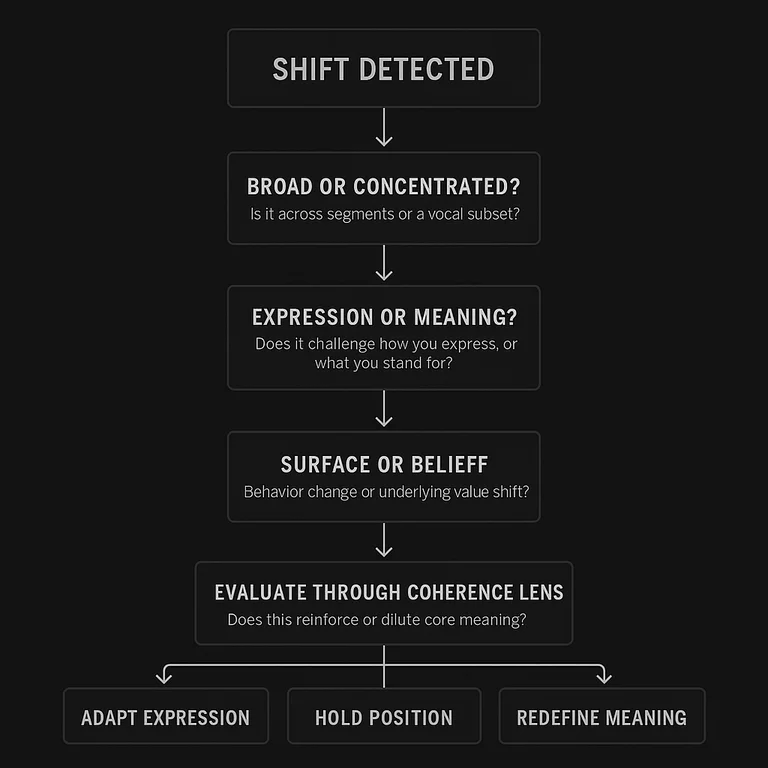
Common failure mode: Brands mistake high social media volume for meaningful preference change. Noise and signal look similar at scale, and a social strategy that responds to every trend rarely leaves room to tell them apart. Slow down before reacting.
Key takeaway: Meaningful preference shifts show up across multiple data sources, persist over time, and reflect changes in underlying belief. Trend spikes rarely meet all three criteria.
What Methods Effectively Measure Shifts in Audience Sentiment?
Measuring audience sentiment accurately requires triangulating across multiple sources rather than relying on any single signal. No individual data point is sufficient.
Audience research remains the most direct method. Regular qualitative conversations with actual audience members, not just surveys, reveal how people are thinking and what language they use to describe their needs. Survey data is useful for scale but should be designed around specific hypotheses rather than general satisfaction metrics.
Social listening captures ambient signals about how audiences talk about a category or brand unprompted. Tools like Brandwatch or Sprout Social can identify emerging language patterns and sentiment shifts over time. The limitation is that social audiences are often not representative of a brand’s full customer base. Use it as an early signal, not a final answer.
Sales and behavioral data provides the most direct evidence that preferences are shifting in commercially meaningful ways. A sustained change in which products or services audiences choose, or in how they describe their buying rationale, reflects genuine movement. This data lags the conversation but reflects real decisions.
Coherence gaps deserve specific attention. When a brand’s audience starts describing the brand differently than the brand describes itself, that misalignment is a meaningful signal. It indicates that the brand’s signals and its audience’s experience are no longer in alignment.
Key takeaway: Triangulate across qualitative research, behavioral data, and coherence monitoring. Single-source sentiment measurement produces false confidence.
How Can Brands Respond to Preference Shifts Without Abandoning Core Values?
Brands respond to preference shifts without losing coherence by distinguishing between what they stand for and how they express it. Core values define meaning. Expression evolves. Confusing the two leads to either rigid irrelevance or unprincipled drift.
Patagonia is a useful reference point here. The brand’s core meaning, built around environmental responsibility and opposition to disposable consumption culture, has remained consistent for decades. But the expression of that meaning has shifted deliberately. On Black Friday 2011, Patagonia ran a full-page New York Times ad headlined “Don’t Buy This Jacket,” urging customers to consider the environmental cost of each purchase before making it. Sales rose nearly 30 percent the following year, reaching $543 million, and the brand hit $1 billion in annual revenue by 2017. The meaning stayed fixed. The expression — anti-consumption campaigns, supply chain transparency, political positioning — evolved to match what audiences increasingly expected from a brand making environmental claims.
The test for any adaptation is whether it reinforces or dilutes core meaning. An adaptation that helps audiences understand and trust what the brand stands for is worth pursuing. An adaptation that generates short-term attention while obscuring what the brand actually means is not, regardless of how well it performs in the immediate term.
| Element | Content |
|---|---|
| Term | Coherent adaptation |
| Plain definition | Evolving how a brand expresses its meaning without changing what that meaning is |
| Why it matters | Audiences trust patterns. If the meaning shifts without explanation, trust erodes. |
| Common confusion | Brands often treat adaptation as a values question when it is more often an expression question |
Key takeaway: Adaptation should deepen the expression of core meaning, not replace it. If a proposed change cannot be connected back to what the brand fundamentally stands for, treat that as a warning signal.
What Does Coherent Adaptation Look Like in Practice?
Coherent adaptation is the process of changing how a brand expresses itself in response to genuine audience shifts, while maintaining the meaning that makes the brand legible and trustworthy over time.
In practice, it involves three steps. We didn’t arrive at them theoretically — they’re the pattern we see in the engagements that hold, and the gap we see in the ones that drift.
1. Name the shift precisely. Before responding, define exactly what has changed and why it matters to your audience. Vague responses to vague signals produce vague outcomes. If the shift is that audiences now expect supply chain transparency from brands in your category, name that specifically and evaluate whether it challenges how you express your values or what your values are.
2. Evaluate the response through the lens of coherence. Ask: if we make this change, do all our signals still reinforce the same underlying meaning? If yes, proceed. If no, decide whether the incoherence is worth the adaptation, and if so, how you will address it.
3. Move deliberately, not reactively. Reactive adaptation signals to audiences that the brand is managed by external pressure rather than internal conviction. Deliberate adaptation, accompanied by clear explanation, signals confidence. Confidence builds trust.
Nike’s September 2018 decision to feature Colin Kaepernick in its thirtieth-anniversary “Just Do It” campaign is a useful example. The brand’s core meaning has always centered on the belief that athletic aspiration is universal. Featuring an athlete who had been effectively blacklisted for protesting racial injustice was a coherent extension of that meaning, not a departure from it. The initial backlash was loud — boycott videos went viral, and the stock dipped 3 percent in the first days. Within two weeks, online sales had jumped 31 percent year-over-year, and Nike’s market value rose $6 billion to an all-time high (Fortune, September 2018). The audience segment that objected was real, but the adaptation remained legible within the brand’s established framework.
Key takeaway: Coherent adaptation is deliberate, clearly connected to core meaning, and explained in a way that helps audiences follow the reasoning.
When Should Brands Hold Their Position Instead of Adapting?
Brands should hold their position when the pressure to change comes from noise rather than signal, when the proposed adaptation would dilute core meaning, or when short-term audience approval would undermine long-term trust.
Not every vocal preference shift demands a response. Brands that are consistently responsive to loud voices, regardless of whether those voices represent genuine audience movement, train their audiences to expect perpetual accommodation. That pattern erodes the perception of conviction, which is a core component of trust.
We’ve watched this play out. A brand we worked with was convinced it needed to rework its positioning because a vocal group online kept pushing for it. When we mapped that signal against the broader audience, the pressure turned out to be concentrated in a small, loud segment that was never going to be the core customer. Holding the position cost a handful of angry comments. Abandoning it would have cost the trust of the people who actually kept the business running.
The more useful question is not “should we adapt?” but “what does this signal tell us about our audience’s relationship to our meaning?” Sometimes the answer is that the signal reveals a gap between what the brand claims and what audiences experience. That is worth addressing. Sometimes the signal reveals that a subset of the audience wants the brand to be something it is not. That is worth declining.
A structured decision framework helps. Before committing to adaptation, test the proposed change against three criteria: Does it reinforce core meaning? Does it reflect a genuine and sustained shift in the brand’s primary audience? Does it strengthen or weaken long-term coherence? If the answer to all three is yes, move. If not, hold.
Key takeaway: Holding position is a strategic choice, not a failure to listen. Brands that adapt to everything stand for nothing.
How Should Brands Communicate Change to Maintain Trust?
When brands adapt in response to genuine preference shifts, how they communicate that change matters as much as the change itself. Unexplained adaptation reads as opportunism. Explained adaptation, connected to core meaning, reads as evolution. The commercial stakes are specific: the 2025 Edelman Trust Barometer reports that trust now ranks alongside price and quality as a purchase driver, and 73 percent of respondents said their trust in a brand would increase if it authentically reflected current culture. Unexplained change doesn’t just confuse audiences — it risks the factor they are now explicitly weighting in purchase decisions.
Effective communication of change follows a consistent pattern. Name what is changing and what is not. Audiences tolerate change more readily when they understand the stable core beneath it. Connect the change to the brand’s established meaning. Explain why this adaptation is consistent with what the brand has always stood for. Acknowledge the shift in the audience’s world that is prompting the response. This signals that the brand is paying attention, not just executing strategy in a vacuum.
Transparent communication is not the same as over-explanation. Long justifications produce skepticism. A direct, clear statement of what is changing, why, and what remains constant is more effective than a campaign built around managing the narrative.
Common failure mode: Brands announce change with a focus on what they are gaining rather than what their audience can still count on. Audiences hear “we are changing” as “you cannot rely on us.” Reframe the communication around continuity of meaning, not innovation.
Key takeaway: When communicating change, lead with what stays constant. Anchor the adaptation in established meaning before introducing what is new.
Conclusion
Brands that navigate preference shifts well share a common discipline. They know what they stand for clearly enough to distinguish meaningful change from noise. They adapt expression without abandoning meaning. They communicate change in a way that reinforces rather than undermines trust.
The goal is not to stay the same. The goal is to remain coherent. Coherence, over time, is what builds the kind of trust that survives market volatility, cultural change, and competitive pressure.
Measurement tells you what is happening. Meaning tells you what to do about it.